ECON0703/ECON2285 – Mathematical Economics
HKU Prof.Luo
COURSE DESCRIPTION
Modern economic theory is treated mathematically. Topics may include: applications of optimization to consumption and saving behavior and investment decisions, market equilibrium determination, optimal control and dynamic programing, and risk and uncertainty.
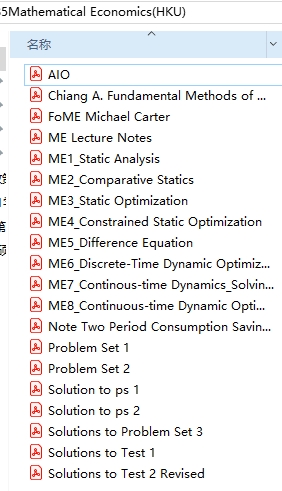
资料链接
COURSE CONTENT AND TENTATIVE TEACHING SCHEDULE
Part I:
1. Equilibrium models and national income multipliers
2. Demand, supply, cross and income elasticity
3. Marginal and total revenue, demand functions; marginal and total cost
4. Consumer and producer surplus, taxes
5. Math of finance and growth models
Part II:
1. Cobb-Douglas production function, marginal productivity of labor and capital,
marginal rate of technical substitution
2. Cobb-Douglas utility function, marginal utility, marginal rate of substitution
3. Unconstrained optimization
4. Constrained optimization
Part III:
1. Constrained optimization with linear algebra
2. Difference/differential equations
Part IV:
1. Introduction to Dynamic Optimization: Discrete-time
2. Introduction to Dynamic Optimization: Continuous-time
Reference textbooks:
Alpha Chiang and Kevin Wainwright, Fundamental Methods of Mathematical Economics, 4th Edition (2006) Sydsaeter, K., Hammond, P., Seierstad, A., Strom Arne. Further Mathematics for Economic Analysis, 2ed. Prentice Hall (2008)
Wälde, Klaus (2012), Applied Intertemporal Optimization, available from: http://www.waelde.com/pdf/AIO.pdf
(These textbooks are not mandatory. The course will use selective chapters of these books.)
You may also refer to these online lecture notes on mathematical economics:
https://mjo.osborne.economics.utoronto.ca/index.php/tutorial/index/1/toc/c
http://people.tamu.edu/~gtian/ecmt660.pdf





 扫码加好友,拉您进群
 全部版块
全部版块 我的主页
我的主页

 收藏
收藏