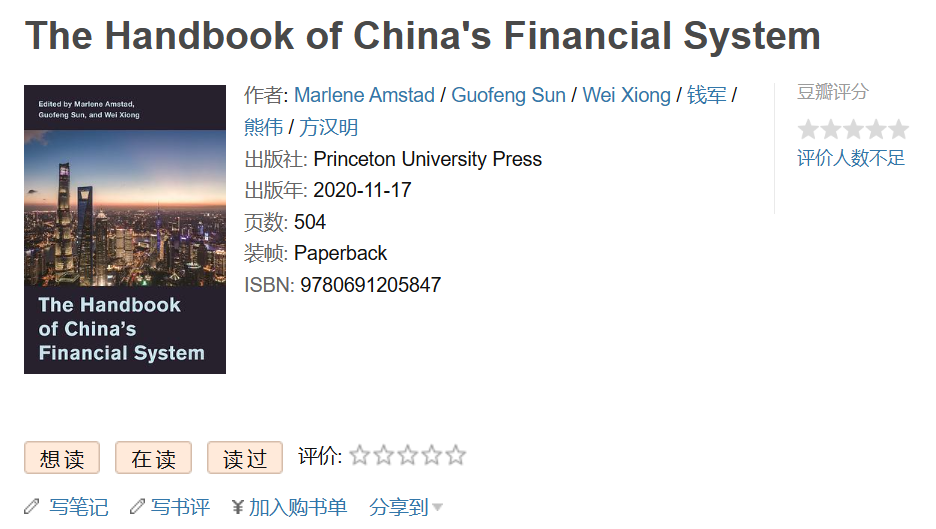
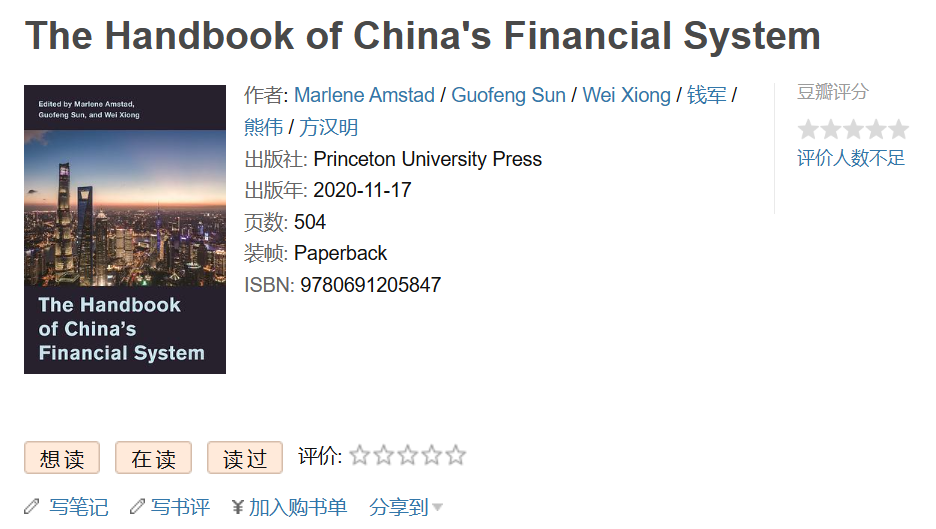
The Chinese economy is one of the most important in the world, and its success is driven in large part by its financial system. Though closely scrutinized, this system is poorly understood and vastly different than those in the West. The Handbook of China’s Financial System will serve as a standard reference guide and invaluable resource to the workings of this critical institution.
The handbook looks in depth at the central aspects of the system, including banking, bonds, the stock market, asset management, the pension system, and financial technology. Each chapter is written by leading experts in the field, and the contributors represent a unique mix of scholars and policymakers, many with firsthand knowledge of setting and carrying out Chinese financial policy. The first authoritative volume on China’s financial system, this handbook sheds new light on how it developed, how it works, and the prospects and direction of significant reforms to come.
Contributors include Franklin Allen, Marlene Amstad, Kaiji Chen, Tuo Deng, Hanming Fang, Jin Feng, Tingting Ge, Kai Guo, Zhiguo He, Yiping Huang, Zhaojun Huang, Ningxin Jiang, Wenxi Jiang, Chang Liu, Jun Ma, Yanliang Mao, Fan Qi, Jun Qian, Chenyu Shan, Guofeng Sun, Xuan Tian, Chu Wang, Cong Wang, Tao Wang, Wei Xiong, Yi Xiong, Tao Zha, Bohui Zhang, Tianyu Zhang, Zhiwei Zhang, Ye Zhao, and Julie Lei Zhu.
中国经济是世界上最重要的经济体之一,它的成功在很大程度上是由其金融体系推动的。尽管经过仔细审查,但这个体系仍不为人所知,而且与西方的体系大相径庭。《中国金融体系手册》将成为这一重要机构运作的标准参考指南和宝贵资源。
该手册深入研究了该体系的核心方面,包括银行、债券、股票市场、资产管理、养老金体系和金融技术。每章都由该领域的顶尖专家撰写,撰稿人代表了学者和政策制定者的独特组合,其中许多人拥有制定和执行中国金融政策的第一手知识。第一本关于中国金融体系的权威书籍,这本手册揭示了中国金融体系的发展历程、运作方式以及未来重大改革的前景和方向。






 扫码加好友,拉您进群
 全部版块
全部版块 我的主页
我的主页


 收藏
收藏