Unholy Trinity: The IMF, World Bank and WTO
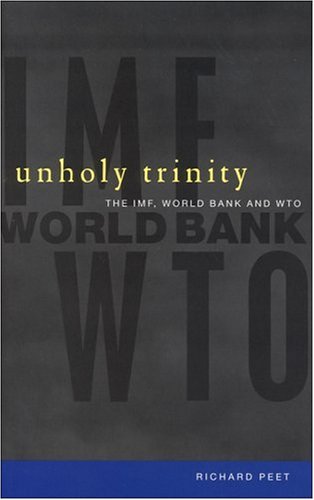
Publisher: Zed Books
Number Of Pages: 256
Publication Date: 2003-11-29
Sales Rank: 271914
ISBN / ASIN: 184277073X
EAN: 9781842770733
Binding: Paperback
Manufacturer: Zed Books
Studio: Zed Books
Average Rating: 4
Our lives are all affected by three hugely powerful and well financed, but undemocratic, organizations: the International Monetary Fund, the World Bank and the World Trade Organization. These institutions share a common ideology. They aggressively promote "corporate" capitalism, neoliberalism, giving free rein to the interests of a small number of transnational corporations. This book presents the history and fundamental ideas of this economic ideology. Describing each member of the "unholy trinity," it shows how neoliberalism hijacked the IMF, World Bank and WTO in relation to their global financial, development and trade management roles.
Review:
Whose Hitler?
In a word, if you like living in a sovereign nation, then write your Congressional representive, your Senators, and have the US removed from these organizations. There is a real bad element here. World domination bad.
Review:
good class action
This is what university work should be like: a professor leading a group of studnets in common action and collectieley publishing their work. Well done. Lots of good points which the unholy trinity should answer in some forum or other. All three organs are dominated by the US as Stiglitz, Bellamy and others have pointed out. Whether US hegemony is a good or bad thing is a different question.
I felt the book could have done without Foucault, who has little to contribute on the parameters of discourse or much else. The fact is the budgets of these institutions dwarf all others and it makes a welcome change to see an articulate counter point of view, especially as it was a grassroots student project. Definitely worth a read.
Review:
good overview of the IMF, World Bank & WTO
Any one looking for a good, critical overview of the history of the International Monetary Fund, World Bank, and World Trade Organization--the major institutions of international economic governance, the institutional guardians and promoters of neoliberal globalization--should check this book out. It reviews the history of these three organizations in depth. Most analyses of these organizations that I've seen just look at their current policies and critique them. Peet (and the junior student authors who assisted him) add a great deal of historical depth to this, looking at the conditions under which the unhol trinity were founded at the end of World War II, how their missions have changed over time, and the power structures in which these organizations are embedded and part of. He looks at how the changing ways the US government has used these organizations to advance the interests of the US political-economic elite (what Peet et al. call the Washington-Wall Street Alliance) on the world stage. This book also provides a progressive critique of their impact, although other sources probably go into deeper depth on that score. Since Peet is a social scientist, he doesn't just put the problem down to bad intentions, but down to bad social structures--a refreshing change from some of the simple-minded demonization of the elite you can find in some quarters. Peet particularly analyzes how the role of people's beliefs in shaping their actions within these institutions. In some ways, this is the weakest part of the book. He tries to use an analysis of discourse a la Foucault to explain the working of these organizations, explaining how the hegemony of neoclassical economics shuts out any debates of alternatives. While this is valuable, discourse analysis along can not bear the full weight of analyzing the problems with the unholy trinity--you need some sort of political-economic analysis in the lines of world-systems theory or something to make full sense of these organizations. Indeed, Peet lays out his Foucauldian analysis in the first chapter--and then those ideas barely show up again. Honestly, I would suggest anyone who's not an academic just skip the first chapter and read the rest of the book. You won't miss much. After the first chapter though, the book provides a solid overview of the history of the IMF, World Bank and WTO--and through them much of the process of globalization.




 扫码加好友,拉您进群
 全部版块
全部版块 我的主页
我的主页


 收藏
收藏