全部版块 我的主页
论坛 计量经济学与统计论坛 五区 计量经济学与统计软件 HLM专版
2561 5
2014-03-24
各位好,
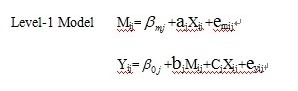
      我想请问下软件HLM中,Level-1只能放入一个式子吗?可不可以放入下图这样的两个式子呢?
QQ图片20140324233208.jpg


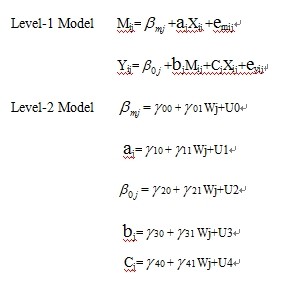
原版模型:
QQ图片20140324232320.jpg

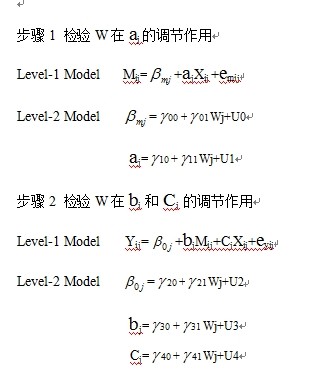
Level-1可以同时放入两个式子?
附件列表
QQ图片20140324232741.jpg

原图尺寸 25.13 KB

QQ图片20140324232741.jpg

二维码

扫码加我 拉你入群

请注明:姓名-公司-职位

以便审核进群资格,未注明则拒绝

全部回复
2014-3-25 09:51:15
My answer to your question is No. Depending on measurement level of your Independent (IV) and dependent (DV) variables, you can have following choice:
  • If your IV are categorical and DV continuous you can try MANOVA.
  • If it is other way around it would be discriminant analysis (although, rather complicated, not available for 2 DV through point and click in SPSS or similar simple software).
  • If all variables are continuous you can go with canonical correlation (not my preference, difficult interpretation of results) or with path model.
  • You can also do path models with categorical variables in form of dichotomous or indicator (dummy, 0,1 variables). As you can see, general linear model is very flexible.
  • Several DV variables can make a single construct (latent variable) so you can go with structural equation model (SEM).

Hope it helps.
Trevor
Statistical Analyst, NORC

二维码

扫码加我 拉你入群

请注明:姓名-公司-职位

以便审核进群资格,未注明则拒绝

2014-3-25 10:14:52
Trevor 发表于 2014-3-25 09:51
My answer to your question is No. Depending on measurement level of your Independent (IV) and depend ...
thank you for your reply
I think I can get it
二维码

扫码加我 拉你入群

请注明:姓名-公司-职位

以便审核进群资格,未注明则拒绝

2014-3-25 10:31:36
The short answer to your question is YES, but it isn't the most straightforward explanation, so rather than try to explain it all, I offer the following papers.  The earliest example I know of is:

  • Raudenbush, S. W, Rowan, B., & Kang, S. J. (1991). A multilevel, multivariate statistical model for studying school climate in secondary  schools with estimation via the EM algorithm. Journal of Educational Statistics, 16, 295-330.

It's the underlying device in our dyadic model, although it's not so obvious because it is the same outcome on each of two members of a couple, but if you look at the model, they are separate outcomes, one male, one female:

  • Barnett, R. C, Marshall, N. L.,Raudenbush, S. W., Brennan, R. T. and Barnett, R. C. (1995). 'A multivariate hierarchical linear model for studying psychological change within marital couples', Journal of Family Psychology, 9, 161-174.  

  • Raudenbush, S. W., & Brennan, R. T. (1993). Gender and the relationship between job experiences and psychological distress: A study of dual-earner couples. Journal of Personality and Social Psychology, 64, 794-806.

This is more obvious in the following papers, where as in the original Raudenbush, Rowan, & Kang  paper, there are multiple correlated outcomes for one person:

  • Supovitz, J. A., & Brennan, R. T. (1997). Mirror, mirror on the wall, which is the fairest test of all? An examination of the equitability of portfolio assessment relative to standardized tests. Harvard Educational Review, 67, 472–506.
  • Brennan, R., Kim, J., Wenz-Gross, M., & Siperstein, G. (2001). The relative equitability of high-stakes testing versus teacher-assigned grades: An analysis of the Massachusetts Comprehensive Assessment System (MCAS). Harvard Educational Review, 71(2), 173-216.

A similar approach is taken in several approaches to data from multiple reporters, such as child, teacher, and parent all reporting on the same target child.  It's not really the point of this paper, but I use the approach here, too, which also has multiple outcomes for each person:

  • Brennan, R. T., Molnar, B. E., & Earls, F. (2007). Refining the measurement of exposure to violence (ETV) in urban youth. Journal of Community Psychology, 35, 603–618

These papers, and especially more examples of dyadic analysis are available on my ResearchGate profile: [url=]https://www.researchgate.net/profile/Robert_Brennan2/[/url]Roughly speaking the idea is getting rid of the ordinary level-one intercept B0 and using the other level-one betas to create, for lack of a better word, pseudointercepts, but there is more to it than that as detailed in the articles.I assume the question arises because the two outcomes are related in some way.  

It is possible to do these sorts of models in HLM as demonstrated in the citations above, but it is more familiar in the SEM context, when some of the methods above were first applied, multilevel clustering was not available in SEM software, so multilevel software was the only choice for some of the models, and sometimes still the better or more straightforward choice, but in other cases of correlated outcomes SEM might be the easier or more straightforward method.


Robert T. Brennan, Harvard University
二维码

扫码加我 拉你入群

请注明:姓名-公司-职位

以便审核进群资格,未注明则拒绝

2014-3-25 10:35:38
Hi

In MPLUS you can, not sure if you can do these in HLM.
Lets say you have two possible clustered variables on educational data. Y1 is math achievement and Y2 is Creativity, and you want to know if school characteristics (among other covariates) are related to this outcomes (type of school, either private or public is a dummy pub =1).

MPLUS syntax the null model could be:
ANALYSIS:
type = twolevel;
MODEL:
%within%
y1 y2;
%between%
y1 y2;

In MPLUS syntax a single cov in level 2 could be (for the example)

ANALYSIS:
type = twolevel;
MODEL:
%within%
y1 y2;
%between%
y1 y2 on pub;

If you is thinking of something of this sort, I would go for MPLUS. Maybe there are similar alternatives in R (but I dont know a reference for this). Mplus is a sure shot.

Good luck with this!

Diego Carrasco
PhD researcher, CRESS Lab,
University of Sussex
Room 2D6, Pevensey I Building, Falmer,
Brighton, UK, BN1 9QH

二维码

扫码加我 拉你入群

请注明:姓名-公司-职位

以便审核进群资格,未注明则拒绝

2014-3-25 22:56:04
Lisrelchen 发表于 2014-3-25 10:35
Hi

In MPLUS you can, not sure if you can do these in HLM.
Thank you very very much
You are so kind-hearted
二维码

扫码加我 拉你入群

请注明:姓名-公司-职位

以便审核进群资格,未注明则拒绝

相关推荐
栏目导航
热门文章
推荐文章

说点什么

分享

扫码加好友,拉您进群
各岗位、行业、专业交流群