Design of Comparative Experiments (Cambridge Series in Statistical and Probabilistic Mathematics) (Cambridge Series in Statistical and Probabilistic Mathematics) (Paperback)
by R. A. Bailey (Author)
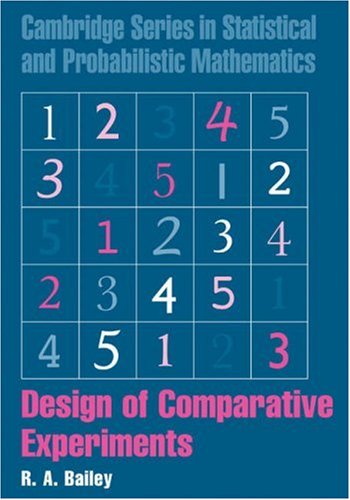
Paperback: 348 pages Publisher: Cambridge University Press (17 April 2008) Language English Synopsis
This book should be on the shelf of every practising statistician who designs experiments. Good design considers units and treatments first, and then allocates treatments to units. It does not choose from a menu of named designs. This approach requires a notation for units that does not depend on the treatments applied. Most structure on the set of observational units, or on the set of treatments, can be defined by factors. This book develops a coherent framework for thinking about factors and their relationships, including the use of Hasse diagrams. These are used to elucidate structure, calculate degrees of freedom and allocate treatment subspaces to appropriate strata. Based on a one-term course the author has taught since 1989, the book is ideal for advanced undergraduate and beginning graduate courses. Examples, exercises and discussion questions are drawn from a wide range of real applications: from drug development, to agriculture, to manufacturing.
Contents
Preface page xi
1 Forward look 1
1.1 Stages in a statistically designed experiment 1
1.1.1 Consultation 1
1.1.2 Statistical design 2
1.1.3 Data collection 2
1.1.4 Data scrutiny 3
1.1.5 Analysis 4
1.1.6 Interpretation 5
1.2 The ideal and the reality 5
1.2.1 Purpose of the experiment 5
1.2.2 Replication 5
1.2.3 Local control 6
1.2.4 Constraints 6
1.2.5 Choice 7
1.3 An example 7
1.4 Defining terms 8
1.5 Linear model 14
1.6 Summary 15
Questions for discussion 16
2 Unstructured experiments 19
2.1 Completely randomized designs 19
2.2 Why and how to randomize 20
2.3 The treatment subspace 21
2.4 Orthogonal projection 23
2.5 Linear model 24
2.6 Estimation 24
2.7 Comparison with matrix notation 26
2.8 Sums of squares 26
2.9 Variance 28
2.10 Replication: equal or unequal? 30
2.11 Allowing for the overall mean 30
2.12 Hypothesis testing 33
2.13 Sufficient replication for power 35
2.14 A more general model 38
Questions for discussion 41
3 Simple treatment structure 43
3.1 Replication of control treatments 43
3.2 Comparing new treatments in the presence of a control 44
3.3 Other treatment groupings 47
Questions for discussion 52
4 Blocking 53
4.1 Types of block 53
4.1.1 Natural discrete divisions 53
4.1.2 Continuous gradients 55
4.1.3 Choice of blocking for trial management 55
4.1.4 How and when to block 56
4.2 Orthogonal block designs 57
4.3 Construction and randomization 59
4.4 Models for block designs 59
4.5 Analysis when blocks have fixed effects 61
4.6 Analysis when blocks have random effects 67
4.7 Why use blocks? 68
4.8 Loss of power with blocking 69
Questions for discussion 71
5 Factorial treatment structure 75
5.1 Treatment factors and their subspaces 75
5.2 Interaction 77
5.3 Principles of expectation models 84
5.4 Decomposing the treatment subspace 87
5.5 Analysis 90
5.6 Three treatment factors 92
5.7 Factorial experiments 97
5.8 Construction and randomization of factorial designs 98
5.9 Factorial treatments plus control 99
Questions for discussion 99
6 Row–column designs 105
6.1 Double blocking 105
6.2 Latin squares 106
6.3 Construction and randomization 108
6.4 Orthogonal subspaces 110
6.5 Fixed row and column effects: model and analysis 110
Contents vii
6.6 Random row and column effects: model and analysis 112
Questions for discussion 116
7 Experiments on people and animals 117
7.1 Introduction 117
7.2 Historical controls 118
7.3 Cross-over trials 118
7.4 Matched pairs, matched threes, and so on 119
7.5 Completely randomized designs 120
7.6 Body parts as experimental units 120
7.7 Sequential allocation to an unknown number of patients 121
7.8 Safeguards against bias 122
7.9 Ethical issues 124
7.10 Analysis by intention to treat 126
Questions for discussion 127
8 Small units inside large units 131
8.1 Experimental units bigger than observational units 131
8.1.1 The context 131
8.1.2 Construction and randomization 132
8.1.3 Model and strata 132
8.1.4 Analysis 132
8.1.5 Hypothesis testing 135
8.1.6 Decreasing variance 137
8.2 Treatment factors in different strata 138
8.3 Split-plot designs 146
8.3.1 Blocking the large units 146
8.3.2 Construction and randomization 147
8.3.3 Model and strata 148
8.3.4 Analysis 149
8.3.5 Evaluation 152
8.4 The split-plot principle 152
Questions for discussion 154
9 More about Latin squares 157
9.1 Uses of Latin squares 157
9.1.1 One treatment factor in a square 157
9.1.2 More general row–column designs 158
9.1.3 Two treatment factors in a block design 159
9.1.4 Three treatment factors in an unblocked design 161
9.2 Graeco-Latin squares 162
9.3 Uses of Graeco-Latin squares 166
9.3.1 Superimposed design in a square 166
9.3.2 Two treatment factors in a square 166
9.3.3 Three treatment factors in a block design 166
viii Contents
9.3.4 Four treatment factors in an unblocked design 167
Questions for discussion 167
10 The calculus of factors 169
10.1 Introduction 169
10.2 Relations on factors 169
10.2.1 Factors and their classes 169
10.2.2 Aliasing 170
10.2.3 One factor finer than another 171
10.2.4 Two special factors 171
10.3 Operations on factors 171
10.3.1 The infimum of two factors 171
10.3.2 The supremum of two factors 172
10.3.3 Uniform factors 175
10.4 Hasse diagrams 175
10.5 Subspaces defined by factors 178
10.5.1 One subspace per factor 178
10.5.2 Fitted values and crude sums of squares 178
10.5.3 Relations between subspaces 178
10.6 Orthogonal factors 178
10.6.1 Definition of orthogonality 178
10.6.2 Projection matrices commute 179
10.6.3 Proportional meeting 180
10.6.4 How replication can affect orthogonality 181
10.6.5 A chain of factors 181
10.7 Orthogonal decomposition 182
10.7.1 A second subspace for each factor 182
10.7.2 Effects and sums of squares 184
10.8 Calculations on the Hasse diagram 185
10.8.1 Degrees of freedom 185
10.8.2 Sums of squares 187
10.9 Orthogonal treatment structures 189
10.9.1 Conditions on treatment factors 189
10.9.2 Collections of expectation models 190
10.10 Orthogonal plot structures 193
10.10.1 Conditions on plot factors 193
10.10.2 Variance and covariance 194
10.10.3 Matrix formulation 195
10.10.4 Strata 196
10.11 Randomization 196
10.12 Orthogonal designs 197
10.12.1 Desirable properties 197
10.12.2 General definition 198
10.12.3 Locating treatment subspaces 198
10.12.4 Analysis of variance 200
Contents ix
10.13 Further examples 202
Questions for discussion 215
11 Incomplete-block designs 219
11.1 Introduction 219
11.2 Balance 219
11.3 Lattice designs 221
11.4 Randomization 223
11.5 Analysis of balanced incomplete-block designs 226
11.6 Efficiency 229
11.7 Analysis of lattice designs 230
11.8 Optimality 233
11.9 Supplemented balance 234
11.10 Row–column designs with incomplete columns 235
Questions for discussion 238
12 Factorial designs in incomplete blocks 241
12.1 Confounding 241
12.2 Decomposing interactions 242
12.3 Constructing designs with specified confounding 245
12.4 Confounding more than one character 249
12.5 Pseudofactors for mixed numbers of levels 251
12.6 Analysis of single-replicate designs 253
12.7 Several replicates 257
Questions for discussion 258
13 Fractional factorial designs 259
13.1 Fractional replicates 259
13.2 Choice of defining contrasts 260
13.3 Weight 262
13.4 Resolution 265
13.5 Analysis of fractional replicates 266
Questions for discussion 270
14 Backward look 271
14.1 Randomization 271
14.1.1 Random sampling 271
14.1.2 Random permutations of the plots 272
14.1.3 Random choice of plan 273
14.1.4 Randomizing treatment labels 273
14.1.5 Randomizing instances of each treatment 275
14.1.6 Random allocation to position 275
14.1.7 Restricted randomization 278
14.2 Factors such as time, sex, age and breed 279
14.3 Writing a protocol 282
14.3.1 What is the purpose of the experiment? 282
14.3.2 What are the treatments? 282
14.3.3 Methods 283
14.3.4 What are the experimental units? 283
14.3.5 What are the observational units? 283
14.3.6 What measurements are to be recorded? 283
14.3.7 What is the design? 283
14.3.8 Justification for the design 284
14.3.9 Randomization used 284
14.3.10 Plan 284
14.3.11 Proposed statistical analysis 284
14.4 The eight stages 285
14.5 A story 286
Questions for discussion 290
Exercises 291
Sources of examples, questions and exercises 313
Further reading 319
References 321
Index 327



 全部版块
全部版块 我的主页
我的主页


 收藏
收藏







 扫码加好友,拉您进群