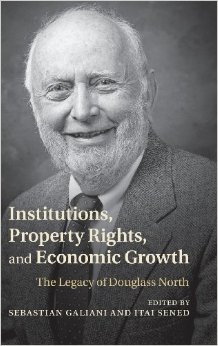
INSTITUTIONS, PROPERTY RIGHTS, AND ECONOMIC GROWTH
This volume showcases the impact of the work of Douglass C. North, winner of
the Nobel Prize and father of the field of New Institutional Economics. Leading
scholars contribute to a substantive discussion that best illustrates the broad
reach and depth of Professor North’s work. The volume speaks concisely about
his legacy across multiple social sciences, specifically on scholarship pertaining
to the understanding of property rights, the institutions that support the system
of property rights, and economic growth.
Sebastian Galiani is Professor of Economics at the University of Maryland.
He is a Fellow of the National Bureau for Economic Research and the Bureau
for Research and Economic Analysis of Development and a member of the
executive committee of the Abdul Latif Jameel Poverty Action Lab at MIT. He is
also associate editor of the Journal of Development Economics. He has published
numerous papers in leading academic journals, including the Journal of Political
Economy, Quarterly Journal of Economics, American Economic Journal, Review
of Economics and Statistics, Journal of Public Economics, Journal of Development
Economics, Journal of Public Economic Theory, Economic Inquiry, and Labour
Economics. Professor Galiani received his PhD from Oxford University.
Itai Sened is Professor of Political Science atWashington University in St. Louis
and Professor of Public Policy at Tel Aviv University. He has authored or coauthored
several books, including The Political Institution of Private Property
(Cambridge University Press, 1997); Political Bargaining: Theory, Practice and
Process (with Gideon Doron, 2001); and Multiparty Democracy (with Norman
Schofield, Cambridge University Press, 2006). He has also published numerous
articles in leading journals, including The American Political Science Review,
The American Journal of Political Science, The Journal of Politics, The British
Journal of Political Science, European Journal for Political Research, and Journal
of Theoretical Politics. He received his PhD from the University of Rochester.




 扫码加好友,拉您进群
 全部版块
全部版块 我的主页
我的主页


 收藏
收藏