sysuse auto,clear
reg price weight
est store m1
reg price weight length
est store m2
reg price weight length rep78
est store m3
outreg2 [m1] using tab01, word replace
ctitle("price,reg1,m1")
outreg2 [m2] using tab01, word
ctitle("price,reg2,m2") append
outreg2 [m3] using tab01, word
ctitle("price,reg3,m3") append
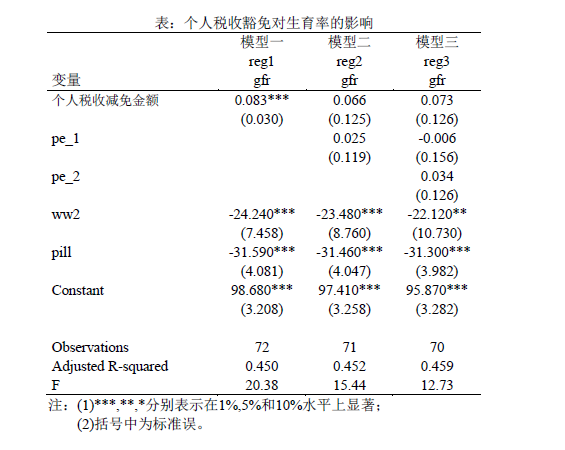
输入的命令和上面类似,
但是就如图所示,下方有一行F值,不知道输入什么命令可以实现?
Additional statistics may be added with addstat( ) or addtext( ). Values stored in
macros r( ), e( ), or s( ) can be included directly. You can see what values are
available by typing ereturn list or return list.
To test the equality of two of the estimated coefficients and report the results in the
table, note that test will sometimes return chi-squared, then you would instead use
addstat(chi-square test, r(chi2)):
reg mpg foreign weight length
test foreign length
outreg2 using myfile, adds(F-test, r(F), Prob > F, `r(p)') replace
seeout
To add results of lincom postestimation command to a table:
sysuse auto, clear
reg price mpg rep78 head
lincom mpg + rep
local tstat=r(estimate)/r(se)
local pval = tprob(r(df), abs(`tstat'))
outreg2 using "myfile", adds(joint, r(estimate), t-stat, `tstat', p-val,`pval')
replace see
In some cases it is better to save the value of a previously calculated statistic in a
local macro and then put that into addstat( ):
regress mpg rep78 headroom
test rep78
local F1 = r(F)
test headroom
outreg2 using 2test, addstat(Test1 F, `F1', Test2 F, `r(F)')
If it is missing, outreg2 will automatically calculate e(p), which is presumably the
F-test or chi-square-test of significance of a regression.
outreg2 using myfile, addstat(F test, e(p))
Another example would be to report a pseudo R-squared after a logit estimation, which
outreg2 does not otherwise report.
dec(#) or fmt(type) for everything, default dec(3) and fmt(fc)
where # is fixed decimals between 0 and 11,
and type is one of the following:
e exponential
f fixed
fc fixed with commas for thousands
g general
gc general with commas for thousands
Use the following only if you want them different from dec(#) or fmt(type):
bdec(#) or bfmt(type) for coefficient only
sdec(#) or sfmt(type) for standard error
tdec(#) or tfmt(type) for t-statistics
pdec(#) or pfmt(type) for p-value
cdec(#) or cfmt(type) for conf. interval
rdec(#) or rfmt(type) for r-square
adec(#) or afmt(type) for addstat( ) contents




 扫码加好友,拉您进群
 全部版块
全部版块 我的主页
我的主页

 收藏
收藏