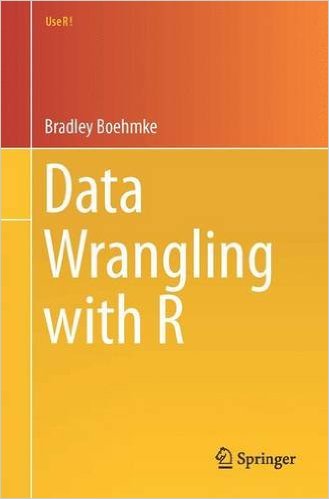
Data Wrangling with R
Authors: Bradley C. Boehmke, Ph.D.
 Presents techniques that allow users to spend less time obtaining, cleaning, manipulating, and preprocessing data and more time visualizing, analyzing, and presenting data via a step-by-step tutorial approach
Includes a wide range of programming activities, from understanding basic data objects in R to writing functions, applying loops, and webscraping
Beneficial to all levels of R programmers: Beginner R programmers will gain a basic understanding of the functionality of R along with learning how to work with data using R, while intermediate and advanced R programmers will find the early chapters reiterating established knowledge and will learn newer and more efficient data wrangling techniques in the mid and later chapters
Covers the most recent data wrangling packages: dplyr, tidyr, httr, stringr, lubridate, readr, rvest, magrittr, xlsx, readxl, and others
Provides code examples and chapter exercises
Presents techniques that allow users to spend less time obtaining, cleaning, manipulating, and preprocessing data and more time visualizing, analyzing, and presenting data via a step-by-step tutorial approach
Includes a wide range of programming activities, from understanding basic data objects in R to writing functions, applying loops, and webscraping
Beneficial to all levels of R programmers: Beginner R programmers will gain a basic understanding of the functionality of R along with learning how to work with data using R, while intermediate and advanced R programmers will find the early chapters reiterating established knowledge and will learn newer and more efficient data wrangling techniques in the mid and later chapters
Covers the most recent data wrangling packages: dplyr, tidyr, httr, stringr, lubridate, readr, rvest, magrittr, xlsx, readxl, and others
Provides code examples and chapter exercises
This guide for practicing statisticians, data scientists, and R users and programmers will teach the essentials of preprocessing: data leveraging the R programming language to easily and quickly turn noisy data into usable pieces of information. Data wrangling, which is also commonly referred to as data munging, transformation, manipulation, janitor work, etc., can be a painstakingly laborious process. Roughly 80% of data analysis is spent on cleaning and preparing data; however, being a prerequisite to the rest of the data analysis workflow (visualization, analysis, reporting), it is essential that one become fluent and efficient in data wrangling techniques.
This book will guide the user through the data wrangling process via a step-by-step tutorial approach and provide a solid foundation for working with data in R. The author's goal is to teach the user how to easily wrangle data in order to spend more time on understanding the content of the data. By the end of the book, the user will have learned:
• How to work with different types of data such as numerics, characters, regular expressions, factors, and dates
• The difference between different data structures and how to create, add additional components to, and subset each data structure
• How to acquire and parse data from locations previously inaccessible
• How to develop functions and use loop control structures to reduce code redundancy
• How to use pipe operators to simplify code and make it more readable
• How to reshape the layout of data and manipulate, summarize, and join data sets
 目录与下载地址:




 扫码加好友,拉您进群
 全部版块
全部版块 我的主页
我的主页


 收藏
收藏