The impact of disasters is growing over time, and the need to consider disaster risk as a core element of a comprehensive and coherent business strategy is increasingly compelling. Nonetheless, disaster risk is often still considered as a stand-alone component of business risk, often a “tail-risk”, hard to measure and, therefore, overlooked. In 2014 UNISDR launched R!SE (now ARISE), a global initiative under the umbrella of the UN, with the objective of fostering a transition from managing disasters to managing risks and promoting the creation of “risk-resilient societies”. One of the objectives of ARISE is to shift this paradigm and make disaster risk a fundamental aspect of business planning.
The scientific evidence, reinforced in September 2013 by the Intergovernmental Panel on Climate Change (IPCC), is aligned with the economic case for action: unprecedented loss of life and infrastructural damage in recent years caused by disasters in the US, Japan, the Philippines and Thailand, among others, emphasise the importance of effective disaster risk-reduction (DRR) strategies. Yet, investment continues to be made, on a regular basis, in disaster-prone areas, such as river basins and low-lying coastal regions.
Factoring risk into investment decisions does not imply that disaster-prone locations need be ignored by the business community. Rather, businesses should consider a region’s DRR strategy and preparedness, its capacity to respond effectively to disasters, and its ability to promote post-disaster recovery. This puts the role of policymakers, regulators and the emergency services at the forefront of the DRR effort, and underlines the importance of collaboration between private and public actors in advancing preparedness.
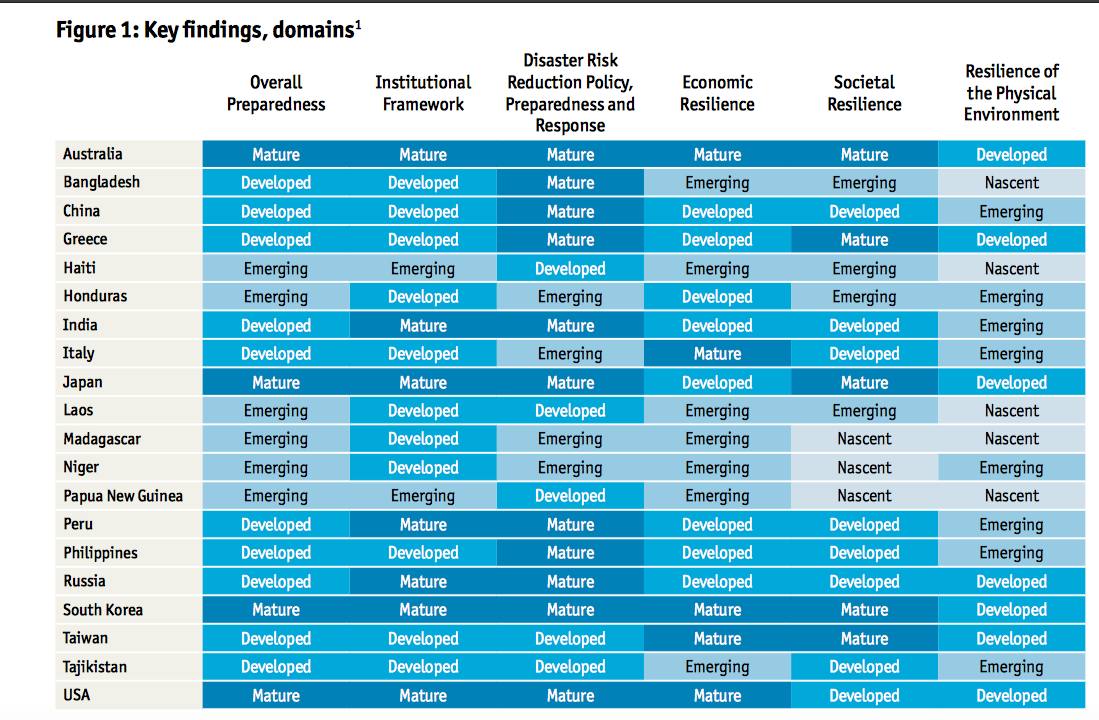
The Disaster Risk-Integrated Operational Risk (DRIOR) model is an important step in the promotion of a better understanding of disaster-related risks in the context of business planning, and represents a sustained effort to promote disaster-sensitive investment. The model looks at policies, regulations and institutions, as well as the broader business operating environment in 20 pilot countries, providing metrics for both policymakers and businesses, with the aim of promoting a better understanding of how to measure risk. The DRIOR model was developed by The EIU, through substantial engagement with the United Nations Office for Disaster Risk Reduction (UNISDR) and a team of subject-matter experts. Building on five domains, 23 indicators and 82 sub-indicators, both qualitative and quantitative, the DRIOR model makes a substantial contribution to mainstreaming disaster risk, and aims to open a dialogue on what is needed to foster the transition to “risk-resilient societies”.


声明: 本文库提供的资源仅供学术研究、浏览新闻等参考之用,发布者不负任何法律责任,敬请下载者支持阅订正版并在下载24小时内删除。




 扫码加好友,拉您进群
 全部版块
全部版块 我的主页
我的主页


 收藏
收藏