source from :FT
https://www.ft.com/content/008188c8-4090-11e7-9d56-25f963e998b2
FT Confidential Research Add to myFT
Liquidity strains test Chinese insurers and regulators Premium
Providers sell assets as crackdown risks exposing fissures in financial system
YESTERDAY by: FT Confidential Research
- Liquidity risks are growing in China’s insurance industry as the government clamps down on sales of universal life products.
- Insurers are being forced to sell off their most liquid assets. This is not yet a fire sale, although pressure to dump their holdings is building.
- The government will need to tread carefully as the tentacles of a rapidly expanded insurance sector have reached deep into the banking system and real estate market.
- China’s insurance regulators were asleep at the wheel. Now they have awoken, their belated attempts to force insurers to shrink their balance sheets threaten to rock the financial system and compel the government to moderate its current deleveraging push.
Facing ever-tighter constraints on their ability to sell the short-term products that drove their growth, China’s new crop of insurers are now offloading their most liquid holdings in a bid to stave off cash shortages.
Based on company disclosures, we estimate Foresea Life Insurance has raised about Rmb400m ($58m) from the sale of its holdings in Shenzhen Textile, Rainbow Department Store and Weihai Heavy Machinery since the fourth quarter of last year. Evergrande Life Insurance sold shares in Zhongyuan Huadian Science & Technology, Dongliang New Material and China Design Group, raising an estimated Rmb273m.
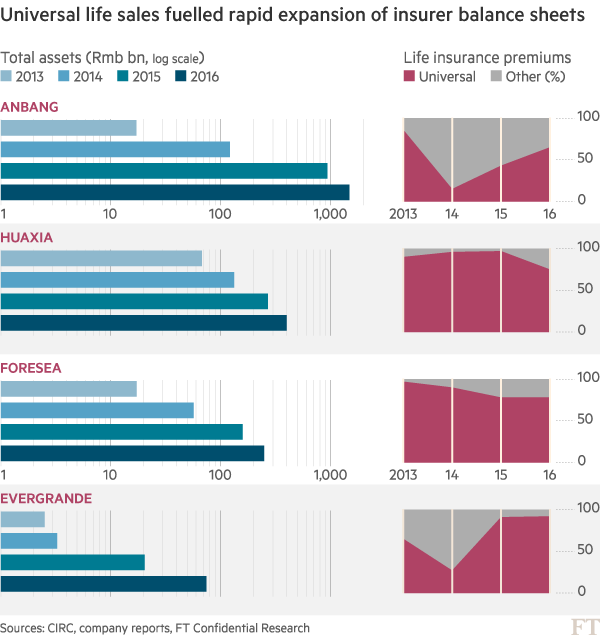
But this is peanuts when compared with their balance sheets. Foresea’s assets surged to Rmb244.1bn last year from just Rmb17bn in 2013, while those of Anbang Insurance rose even more sharply, to Rmb1.45tn, also from Rmb17bn (see chart). Foresea’s disclosed shareholdings now total more than Rmb30bn.

Ongoing share sales by these companies have contributed to domestic stock markets’ recent corrections. If the government does not relax its stance — and there is no evidence so far it is willing to do so — pressure will build for further asset disposals.
Unintended consequences
Life insurance companies have grown fat on sales of universal life products — short-term investment vehicles akin to wealth management products but with an embedded life policy — since 2013. The phenomenal growth of the universal life business was an unintended consequence of legitimate attempts to shake up China’s sleepy insurance sector. Insurers were given more leeway to invest in equities — even more so during the mid-2015 stock market crash — as well as in “other” investments, which includes shadow finance assets, such as trust loans.
However, liberalisation gave rise to a new breed of insurance company that sold short-term products to raise funds for investment in long-term assets. They amassed piles of cash to go on an extraordinary domestic and global shopping spree.
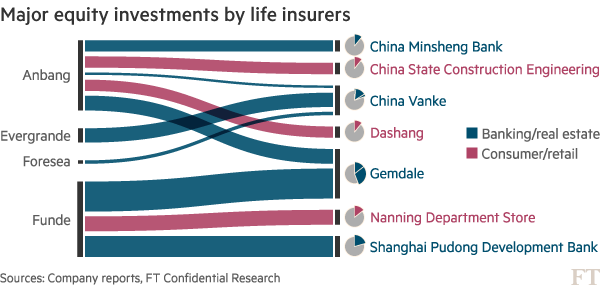
In China, Foresea and its parent Baoneng Group were thrust into the limelight after attempting a hostile takeover of China Vanke, one of the country’s largest property developers. Anbang, whose chairman is married to a granddaughter of former leader Deng Xiaoping, made headlines in 2014 with its $2bn purchase of New York’s landmark Waldorf Astoria hotel. Life Insurance companies have amassed large stakes in listed firms across the property, energy and retail industries (see chart).

Sizeable purchases of stakes in leading banks have helped erode the walls separating the insurance, banking and securities sectors. Bank channels helped insurers market their life products while investments in developers provided indirect exposure to the booming housing market. A large proportion of the “other” investments held by insurers are also direct or indirect loans to the real estate sector. Although regulatory data suggests a reasonable split between bonds, equities, deposits and other investments, we believe the more conservative investments of large state-owned insurers help massage these figures (see chart).

Regulators may have become particularly aggrieved that these upstarts were buying state-owned companies. In a surprisingly raw outburst for a Chinese bureaucrat, the head of the China Securities Regulatory Commission branded these insurers “barbarians”. In mid-2016, Xiang Junbo, the head of the insurance regulator, accused them of using companies as cash machines to finance acquisitions.
Too late for Director Xiang
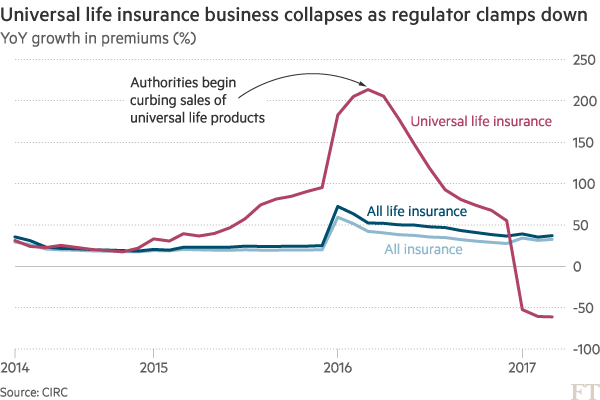
That was one of Mr Xiang’s last public statements. The regulator began cracking down last year, but it was too late for Mr Xiang, who was dismissed in April as part of a widespread and ongoing effort to clean up the financial system. Sales of universal life products peaked in the first half of last year but have been sliding ever since as the China Insurance Regulatory Commission (CIRC) restricts the once-booming business (see chart).

Total universal life insurance sales fell 61.2 per cent in the first quarter to Rmb231.3bn, the online sales channels of six insurers have been closed, Evergrande Life has been ordered out of the stock market for a year, Foresea Life’s universal life business was suspended and, in an unprecedented move, its chairman was banned from the industry for 10 years.
Anbang, which may once have been protected through its links to Deng Xiaoping, is now threatening to sue influential Caixin magazine after a hard-hitting report alleged financial impropriety. Since the report’s publication at the end of April, Anbang has been banned from selling new products for three months.
End of the line for universal life
These prohibitions are part of a government push to force financial institutions to shrink their balance sheets. At the China Banking Regulatory Commission, newly installed director Guo Shuqing has unleashed a “regulatory storm” against smaller banks and the institutions they work with to bypass capital rules. This is part of a deleveraging push that has rocked domestic commodities, bond and stock markets as investors watch for signs that this time the government is willing to take the pain and clean up the system.
Foresea got to the heart of the matter in a leaked letter to the CIRC at the end of April warning of “mass incidents” — public protests — in the event it could not meet the redemption demands of its customers. If the insurer was unable to sell new products to honour claims on existing products then social stability, one of the party’s red lines, could be at risk.
Foresea’s warning highlights the asset/liability mismatch that elevates concern about the life insurance industry and points to further asset sales. Roughly 90 per cent of the products sold by the industry in the past two years had maturities of less than three years. Regulators have gradually forced insurers to stop selling short-term products, but redemption pressures are building up. We estimate the outstanding value of these products at Rmb800bn to Rmb1tn, with as much as Rmb600bn invested in the stock market.
It would not surprise us if the CIRC’s ultimate goal is to regulate the universal life product out of existence to force insurers to focus on the dull business of insurance.
Preventing a liquidity crunch may be complicated by insurers’ reticence to sell into a falling market. This is prompting a search for alternative fundraising schemes. Foresea has reportedly pledged its stockholdings 19 times since September 2015 to raise new funds while Evergrande has reportedly been issuing bonds.
Known unknowns
These are stop-gap measures and will not reduce the pressure on insurance companies to sell down their shareholdings. One option for the insurers is a government-orchestrated suspension of trading and the arrangement of block sales, as happened in January when Shenzhen Metro bought a 15.3 per cent stake in Vanke, ending Baoneng’s hostile takeover bid.
Given the size of their balance sheets, regulators will be tested because any meaningful deleveraging — or a liquidity crunch — would ripple across the financial system. As with attempts to cut linkages between small banks and non-bank financial institutions, the authorities are treading carefully because the tangled web of Chinese debt means it is unclear just where loans have ended up. These insurers have direct stakes in the banking and property markets, as well as indirect exposure via “other” investments.
Regulators have increased provisions of funding to the interbank market in recent weeks, signalling flexibility in their approach to deleveraging. But the CIRC remains under political fire in the wake of Mr Xiang’s dismissal and there is no indication that it is prepared to relax its stance yet.
The simple way to ease liquidity strains would be to loosen operational standards or simply allow insurers to go back to selling life products. But this would be a backward step for reform and, while we expect regulators to step in should there be excess volatility, the tone of official rhetoric suggests such a retreat is not imminent.
FT Confidential Research is an independent research service from the Financial Times, providing in-depth analysis of and statistical insight into China and Southeast Asia. Our team of researchers in these key markets combine findings from our proprietary surveys with on-the-ground research to provide predictive analysis for investors.




 扫码加好友,拉您进群
 全部版块
全部版块 我的主页
我的主页


 收藏
收藏