source from:FT
Baidu Inc Add to myFT
Baidu profits jump after mobile and AI push

Chinese search group benefits from app development and advertising technology
JULY 28, 2017 by: Yuan Yang in Beijing
Baidu’s profits jumped in the second quarter as the Chinese internet search group’s strategies for mobile use and artificial intelligence started to get traction.
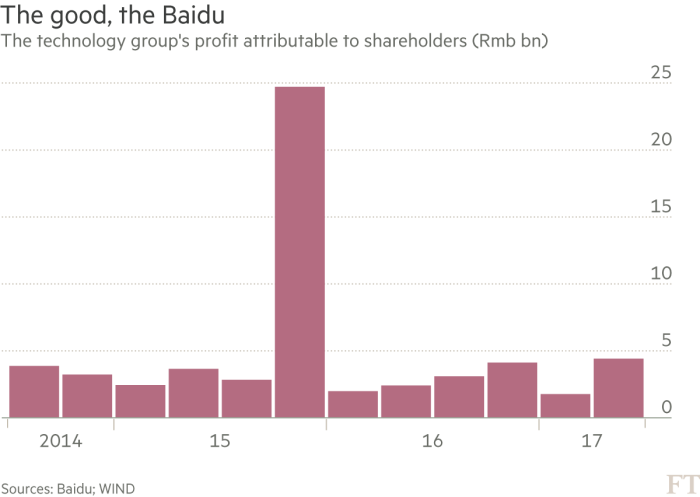
Profits attributable to shareholders for the New York-listed group rose 82.9 per cent in a year to Rmb4.415bn ($651m) in the quarter ending June 30.
The profit result was about 50 per cent better than the median projection by analysts, according to Bloomberg.
Speaking at Baidu’s results briefing on Friday, chief operating officer Qi Lu chalked up the company’s gains to more mobile advertising through the Baidu search app, as well as use of artificial intelligence that has improved the effectiveness of advertising placements.
“The company has really improved search relevance and upgraded its user experience,” said Raymond Feng, co-director of research in Shanghai for market research company Pacific Epoch.
Baidu started catching up with its mobile-savvy domestic rivals Tencent and Alibaba on mobile revenues by monetising its search app with a news feed feature last autumn, a function that was recently copied by Silicon Valley group Google.
Baidu also on Thursday announced a partnership with US payments group PayPal to make it more competitive in the world’s biggest mobile payments market, which is dominated by domestic groups Ant Financial and Tencent. The partnership allows Baidu Wallet users to make online purchases outside China by linking their Baidu Wallets to PayPal.
The transition of users — and advertisers’ money — from desktop to mobile had previously been a sore spot for Baidu, which has admitted it was slower than rivals Tencent and Alibaba in responding to the trend.

Baidu is placing a big long-term bet on investment in AI research to take the company to what it sees as the next platform of computing: omnipresent AI devices that converse with the user through sound and voice recognition.
Chief executive Robin Li also argues that AI can generate revenue in the short term by improving search and advertising placement.
“Advertisers acknowledge Baidu’s use of technology to match users to ads,” added Mr Feng, who oversees a monthly survey of 1,000 Baidu advertisers. “Baidu’s advertising relevance is high, and is based on its data mining and use of AI in analysing user behaviour.”
The company is still recovering from a widely publicised healthcare advertising scandal last year in which a university student died after receiving dubious medical treatment from a provider prominently displayed in Baidu search results.
As a result, the company shed a fifth of its advertisers in the year to June 30.
However, getting rid of questionable clients was made up for by increasing the revenue flow from each client by 32 per cent in the same period, to Rmb37,500 per marketing customer.
“We implemented stricter rules for our customers to do business with us, and after that exercise we are building our customer base again,” said chief financial officer Jennifer Li.
Revenues rose 14.3 per cent from the same quarter in 2016 to Rmb20.9bn, largely in line with analyst expectations.




 扫码加好友,拉您进群
 全部版块
全部版块 我的主页
我的主页


 收藏
收藏