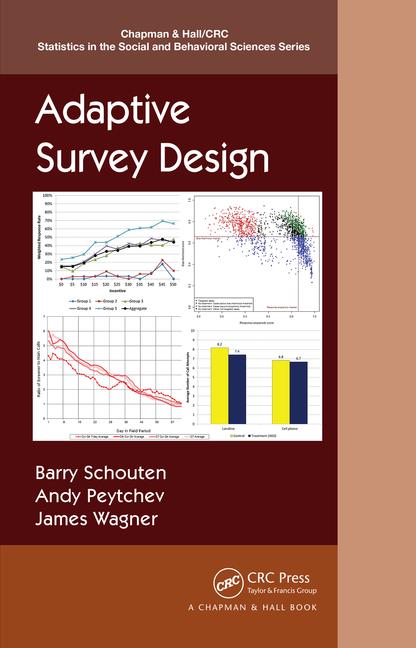
Adaptive Survey DesignBarry Schouten, Andy Peytchev, James Wagner

Features
- Concise introduction to all the key elements of ASD
- Realistic examples from both the Netherlands and the United States
- Suitable for survey managers and survey statisticians alike
- Introduces a view on different survey errors, including nonresponse, measurement, and sampling error
- Provides a research agenda for the near future
SummaryAdaptive survey designs (ASDs) provide a framework for data-driven tailoring of data collection procedures to different sample members, often for cost and bias reduction. People vary in how likely they are to respond and in how they respond. This variation leads to opportunities to selectively deploy design features in order to control both nonresponse and measurement errors. ASD aims at the optimal matching of design features and the characteristics of respondents given the survey budget. Such a goal is sensible, but ASD requires investment in more advanced technical systems and management infrastructure and asks for the collection of relevant auxiliary data. So what are current best practices in ASD? And is ASD worthwhile when the same auxiliary data are employed in the estimation afterwards? In this book, the authors provide answers to these questions, and much more.




 扫码加好友,拉您进群
 全部版块
全部版块 我的主页
我的主页


 收藏
收藏