source from:FT
Equity Valuation Add to myFT
Five markets charts that matter for investors

Treasuries yield curve, bitcoin, US-German yield gap and electric cars metals bonanza
Market dashboard
On Wall Street Tom Braithwaite
Why Donald Trump needs to read Dow 36,000
Your “springboard” guide to current market concerns, presented in a logical and concise manner, with direct links to more details.
- US Treasury yield curve (new)
- Bitcoin and chipmakers
- US-German yield gap (updated)
- Electric cars metals bonanza
- Zombie companies

Share this graphic
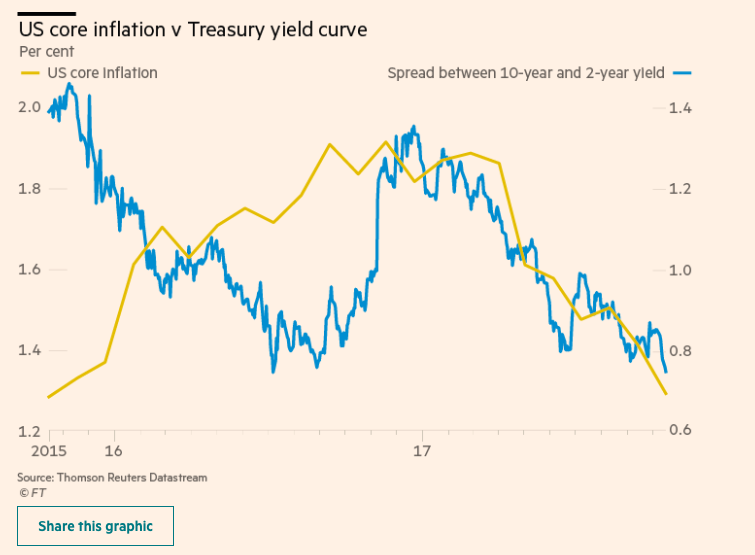
US government bond traders have been riding a powerful trend for some time — sell two- and five-year notes against and buy long-dated Treasuries such as the 10-year note and 30-year bond. This trade has sharply narrowed, or flattened, the difference between short and longer-dated bonds across the yield curve. The shape of the yield curve is important and closely followed by investors as a barometer of what it suggests for the broader economy’s prospects.
A flatter yield curve signals weaker expectations for growth and inflationary pressures, alongside the absence of a meaningful term premium in Treasury securities. So a Treasury yield curve at its flattest level since 2007 reflects bond investors’ view that in the absence of inflation, the 10-year yield will remain stuck in a 2 per cent to 2.50 per cent range for some time. Yield curves in the corporate bond market have also flattened to levels last seen during 2007.
Given the scale of the current flattening trade, there is scope for some reversal. But that may only gain momentum should Federal Reserve policymakers at some stage scale back their projections for tightening policy next year. The central bank’s forecasts that it will lift rates four times over the coming year has driven up short-dated Treasury yields.
But we may be waiting for a while yet for the Fed to shift its stance, as officials stick to the line that inflation pressure should emerge soon given the low rate of unemployment. Channelling the mantra that “the trend is your friend”, some bond traders quip, any steepening in the curve represents an opportunity to renew the flattener trade. Michael Mackenzie

Share this graphic
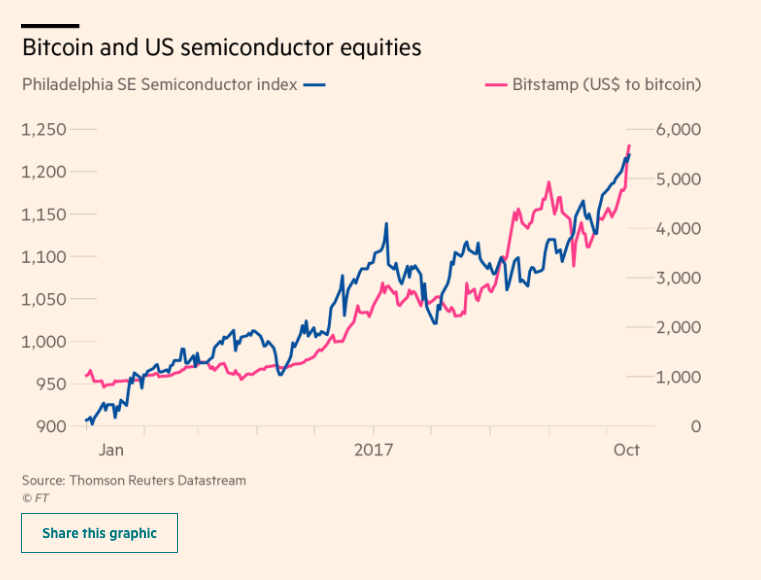
Two markets enjoying a barnstorming run may have something in common.
The performance of semiconductor share prices this year has been stunning, reflecting optimism over rising demand for chips that underpin devices such as mobile phones and gaming to meeting the high ambitions of autonomous driving and artificial intelligence.
Then there is demand for high-powered chips used to mine cryptocurrencies. Shares in Nvidia, for example, are up 80 per cent this year after gaining more than 200 per cent in 2016. The chipmaker is seen by analysts as a beneficiary of crypto mining.
While many on Wall Street dismiss the crypto boom, the recent surge in the bitcoin price has washed over into a big sector of the equity market. A factor worthy of consideration for investors in the semiconductor space. Michael Mackenzie
Read More: bitcoin shoots above 5,800 dollars to record peak

Share this graphic
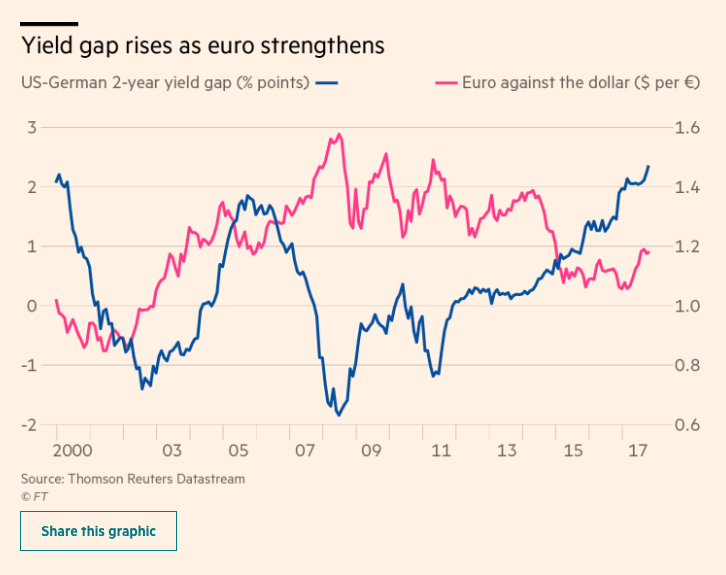
As the euro trades at about 1.18 dollars, currency traders are not too worried by the chunky divergence between US and eurozone bond yields. The two-year Treasury yield has climbed towards 2.30 percentage points above that of its German rival, surpassing the peak seen in March, with this interest rate differential at its widest level since 1999.
Rather than bolster the dollar, the euro loiters near its high for the year — 1.2093 dollars — reflecting a sense among traders that the US tightening cycle is near an end. Indeed, the more important policy driver is what the European Central Bank says about tapering its bond buying in 2018 when the central bank meets later in October.
Some economists now see the ECB buying bonds for much of 2018, albeit at a reduced speed from its current monthly pace of 60bn euros.
A slower taper is seen pushing expectations for an ECB rate rise into 2019. That, in turn, should result in a further widening between US and eurozone borrowing costs.
Whether that is enough to cap the euro’s strength versus the dollar is the big question. Michael Mackenzie
Read More: ECB hints at lower for longer bond-buying plan


Share this graphic
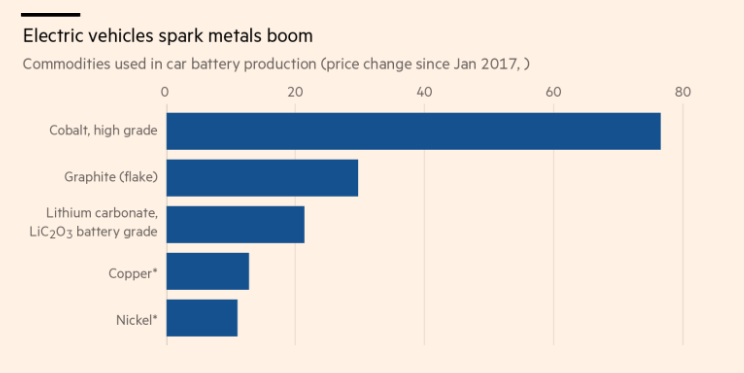
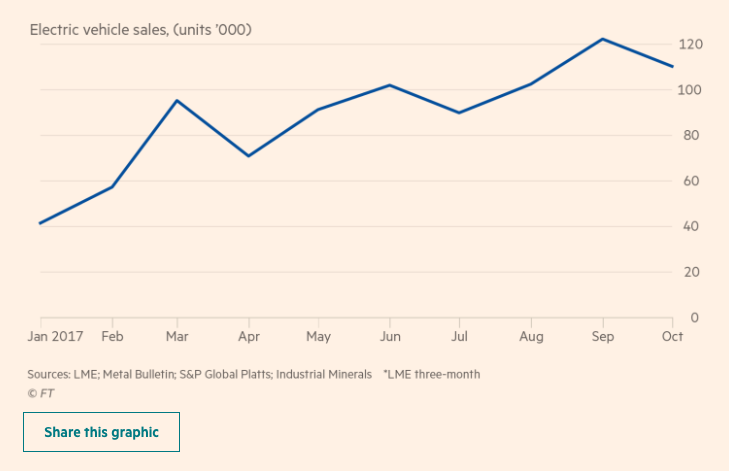
Cobalt, a metal used in most electric vehicle batteries, has been the best performing financial asset this year, rising almost 80 per cent. That’s a better performance than bonds, currencies and equities, according to Macquarie.
Mostly mined in the Democratic Republic of Congo, cobalt supply is already being strained by demand for electric vehicles. It’s also being squeezed by investors, who have bought up large stockpiles of the metal. In June Cobalt 27, which has amassed more than 2,000 tonnes of cobalt, listed in Toronto, offering investors a chance to benefit from the hoard.
Cobalt is already used in batteries for laptops and smartphones, but that market is only expected to grow by 2 per cent over the next few years. In contrast, electric and hybrid cars are expected to drive a 39 per cent growth in cobalt demand through to 2022 even as carmakers reduce the amount they use per battery to save costs, according to Macquarie.
“It’s a really bright future for cobalt,” Vivienne Lloyd, an analyst at Macquarie, says. “There doesn’t seem to be enough of it.”
The current cobalt market can only meet demand for about seven to eight million vehicles, Ms Lloyd estimates.
Lithium, nickel and copper, other metals used in EV batteries, have also benefited this year. Lithium demand is expected to grow by four times by 2025 due to electric vehicles, according to Goldman Sachs. Henry Sanderson
Read More: Electric car push signals cap on endless rise in oil demand

Share this graphic
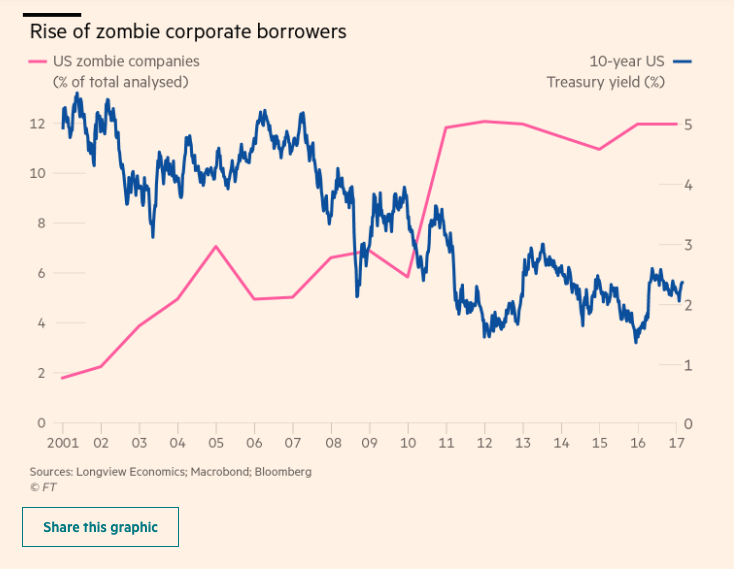
The low interest rate era and easy access to debt markets by companies has a notable downside; the rise of zombie corporate borrowers.
Longview Economics has plotted the percentage of all listed US companies — excluding financials, exchange traded funds and investment trusts — that are least 10 years old and have experienced an EBIT being less than its interest payments for the past three years.
This is not just a US phenomenon. Developed world economies are grappling with zombie companies against a backdrop of ageing populations, slow growth, high debt levels and weak productivity. For all the chatter of rising bond yields as the Federal Reserve has begun winding back the reinvestment flows of its 4.5tn dollars balance sheet, long-dated yields have other forces keeping them capped. Michael Mackenzie




 扫码加好友,拉您进群
 全部版块
全部版块 我的主页
我的主页


 收藏
收藏