source from:WSJ

Why Asia’s Booming Bond Market Doesn’t Need the U.S.
Asia’s reliance on American investors is waning as companies and governments are able to raise more money closer to home
Skyscrapers light up the sky in Shanghai, China's financial capital. SIPA Asia/Zuma Press
By Saumya Vaishampayan and
Yasufumi Saito
Jan. 4, 2018 4:25 a.m. ET
6 COMMENTS
Asia is becoming more self-reliant, at least when it comes to buying and selling U.S. dollar-denominated bonds.
Growing Asian wealth and local investors’ desire for assets denominated in currencies other than their own, especially in China, have helped fuel demand for dollar bonds in the region.
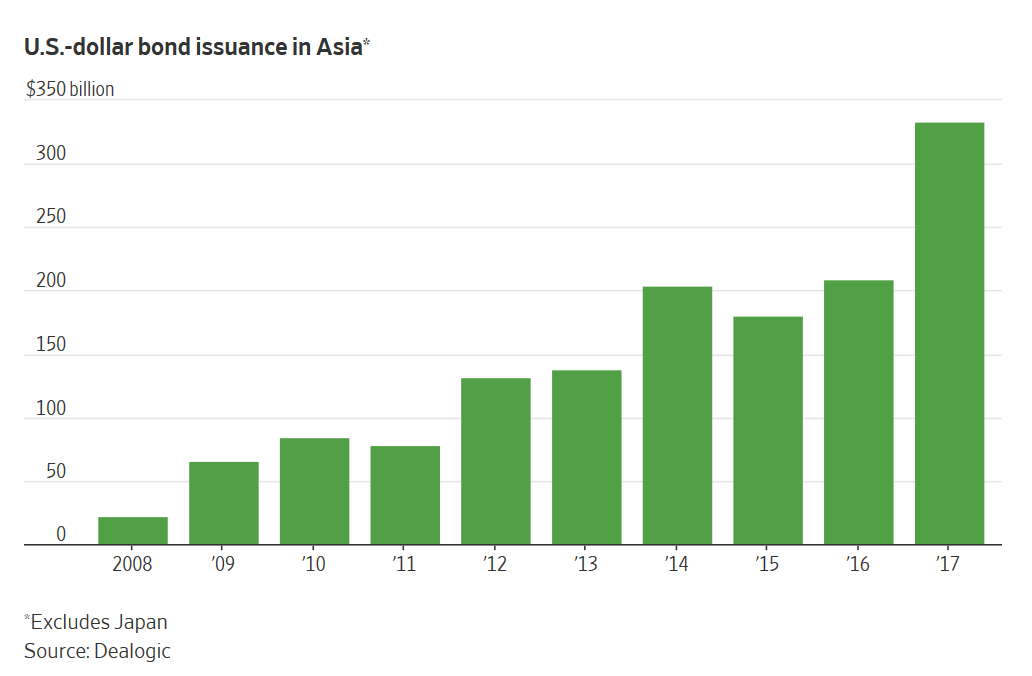
Bankers and analysts say the appetite for dollar bonds remains strong given the pool of cash that still needs to be invested, even after Asian companies and governments, excluding those in Japan, issued a record 333.9 billion dollars last year, according to Dealogic data.
The high level of local demand is changing the way banks sell dollar bonds in Asia, often allowing them to bypass U.S. investors and complete offerings more quickly.
“Asian issuers increasingly do not need to go to the U.S. market to get the same pool of liquidity as they did before,” said Terence Chia, head of the Asia-Pacific debt capital-markets syndicate at Credit Suisse in Hong Kong.

The boom last year was driven by China, where rising domestic-bond yields meant it was cheaper for many companies to borrow in U.S. dollars.
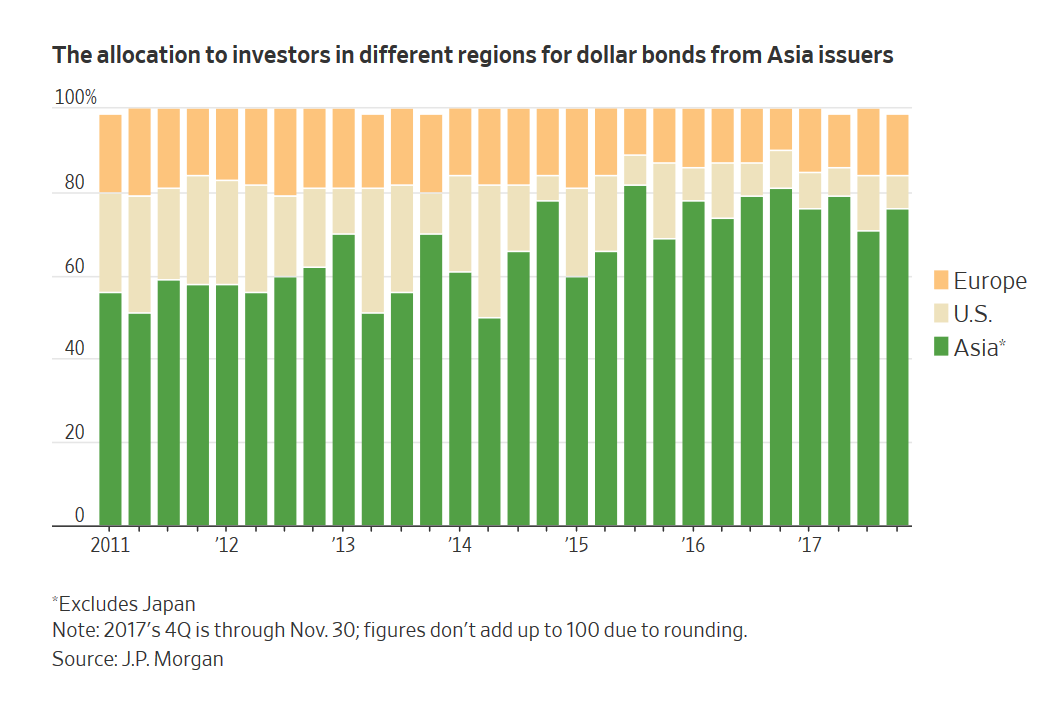
Thanks to the bounty of cash in the region, Asian investors are grabbing a larger share of the dollar bonds sold by Asian issuers.

About 76% of Asian dollar-bond deals were allocated to Asian investors in the fourth quarter of 2017, according to preliminary data from J.P. Morgan, up from 58% in 2011’s fourth quarter.
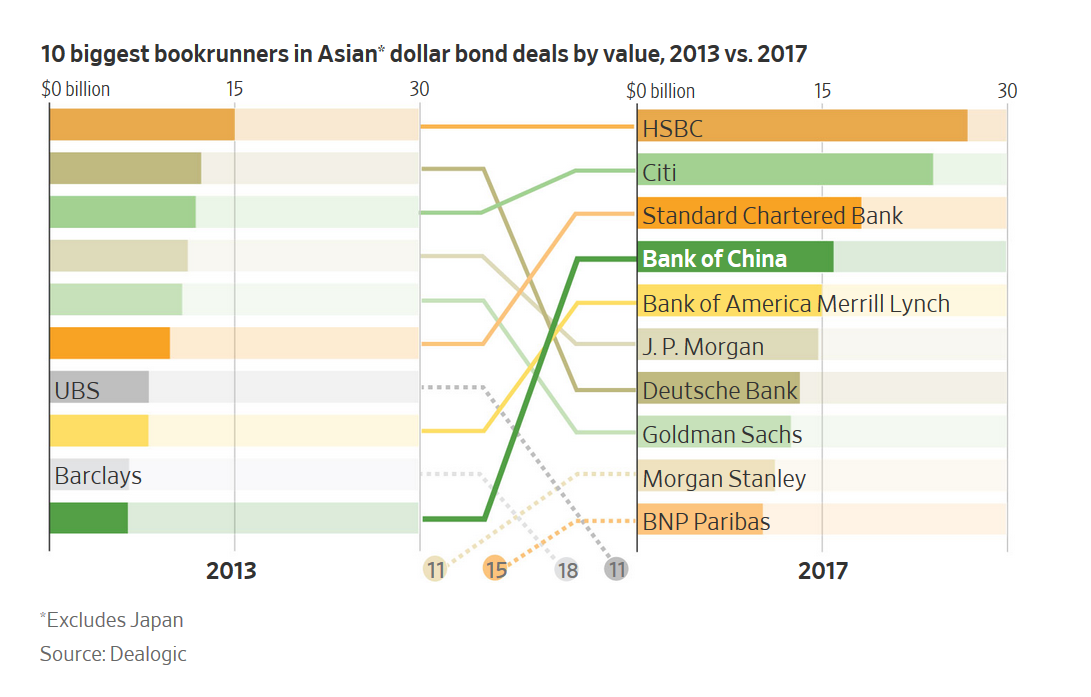
Asian banks such as Bank of China have become bigger players in selling dollar bonds in the region as local demand rises, based on Dealogic data comparing 2017 with 2013.

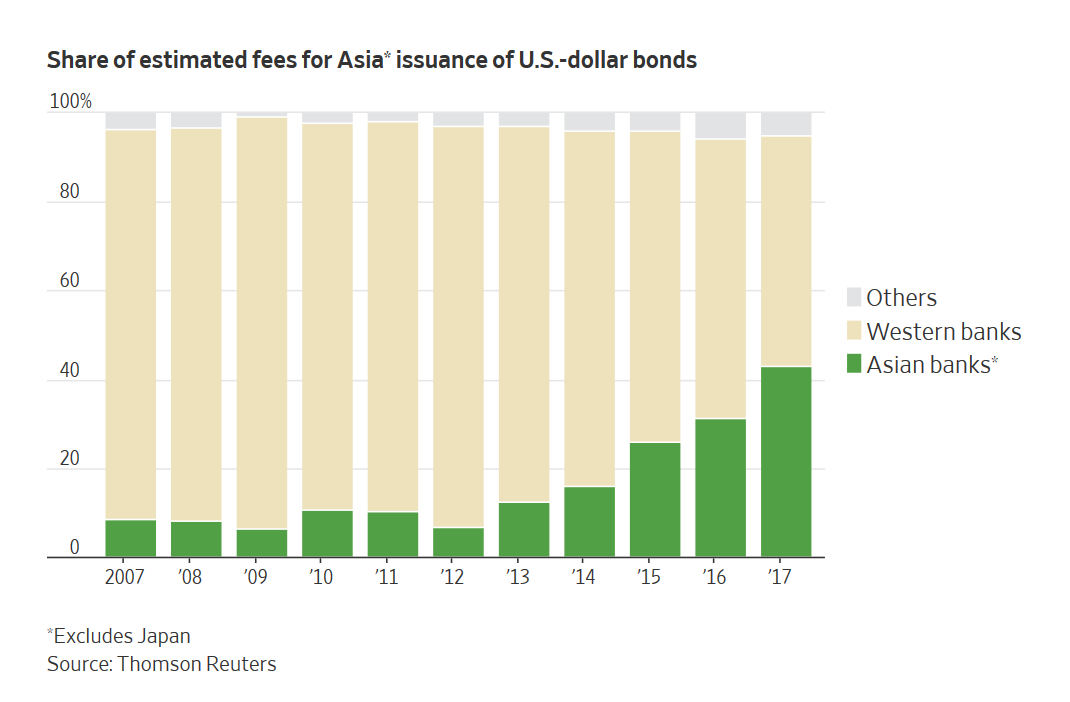
And Asian banks excluding Japan are grabbing a larger share of the estimated fees on those U.S. dollar-bond deals, as they received about 840 million dollars, or 43%, of the estimated fees in 2017, according to Thomson Reuters, up from 96.14 dollars million, or 13%, in 2013.

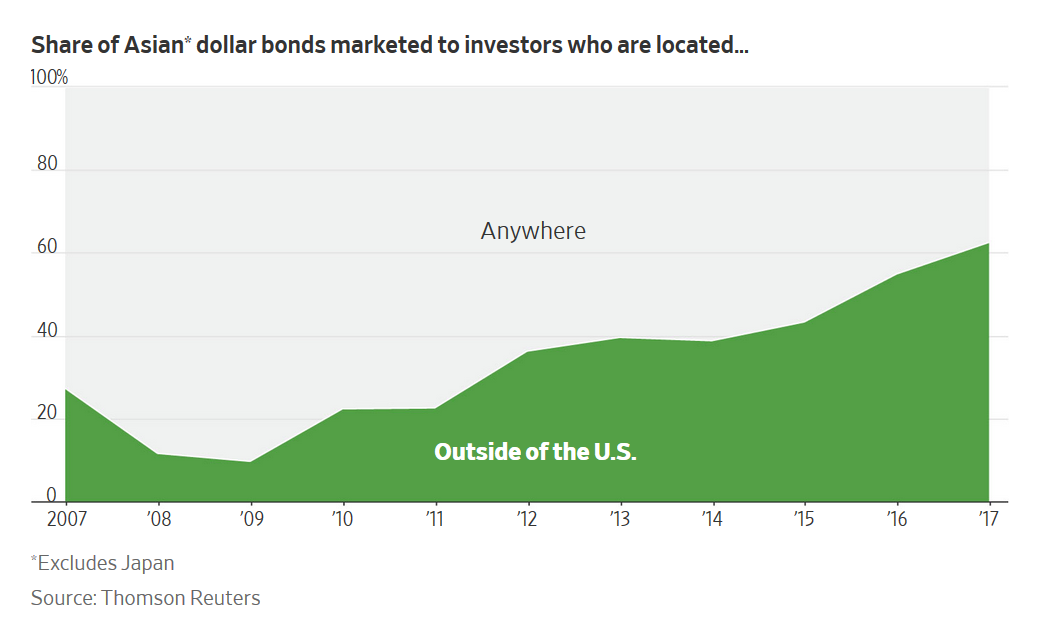
A growing share of U.S. dollar-bond sales in Asia, excluding Japan, are being marketed only outside the U.S., according to Thomson Reuters.

Those offerings, which are known as Reg-S deals, allow debt securities to be offered and sold to investors without being registered under the U.S.’s Securities Act and are typically completed quicker than the deals offered in the U.S.
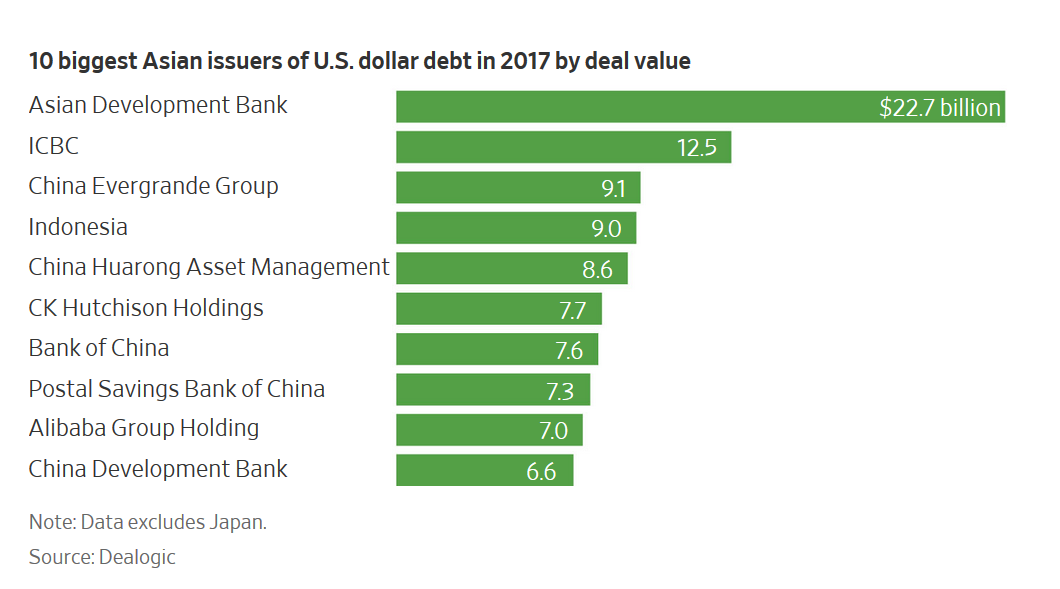
Chinese companies were some of the biggest issuers of dollar debt in Asia last year. Asian Development Bank and Industrial & Commercial Bank of China topped Dealogic’s list of the 10 biggest non-Japanese Asian issuers of dollar debt in 2017 by deal value.

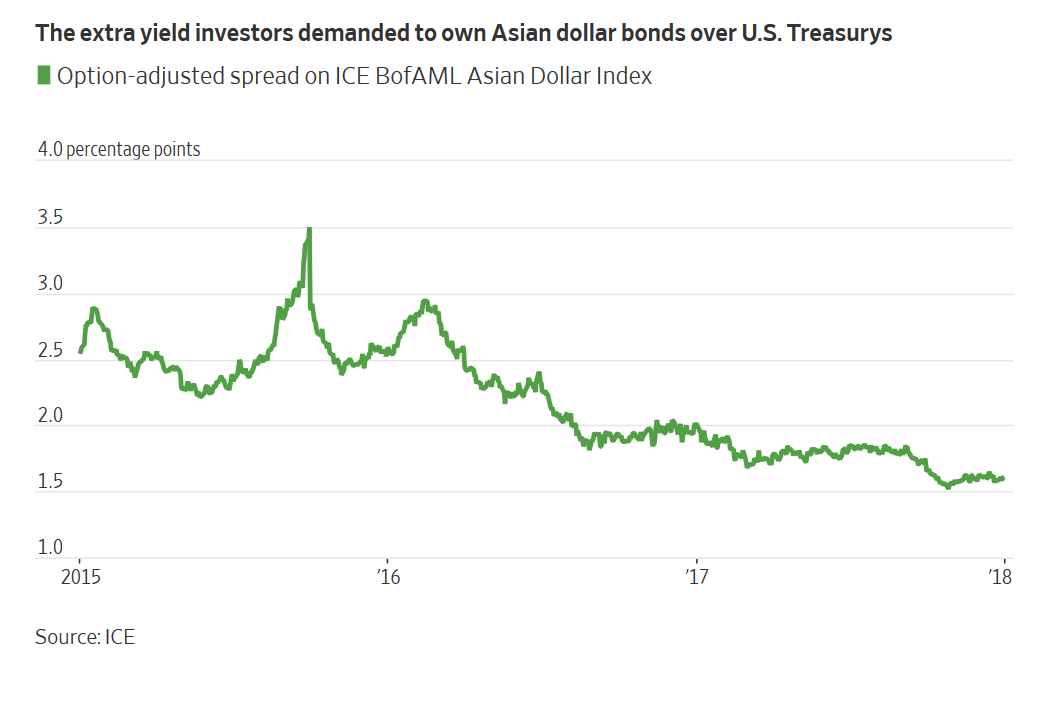
The demand for dollar bonds in Asia means issuers are able to borrow at lower interest rates, shrinking the extra yield that investors earn from Asian dollar bonds compared with Treasurys. At the end of 2017, the extra yield they demanded was down at 1.61 percentage points, according to ICE.





 扫码加好友,拉您进群
 全部版块
全部版块 我的主页
我的主页


 收藏
收藏