经管之家App
让优质教育人人可得
立即打开



Cycles Analysis Overview
There are a variety of ways to search for cycles in a time series. Here are some of the more common ones.
1. Fourier analysis (usually FFT or Fast Fourier Transform these days). This is a method of converting a set of regular measurements of something into a set of frequencies that are present and amplitudes and phases of those frequencies. It uses only frequencies that are exact multiples of the lowest detectable frequency. This later feature is a problem for short data sets. If a cycle has modulations then these will appearas complicated structures about a central frequency.
2. Maximum Entropy Spectral Analysis (MESA) is a method designed by Burg which overcomes the exact frequency multiple feature of FFT and also only tries to extract a limited number of cycles, attributing the remaining variations to noise. It is an ideal tool for short data sets or where the frequencies are possibly changing with time and so will appeal to market traders.
3. The difference between two moving averages is a technique that was used by Dewey to highlight a particular period. For example a 9 month cycle might be shown by plotting the data (or perhaps a 3 month centered moving average) less the 9 month centered moving average.
4. A Factor Analysis of a single series repeated multiple times at different time lags will, perhaps surprisingly, tend to extract cycles.
5. Autocorrelations of time series with itself at various lags will tend to show any cycles present, even if the seriesis very long and the period a little unstable. This is just the situation where FFT is not so useful.
6. ARIMA is a method for determining the various properties of a time series and the best way to treat it such as taking differences, removing seasonal trends and whether it is a random walk or not.
However, before searching for cycles there are sometimes some initial data treatments that are useful in making the analysis more meaningful.
1. For data that does not have a stable mean over time, particularly price data which may go up by large factors over extended periods of time, then it is advisable to take logs of the data first.This means that equal percentage changes in the original data are transformed to equal numerical changes.
2. Take differences between adjacent terms of the data to highlight the rate of change rather than the value itself. This will emphasize the shorter term variations rather than the longer term ones, and for making short term forecasts will often yield more accurate results. Of course this will change a price series into an inflation rate series.
Example 1 shows the Price of Wheat over a period of more than 100 years. Because this was last century, not this century,there is little inflation overall although the price varied considerably. In A the raw data shows wider variations near the middle of the period when the price was higher. This is a case where taking logs is recommended and in B wesee that this results in more even short term fluctuations. Finally, in C the result of taking differences between adjacent values is shown. The cycle of about 5.5 years is still visible, but the shorter term fluctuations are now stronger and the longer term ones have all but vanished.

Having prepared our data we are finally ready to do a Fourier analysis. In general cycles of more than 2 time interval scan be detected but there is a danger of "aliasing" for cycles at the very short end. Aliasing means that the wrong period is determined because the measurement interval is too short for the cycle.
Example 2 shows the spectra obtained from the above cases A, B and C. With quarterly prices it is not possible to detect cycles of less than 1/2 a year. A cycle of exactly one year is present and itis especially easy to see in C. Of course a 1 year cycle is just the seasons and we would expect the price of wheat to vary with the seasons as it is a seasonal crop and requires storage costs to be available at other times.
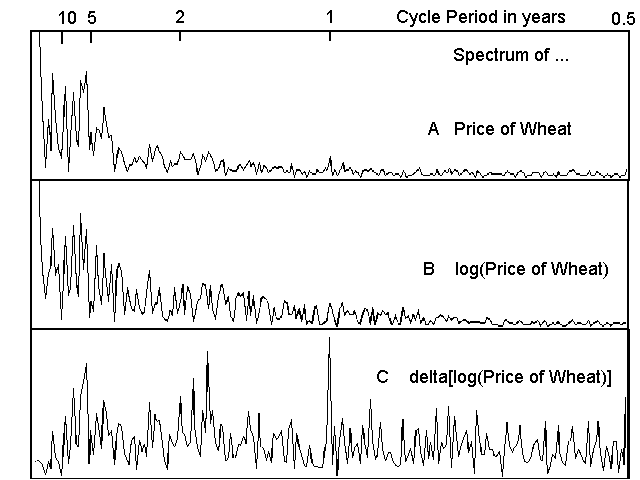
There are the same set of cycles which are present in all three graphs in the 5 to 20 year range. The strongest of these is about 5.5 years and is clearly visible in the original data without much imagination. In B this peak is split into 2 while in A and C it is almost split. This indicates that the cycle is modulated on a long term basis. The modulation may be just a result of changing circumstances and have no ongoing basis.
The accurate periods found in C are 1.001,1.697, 4.20, 4.75, 5.54, 7.3, 9.1, 14.3 years. The strongest ones are the 1year, the 1.697 year and the 5.54 year cycles. These 3 cycles are almost certainly real and C has correlation coefficients of .225, .198 and .187respectively with sine waves of the stated periods. The seasonal one would not be disputed.
The period 5.54 years is exactly half of the average sunspot cycle period. There has been debate about the role of sunspots in affecting the weather and life on earth. However in recent years improved data and methods have shown that there is no doubt that the earth is affected by variations in the sun. But why half? Well, if the sunspot cycle does affect the weather and in turn how well wheat grows then we would expect the variations to be go beyond optimum condition in two directions (be it too hot and too cold or too wet and too dry) and therefore in one sunspot cycle there would be two cycles in wheat growth.
The 1.697 year period is also interesting.There is a weak cycle at 3.39 years which is exactly double that period. The 3.39 year (40.68 month) cycle is also the dominant cycle in the US stock market and commonly called the 40 month cycle and is, according to Dewey, the most commonly reported cycle of all. This finding of cycles that are exactly half as long as others is a very common occurrence. They are called harmonics. Finding cycles of the same length in different series is also common.
You may wonder why the periods are back to front and all bunched up at one end. This is because Fourier analysis measures frequency not period and we calculate the period as 1/frequency. On a frequency basis it is uniformly spread.
For a great deal more useful information,visit:
Electronic Statistics Textbook (http://www.statsoft.com/Textbook) is an extremely comprehensive guide to statistics and includes a thorough section on Time Series Analysis covering many techniques, although unfortunately not including MESA.
The Maths Archives – Fourier Analysis and Wavelets (http://archives.math.utk.edu/topics/fourierAnalysis.html) Links for Java Applets, Fourier Analysis, Harmonic Analysis and other maths archives topics.
The Craft of Economic Modelling (http://www.inforum.umd.edu/papers/TheCraft.html)by Clopper Almon, is a tour of how to analyze economic time series. Makes useof G7 program.
Times Series Analysis and Its Applications by Robert H Shumway and David S Stoffer consists of a book, a free times series analysis package named ASTSA with comprehensive manual and lots of times series data. It is very comprehensive, including spectral analysis and ARIMA models and many data manipulations. Highly recommended.
Nonlinear Time Series Models in Empirical Finance is a book by Philip Hans Franses and Dick van Dijk and time series data and excel spreadsheets are included on the site as well as much of the book.
Forecasting: Methods and Applications (3rd edition) by Spyros G. Makridakis,Steven C. Wheelwright, Rob J Hyndman 1997.
Time-series Forecasting by Chris Chatfield 2000
Cycles The Science of Prediction by Edward R. Dewey, Edwin F. Dakin 2007
Cycles The Mysterious Forces that Trigger Events by Edward R. Dewey, Og Mandino 1971
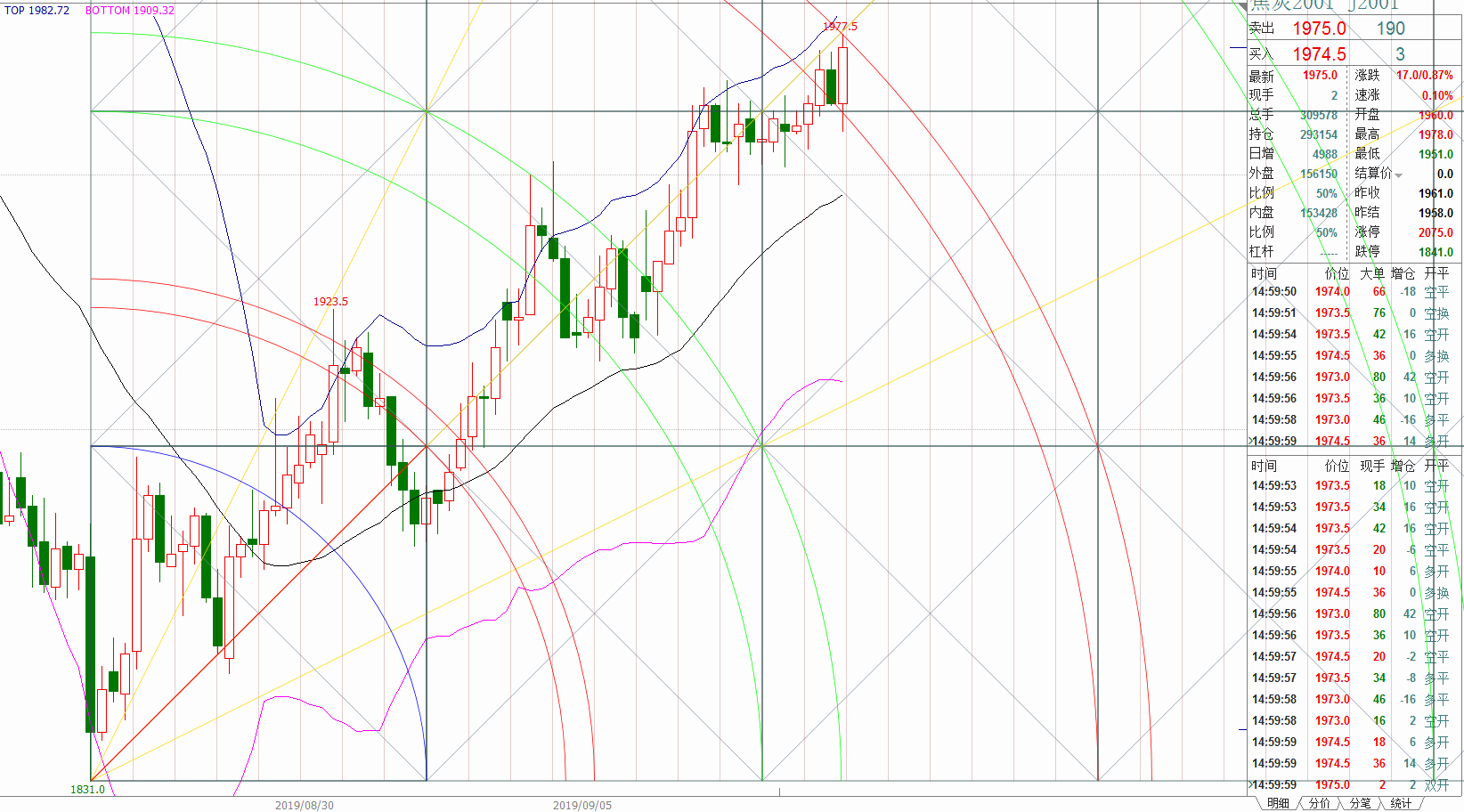
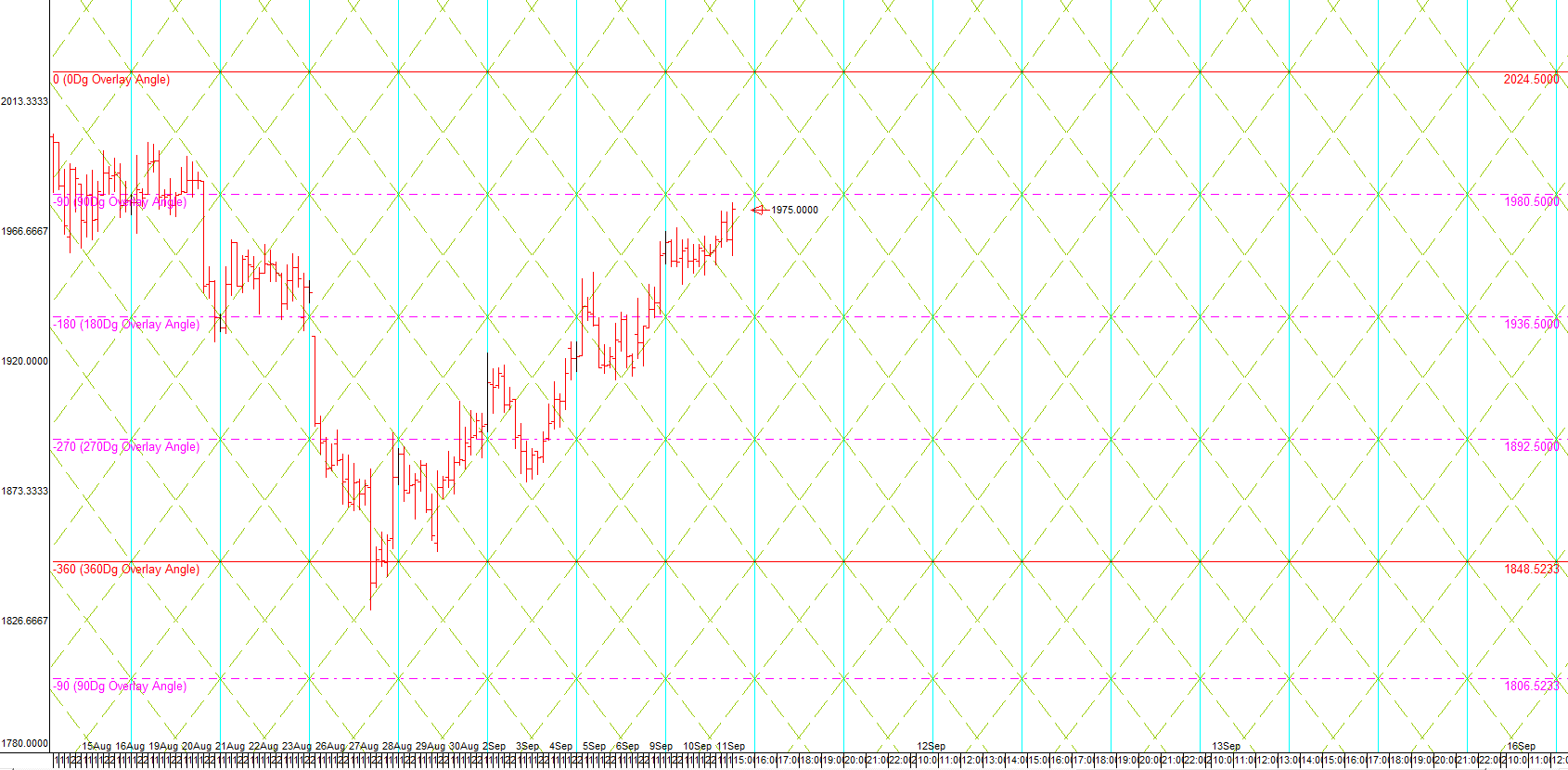


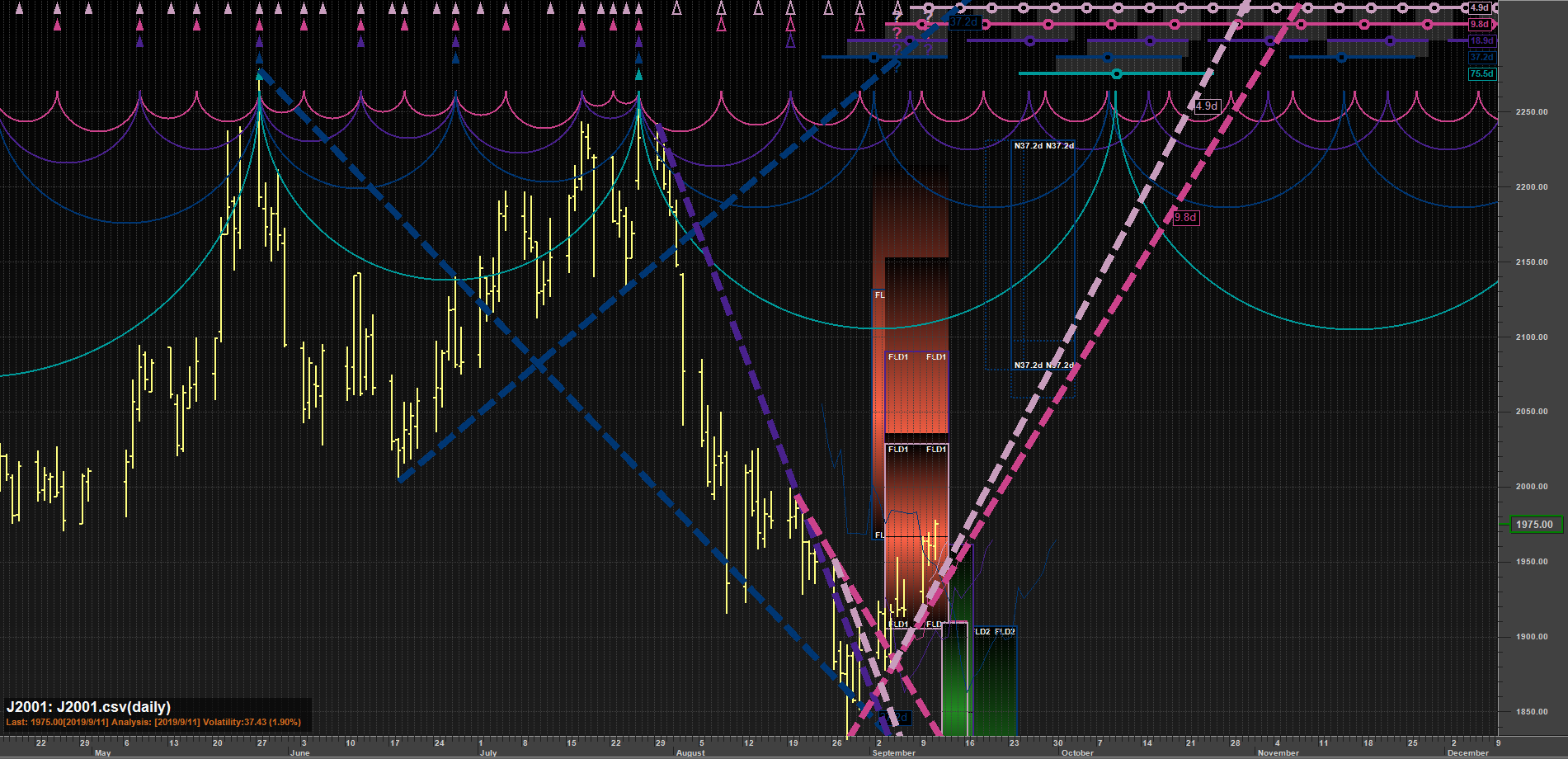
Price is currently in the SECOND 4 day cycle, of the SECOND 9 day cycle, of the SECOND 18 day cycle, of the FIRST 37day cycle, of the 75 day cycle.
Updated FPA reveals that the dominant cycle has a wavelength of 37.2d, or 37 bars. This is assumed to be the 40d nominal wave, which implies that all waves will be (9%) longer than nominal. This cycleis overdue for a HIGH (and a minor nest-of-highs). The underlying trend to this cycle is currently slightly UP, likely accelerating. Recent fulfilled projections however indicate that the underlying trend is FLAT, probably turning UP. The future FLD indicates that this cycle will influence prices to peak soon, and then fall.
The sub-dominant cycle (next wave down fromthe dominant cycle) has a wavelength of 18.9d, or 19 bars. This is assumed to be the 20d nominal wave. This cycle is overdue for a HIGH (and a very minornest-of-highs). This is probably the SECOND of 2 sub-waves. The underlying trend to this cycle is currently slightly UP, likely slowing down. Recent fulfilled projections however indicate that the underlying trend is FLAT,probably turning UP. The future FLD indicates that this cycle will influence prices to peak soon, and then fall.
The pre-dominant cycle (next wave up from the dominant cycle) has a wavelength of 75.5d, or 76 bars. This is assumed to be the 80d nominal wave. This cycle is beginning to RISE, and is accelerating.The underlying trend to this cycle is currently slightly UP, likely accelerating. Recent fulfilled projections however would seem to indicate that the underlying trend is STRONGLY DOWN. The future FLD indicates that this cycle will influence prices to RISE.
Σ L is currently UP (strength: 1), and accelerating.
The 37.2d CYCLE component of Σ L iscurrently STRONGLY UP (strength: 5 cycles), and accelerating.
The 18.9d CYCLE component of Σ L iscurrently STRONGLY UP (strength: 2 cycles), but decelerating.
The 9.8d CYCLE component of Σ L iscurrently STRONGLY DOWN (strength: -3 cycles), and accelerating.
The 4.9d CYCLE component of Σ L iscurrently FLAT, likely TURNING UP.
The last phasing analysis was 1 bar ago. In that time price has RISEN by 14.00 to 1975.00.
FLD PATTERN PROGRESSION:
Sequence Ref #0 is expected to reach a LOWER target of 1850.06(12.15 diff) by the same date, on 2019/8/22
Sequence Ref #1 is expected to reach a HIGHER target of 2146.81(-42.50 diff) by the same date, on 2019/10/10
DETAILED FLD PATTERN/PRICE CORRELATION:
Price did not move DOWN as it was expected to by the FIRST sequence (ref #0) of the previous pattern but it has ALREADY reached the target of 1850.06. Price exceeded this target by 1.0%, 14 bars ago,-6 bars before it was expected. This sequence is probably fulfilled, albeitearly.
The SECOND sequence (ref #1) of the previous pattern could have started, in which case: Price has moved towards the target of 2189.31. The closest price has gotten to this target so far is1978.00 (9.7% short). The target is due in 28 bars.
CURRENT FLD PATTERN PROJECTION:
Price is currently moving UP (last close1975), in the final move of an active downwards FLD pattern. It is possible that the first sequence of the FLD pattern has already been fulfilled, by the low of 1831 on 2019/8/28 which would indicate that the second, UPWARD sequence of the pattern is now in progress.
The first FLD pattern sequence (ref #0)projects a price movement DOWN to a target of 1850.06 by about 2019/8/22.
The second FLD pattern sequence (ref #1)projects a price movement UP to a target of 2146.81 by about 2019/10/5. Price might cross OVER the 75 day FLD on 2019/9/18 & level: 1982.83 however thisFLD cross is too late in the cycle to be considered valid, and so it is morelikely that the FLD will form resistance at this level.
OUTSTANDING FLD PROJECTIONS:
75.5d Mid-Channel Pause FLD projection created on 2019/8/14 projecting a price fall of 149.2500 to 1807.7500 by2019/9/2. This projection target was approached to within 1.3% of the target price on 2019/8/28 and it seems unlikely to reach a new low before the completion of a full cycle and so it is being retired.
37.2d Normal FLD projection created on2019/9/10 projecting a price rise of 123.5000 to 2078.0000 by 2019/9/23. This is still a valid projection target.
18.9d Normal FLD projection created on2019/9/5 projecting a price rise of 98.4583 to 2027.9170 by 2019/9/13. This is still a valid projection target.
9.8d Normal FLD projection created on2019/9/2 projecting a price rise of 74.4583 to 1979.9170 by 2019/9/9. This projection target was approached to within 0.1% of the target price on2019/9/11 and it seems unlikely to reach a new high before the completion of a full cycle and so it is being retired.
4.9d Refined FLD projection created on2019/9/10 projecting a price rise of 41.5938 to 1996.1880 by 2019/9/11. This is still a valid projection target.

 扫码加好友,拉您进群
 全部版块
全部版块 我的主页
我的主页


 收藏
收藏