经管之家App
让优质教育人人可得
立即打开



Timing Matrix plus Tips
Please take time to practice on historical price data. Using a combination of Weekly and Daily charts for analysis, and if possible 30-minute charts for fine-tuning entry, is ideal for overnight swing-trading. For day-trading use 30-minute charts to spot when larger swings may occur, and fine-tune entry with a price-based system on shorter time-frames (I sell my personal day-trading method, it's called 'X' Day Trader).
Of all the methods presented here, the two you want to master are Pitchfork Angles and PF+Fib - they should be your "bread and butter" profit makers. They've both withstood the tests of time in many different market conditions. But there is no reason not to use the other methods for additional confirmation. What's more, to truly master swing-trading with these methods you should be integrating them in a Timing Matrix. While each of the Market Geometry techniques can stand on its own as a good timer, as active traders part of our job is to ensure ourselves of the highest accuracy possible.
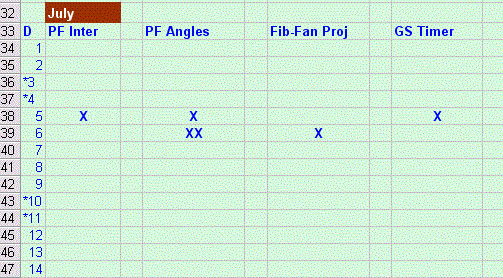
With this strategic change in trading style, I'll get on with the tactics of integrating these techniques. First, please consider using a table (like in a spreadsheet ) for each market you trade where the columns are these techniques and the rows are times. The idea is to tabulate all your projected trend-change times in one source from these techniques. Several times a month you'll see a clustering of projected trend-change times. Make no mistake about it - its finding these clusters of trend-change times from several techniques that is the highest purpose of this course. While each technique alone is very good, when they combine to "vote by committee" that a trend-change is due you have a high probability trade-setup.
Below its set for the month of July, with the rows being days and the columns being our techniques. You'd have one for each market you trade. A day is preceded with an asterisk if it's a weekend (sometimes signals are between two price-bars). An "X" is placed if you have asignal for that day. This would be the best situation possible - each timer giving a signal within a day of each other, with no signals before or after.Note that PF-Angles has 2 X's - that's because for any chart you can usually draw 2 or more of any of these techniques. Using different pivots it's possible(for example) that the second intersect of the first PF-Angles falls on the same day as the first intersect of the second PF-Angles drawing. Of course these are just recommendations - you can structure the appearance anyway you see fit. The idea is that you can spot trend-change clusters easily.
What are we really doing here? We're doing our best to eliminate as much as possible market noise. While this phenomena of market noise makes price-analysis a poor way to make a living trading, it is not entirely absent from time-analysis. By using just significant pivots we have substantially reduced this trade wrecker of market noise. But as stated earlier, we want to come as close as possible to master-trader status so we need to take an extra two steps: 1) use several timing techniques. Even though PF-Angles is the best, the others aren't exactly shabby! Even though they may use the same pivots, the geometry of their drawing is so different from one another that practically speaking they are non-correlated. Hence multiple timing signals within a day of each are viewed as being more powerful. 2) For each technique you can often draw at two,sometimes three, per chart (with the exception of Fib-Fan Projection which is best used on strong long swings). If the time between pivots of the first drawing is long, it will project a time further out into the future. That time just might be equal to the time projection of the second drawing which might be using pivots closer together. This is a general drawing rule -the further back in time you go in your chart, the bigger the pivots you'll be using.
Next, remember that you can be doing analysis on daily charts and find a timing signal, and use a shorter timeframe to fine-tune yourentry. For daily charts use 30-minutes to fine tune. Day-traders who trade for the larger intraday swings can use 30-minute charts (where PF Angles is best)and fine-tune entry on the 5 or 10-minute timeframe. Here's a summary of what to look for:
And please remember to use multiple PF Angles on all reasonable pivots. Those times produce the best trades - I don't believewe'll ever see a better technique than PF Angles.
Finally, you have here one more edge over most traders.Once a trade is profitable and you are in a trend, begin applying the Fib Price Expansion technique as shown in the last example of that section. If the trend corrects there you'll get most of the profit out of that swing, and then don'tbe surprised if these techniques get you into the next swing very early.
Entering Trades
I can't say it enough - being able to predict trend-changes accurately and then trading successfully are two different skill sets. Please use the Trade Execution manual that came with this course!
To help keep it simple, remember that what we're doing here is creating a minimum of a three bar time-zone and looking for:
This implies that most of the time you won't be entering the trade till after the time-zone ends, as you need an extra bar or two to confirm a pivot.
Weekly Timing
A basic premise of market geometry is that the more significant the pivot we use, the less market noise we incorporate in our drawings. Supporting this it's often easier to spot significant pivots on higher timeframes. Weekly charts illustrate this very well. While we may be concerned that the time-zones are too wide, you can narrow the entry time by using the Timing Matrix. On weekly charts, I find the Pitchfork Intersect technique to work exceptionally well. Using weekly Gold as an example, let's just look at a Pitchfork by itself.
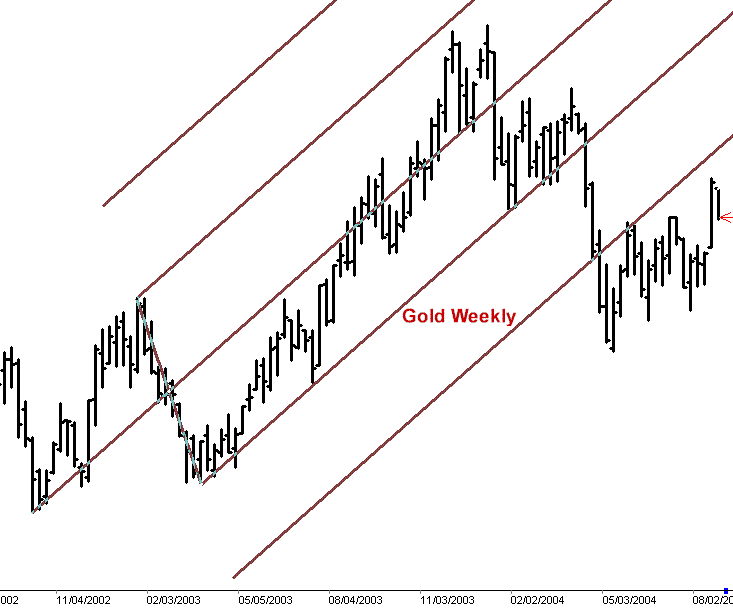
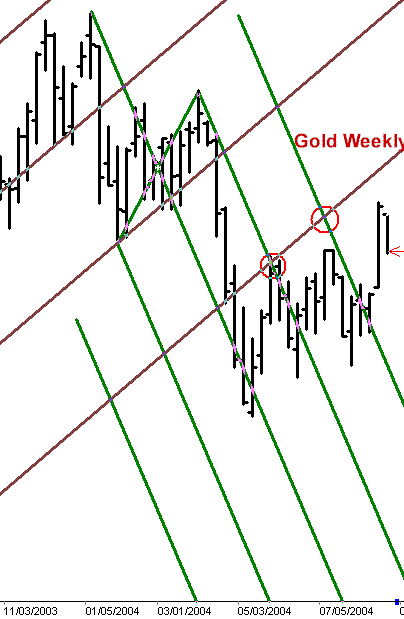
In the below chart the brown lines are the same as in the above chart, and the green lines are another pitchfork. Note how it's catching pivots to the bar.
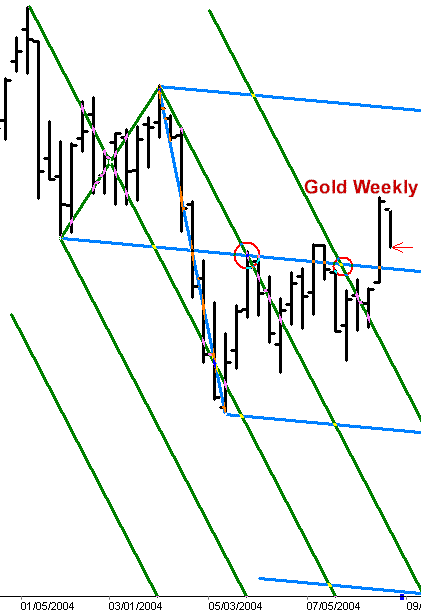
In the below chart, the green PF is the same as above, the blue PF is the next set of pivots. Again catching pivots to the bar.
In trading a market, it's good to know when we have timing signals on our weekly charts as the accuracy is very high and the resulting swings can be more profitable - we can fine-tune day-of-entry with daily chart analysis and the entry techniques found in the Trading Forecasts manual shipped with this course. By itself, Weekly chart Market Geometryis "best" for accuracy but not best for swing trading. It's because the time zone is too wide and the initial stop-loss too large for most traders,especially swing-traders. Also, since I make extensive use of "time clusters" (that's the Timing Matrix) the use of weekly charts alone really becomes impractical alone....unless you also deploy a shorter timeframe to help you fine-tune entry.
30-min Market Geometry is actually poor ifyou use one tool alone - poor in the sense of consistent winning percentage.However, the 30-min timeframe is often the best for finding Time Clusters and populating our Timing Matrix. The good news is that for short-term swing trading,daily charts combine the best of both - use of significant pivots and enough of them to create time-clusters. The best approach is to use multiple timeframes. While it's true that 30-min timeframe can help you fine-tune entry, as with any positive there's always a lurking negative - there'smore random noise in lower timeframes and its more difficult to determine what's a significant pivot, especially in choppy markets - and as we work hard to find trade-setups that may work against us in lower timeframes and cause us to get faked out by market noise and over-trade.

 扫码加好友,拉您进群
 全部版块
全部版块 我的主页
我的主页


 收藏
收藏