Yin, Yang and Chaos
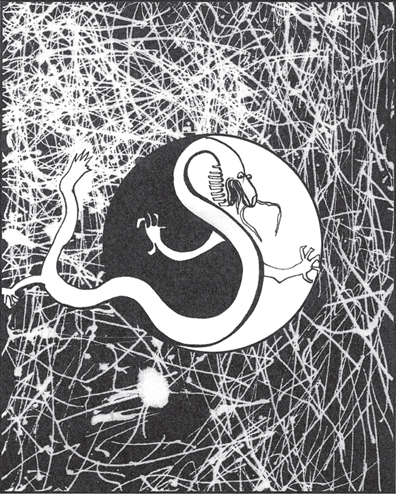
Ancient Chinese thought recognized that chaos and order are related. In Chinese myth, the dragon represents the principle of order, yang, which emerges from chaos. In some Chinese creation stories, a ray of pure light, yin, emerges out of chaos and builds the sky. Yin and yang, the female and male principles, act to create the universe. But even after they have emerged from chaos, yin and yang still retain the qualities of chaos. Too much of either brings back chaos.

Ancient Chaos
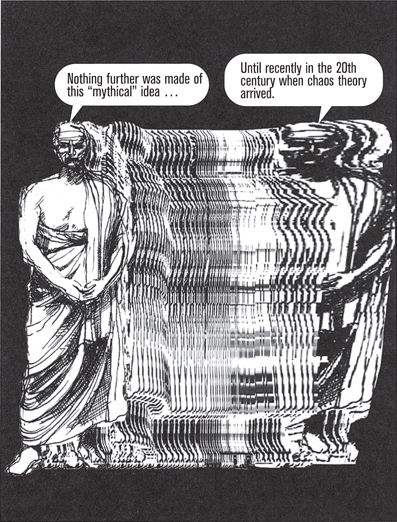
Hesiod, a Greek of the 8th century B.C.,wrote the Theogony, a cosmological poem which states that “first of all Chaos came to be”, and then the Earth and everything stable. The ancient Greeks seem to have accepted that chaos precedes order, in other words, that order comes from disorder.

Nothing further was made of this ‘mythical’ idea ...
Until recently in the 20th century when chaos theory arrived.
Chaos Theory
Chaos theory is a new and exciting field of scientific inquiry.
The phenomenon of chaos is an astounding and controversial discovery that most respectable scientists would have dismissed as fantasy just a decade or so ago.

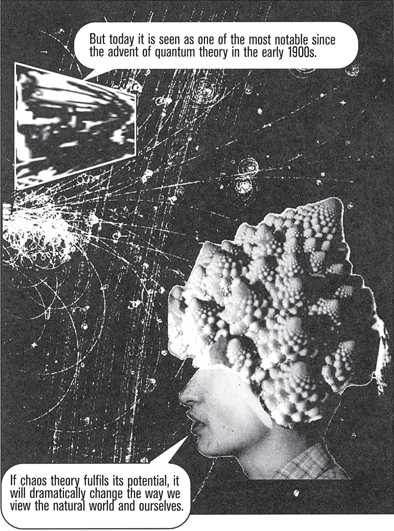
But today it is seen as one of the most notable since the advent of quantum theory in the early 1900s.
If chaos theory fulfils its potential, it will dramatically change the way we view the natural world and ourselves.
Why is Chaos Exciting?
Chaos is exciting for all these reasons ...
It connects our everyday experiences to the laws of nature by revealing the subtle relationships between simplicity and complexity and between orderliness and randomness.
It presents a universe that is at once deterministic and obeys the fundamental physical laws, but is capable of disorder, complexity and unpredictability.
It shows that predictability is a rare phenomenon operating only within the constraints that science has filtered out from the rich diversity of our complex world.
It opens up the possibility of simplifying complicated phenomena.
It combines imaginative mathematics with the awesome processing power of modern computers.
It casts doubt on the traditional model-building procedures of science.
It shows that there are inherent limits to our understanding and predicting the future at all levels of complexity.
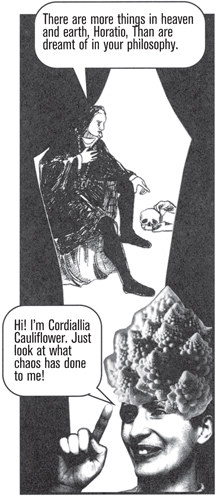
It is strikingly beautiful! Shakespeare had it right when he had Hamlet say in Act 1, scene 5 ...

There are more things in heaven and earth Horatio, Than are dreamt of in your philosophy.
Hi! I’m Cordiallia Cauliflower. Just look at what chaos has done to me!
Where Does Chaos Come From?
Three major recent developments have made chaos a household word.
1. Breathtaking computing power that enables researchers to perform hundreds of millions of complicated calculations in matters of seconds.
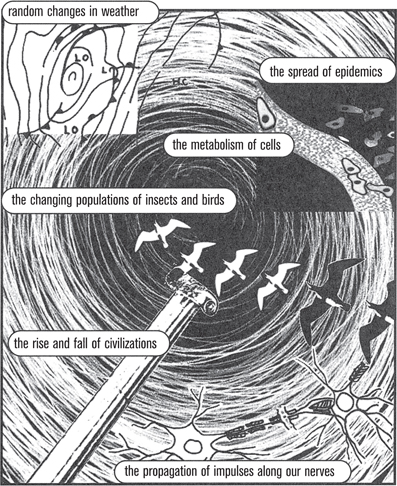
2. The rise in computing power has been accompanied by a growing scientific interest in irregular phenomena such as ...

random changes in weather
the spread of epidemics
the metabolism of cells
the changing populations of insects and birds
the rise and fall of civilizations
the propagation of impulses along our nerves
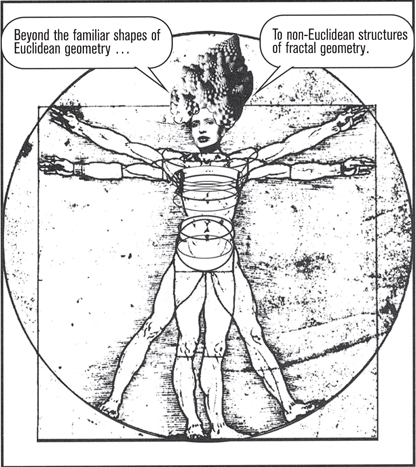
3. Chaos theory was born when these developments were combined with the emergence of a new style of geometrical mathematics ...

Beyond the familiar shapes of Euclidean geometry ...
To non-Euclidean structures of fractal geometry.
These developments have made an impact in almost every field of human endeavour. Chaos theory has been like a sea into which flow the rivers and tributaries of almost every discipline and subject –from mathematics, physics, astronomy, meteorology, biology, chemistry, medicineto economics and engineering, from the study of fluids and electrical circuits to the study of stock markets and civilizations.
Defining Chaos
Chaos has been variously defined. Here are just a few examples ...
“A kind of order without periodicity.”
“Apparently random recurrent behaviour in a simple deterministic (clock-work-like) system.”
“The qualitative study of unstable aperiodic behaviour in deterministic nonlinear dynamical systems.”
And here’s another by a mathematician in the field, Ian Stewart.

The ability of simple models without inbuilt random features, to generate highly irregular behaviour.
Technical definitions of chaos are not easy to understand. So let’s begin to familiarize ourselves with its terminology.




 扫码加好友,拉您进群
 全部版块
全部版块 我的主页
我的主页


 收藏
收藏