
经管之家App
让优质教育人人可得
立即打开



The Language of Chaos
Dynamic,Change and Variable
Chaos is a dynamic phenomenon. It occurswhen something changes. Basically, there are two types of changes.
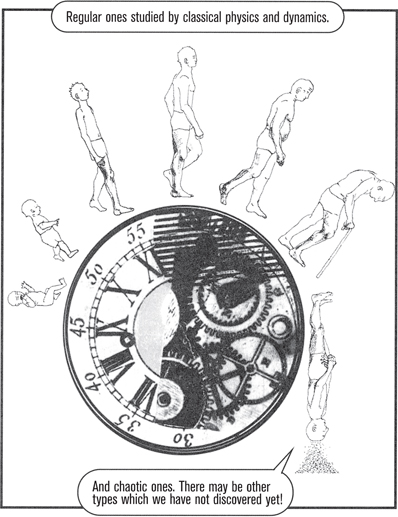
Regular ones studied by classical physicsand dynamics.
And chaotic ones. There may be other typeswhich we have not discovered yet!
What is changeable in a given situation isreferred to as a variable.
Systems
Any entity that changes with time is calleda system. Systems thus have variables. Here are some examples of systems.
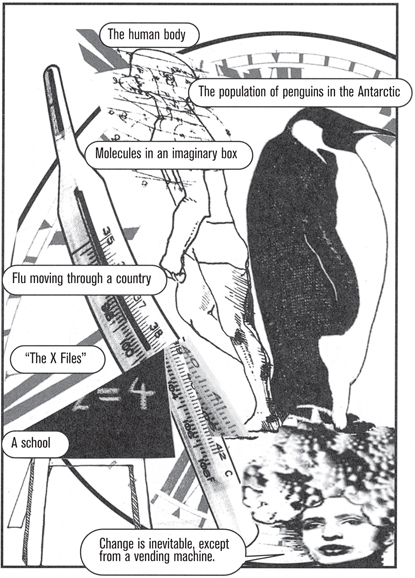
The human body
The population of penguins in the Antarctic
Molecules in an imaginary box
Flu moving through a country
‘The X Flies’
A school
Change is inevitable, except from a vending machine.
Defining Systems
A deterministic system is one that is predictable, stable and completely knowable. Theclassic example of a deterministic system is an old-fashioned grandfatherclock. The balls on a snooker table behave within the boundaries of adeterministic system.
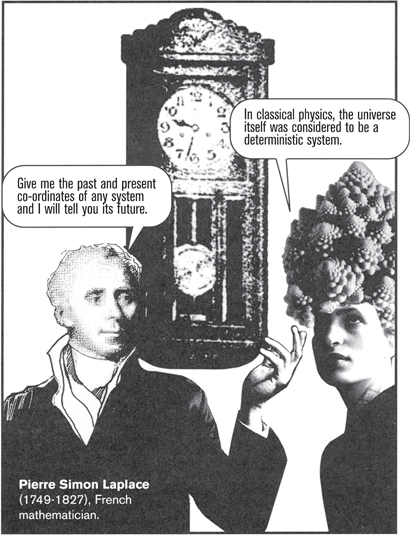
In classical physics, the universe itselfwas considered to be a deterministic system.
Give me the past and present co-ordinatesof any system and I will tell you its future.
In linear systems, variables are simply and directly related. Mathematically, alinear relationship can be expressed as a simple equation where the variablesinvolved appear only to the power of one:
X =2y + Z
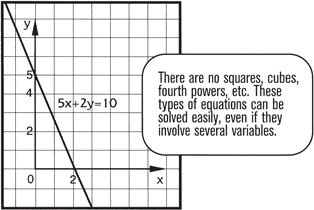
There are no squares, cubes, fourth powers,etc. These types of equations can be solved easily, even if they involveseveral variables.
Nonlinear relationships involve powers other than one. Here is a nonlinearequation:

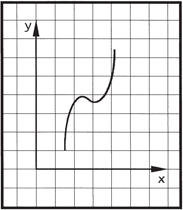
Such equations are much harder to analyzeand frequently need the help of a computer to understand.
Periodicand Aperiodic Equations
A period is an interval of time characterized by the occurrence of a certain condition or event. A variable in a periodic system exactly repeats its past behaviour after the passage of a fixed interval of time – think of a swinging pendulum.
Aperiodic behaviour occurs when no variable affecting the state of the systemundergoes a completely regular repetition of values – visualize the flow ofwater as it goes down a sink.
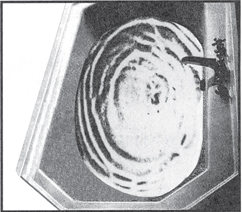
Unstable aperiodic behaviour is highly complex. It neverrepeats itself and continues to show the effects of any small perturbation tothe system. This makes exact predictions impossible and produces a series of measurements that appear random.
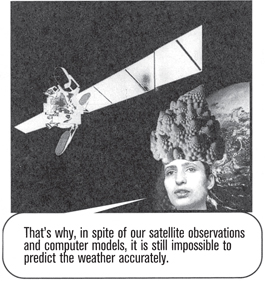
That’s why, in spite of our satellite observations and computer models, it is still impossible to predict the weather accurately.
Whatis Unstable Aperiodic Behaviour?
Behaviour that is unstable yet periodic is difficult to imagine – indeed, it appears to be a contradiction in terms.However, human history provides us with several examples of just such aphenomenon. It is possible to chart broad patterns in the rise and fall ofcivilizations. We can see that these patterns are periodic. But we know that events never actually repeat themselves exactly. In this realistic sense,history is aperiodic. We can also read in history textbooks that seemingly small unimportant events have led to long-lasting changes in the course of human affairs.
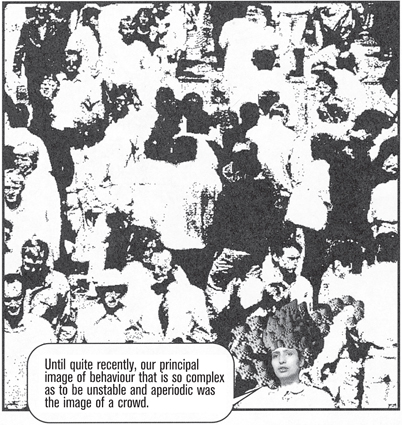
Until quite recently, our principal image of behaviour that is so complex as to be unstable and aperiodic was the image of a crowd.
Now that our perception has changed, we seesuch behaviour in even the commonest events: water dripping from a tap, a flagwaving in the breeze, the fluctuation of animal populations.
Linear Systems
So: simply put, chaos is the occurrence of aperiodic, apparently random events in a deterministic system. In chaos there is order, and in order there lies chaos. The two are more closely connected than we ever thought before.
But since deterministic systems are predictable and stable, this seems to be illogical. As a matter of habit,humans have looked for patterns and linear relations in what they see.
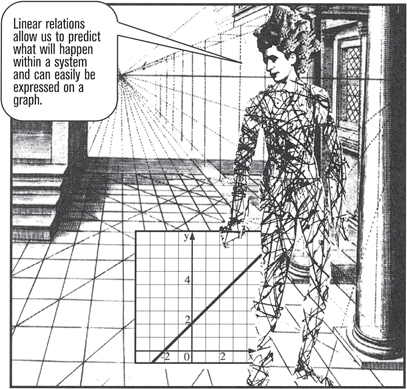
Linear relations allow us to predict what will happen within a system and can easily be expressed on a graph.
In other words, they form a straight line on the graph and we know where that line is going.
Linear relationships and equations are solvable. That makes them easy to think about and work with.
Nonlinear Complication
Nonlinear equations, on the other hand,can not be solved. Friction, for example, often makes things difficult by introducing nonlinearity. Without friction, the amount of energy required to accelerate an object is expressed in a linear equation ...
force= mass x acceleration
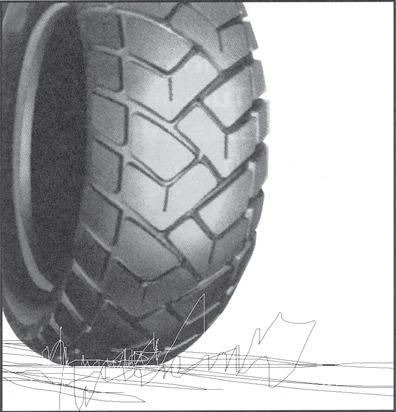
Friction complicates things because the amount of energy changes, depending on how fast the object is moving.
Nonlinearity, therefore, changes the deterministic rules within a system and makes it difficult to predict what is going to happen.
There is a famous example of a nonlinear relationship in the history of chaos. Robert May, a biologist, was studying an imaginary population of fish. The mathematical model he used for the fish population was the equation

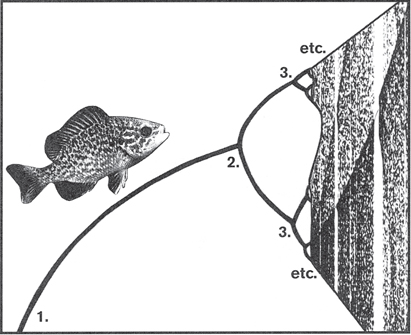
1. As the parameter rose, the final population rose slightly too, making a line that rose as it moved from left to right on the graph.
2. Suddenly, as the parameter passed 3, the line broke in two and May had to plot for two populations. This split meant that the population was going from a one-year cycle to a two-year cycle.
3. As the parameter rose further, the number of points doubled again and again. The behaviour was complex yet regular. Beyond a certain point, the graph became totally chaotic – and the graph was completely blacked in. Yet even in the midst of the chaos, stable cycles returned as the parameter was increased.
Most forces in real life are nonlinear. So why have we not discovered this before? The reason that chaotic behaviour has not been studied until now is because scientists reduced difficult nonlinear problems to simpler linear ones in order to analyze them. Galileo’s work with gravity provides us with a good example. Galileo (1564–1642), an Italian physicist, disregarded small nonlinearities in order to get neat results.
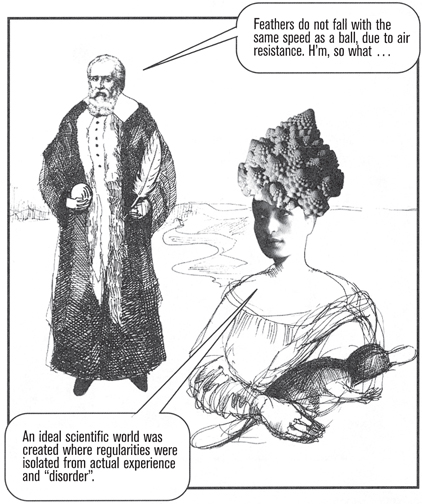
Feathers do not fall with the same speed as a ball, due to air resistance. H’m, so what ...
An ideal scientific world was created wherere gularities were isolated from actual experience and “disorder”.
Since the advent of “modern” Western science, we have been living in a world which acts as if the platypus was the only animal in existence!

 扫码加好友,拉您进群
 全部版块
全部版块 我的主页
我的主页


 收藏
收藏






