全部版块 我的主页
论坛 计量经济学与统计论坛 五区 计量经济学与统计软件 Stata专版
1472 1
2019-11-21
stata中merge命令介绍使用的示例数据:
. webuse overlap1, clear
. merge m:1 id using http://www.stata-press.com/data/r14/overlap2, update replace
. list

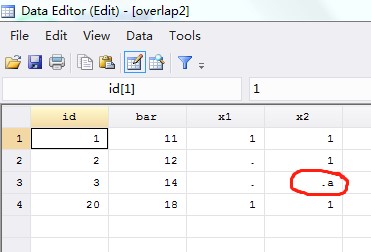
上述http://www.stata-press.com/data/r14/overlap数据打开后呈现如下:
数据求助.jpg
请问各位大佬们知道上图中的“.a”是啥意思不?数据详细情况如下:

--------------------------------------------------------------------------------------------------------------------------------------
              storage   display    value
variable name   type    format     label      variable label
--------------------------------------------------------------------------------------------------------------------------------------
id              float   %9.0g                 
bar             float   %9.0g                 
x1              float   %9.0g                 
x2              float   %9.0g                 
---------------------------------


二维码

扫码加我 拉你入群

请注明:姓名-公司-职位

以便审核进群资格,未注明则拒绝

全部回复
2019-11-21 22:30:45

Title

    [U] 12.2.1 Missing values


Description

    Stata has 27 numeric missing values:

        ., the default, which is called the "system missing value" or sysmiss

    and

        .a, .b, .c, ..., .z, which are called the "extended missing values".

    Numeric missing values are represented by large positive values.  The ordering is

                      all nonmissing numbers < . < .a < .b < ... < .z

    Thus, the expression age > 60 is true if variable age is greater than 60 or missing.

    To exclude missing values, ask whether the value is less than ".".  For instance,

        . list if age > 60 & age < .

    To specify missing values, ask whether the value is greater than or equal to ".".  For
    instance,

        . list if age >=.

    Stata has one string missing value, which is denoted by "" (blank).


Remarks

    More details concerning missing values and their treatment in Stata are provided under
    the following headings:

        Overview
        Expressions
        Operators
        Functions
        Matrices
        Useful commands
        Value labels
        Estimation commands
        Technical note:  checking if a value is missing


    Overview

    1.  Stata supports different types of numeric missing values that can be used to
        specify different reasons that a value is unknown.  The most frequently used
        missing value ., referred to as sysmiss, is nearly always generated by Stata when
        it cannot assign a specific value.  The 26 extended missing values .a, .b, ..., .z
        are available to users requiring more elaborate tracking of missing values.

        Empty strings are treated as missing values of type string.

    2.  Numeric missing values are represented by large positive values.  This means that
        an expression such as income > 100 evaluates to true for missing values of the
        variable income, as well as to those that are greater than 100.  Also, the simple
        expression if varname evaluates to true for all nonzero values of varname,
        including missing values.

    3.  The ordering of missing values is

                      all nonmissing numbers < . < .a < .b < ... < .z

    4.  Most Stata statistical commands deal with missing values by disregarding
        observations with one or more missing values (called "listwise deletion" or
        "complete cases only").

二维码

扫码加我 拉你入群

请注明:姓名-公司-职位

以便审核进群资格,未注明则拒绝

栏目导航
热门文章
推荐文章

说点什么

分享

扫码加好友,拉您进群
各岗位、行业、专业交流群