[size=1.1]For anyone reading this article, the benefits of electricity need not be explained.
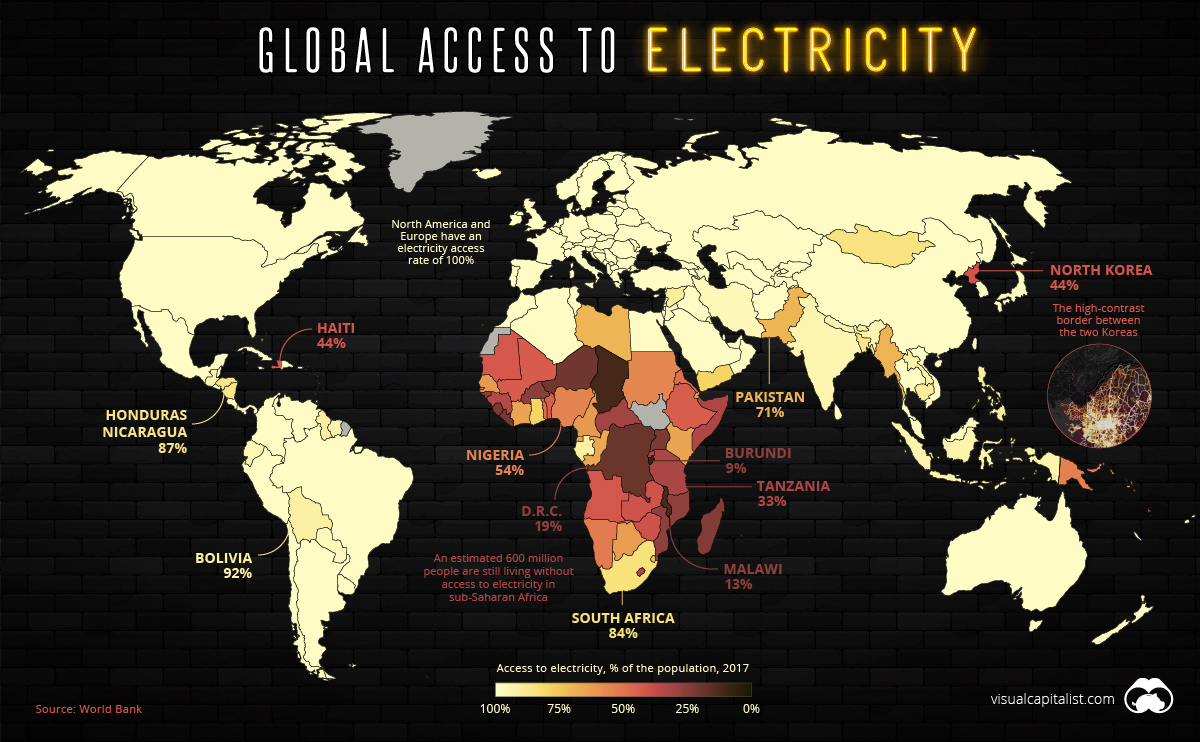
[size=1.1]Access to electricity is now an afterthought in most parts of the world, so it may come as a surprise to learn that 16% of the world’s population — an estimated 1.2 billion people — are still living without this basic necessity. Lack of access to electricity, or “energy poverty”, is the ultimate economic hindrance as it prevents people from participating in the modern economy.
[size=1.1]Where are people still living in the dark, and how are these energy challenges being addressed? Let’s dive in.
Where the Grid Reaches, and Beyond[size=1.1]At this point in time, a majority of countries have 100% electricity access rates, and many more have rates above 95%. This includes most of the world’s high-population countries, such as China, Brazil, and the United States.
[size=1.1]India is fast approaching that benchmark for access. The massive country has made great strides in a short amount of time, jumping from a 70% to 93% access rate in a single decade.
[size=1.1]Meanwhile, North Korea is an obvious outlier in East Asia. The Hermit Kingdom’s lack of electrification isn’t just conspicuous in the data — it’s even visible from space. The border between the two Koreas is clearly visible where the dark expanse of North Korea runs up against the glow of South Korea’s urban areas.
[size=1.1]It’s been estimated that more than half of North Korea’s people are living in energy poverty.
Africa’s Access to Electricity[size=1.1]In 1995, a mere 20% of sub-Saharan Africa’s population had access to power. While today’s figure is above 40%, that still means roughly 600 million people in the region are living without access to electricity.
[size=1.1]Not surprisingly, energy poverty disproportionately impacts rural Africans. Nearly all of the countries with the lowest levels of electricity access have rural-majority populations:
Global Rank
Country
Electricity Access
Rural Population
#197
 Burundi
9%
87%
#196
 Chad
Chad
11%
77%
#195
 Malawi
13%
83%
#194
 D.R.C.
19%
56%
#193
 Niger
Niger
20%
84%
#192
 Liberia
21%
49%
#191
 Uganda
22%
77%
#190
 Sierra Leone
23%
58%
#189
 Madagascar
24%
63%
#188
 Burkina Faso
25%
71%
[size=1.1]Nonexistent and unreliable electricity isn’t just an issue confined to rural Africa. Even Nigeria — Africa’s largest economy — has an electrification rate of just 54%.
[size=1.1]Where there is an electrical grid, instability is also causing problems. A recent survey found that a majority of Nigerian tech firms face 30 or more power outages per month, and more than half ranked electricity as a “major” or “severe” constraint to doing business.
[size=1.1]This is pattern that is repeated in a number of countries in Africa:
[size=1.1]
Mini-Grids, Big Impact[size=1.1]It has taken an average of 25 years for countries to move from 20% to 80% access, so history suggests that it may be a number of years before sub-Saharan Africa fully catches up with other parts of the world. That said, Vietnam was able to close that gap in only nine years.
[size=1.1]Traditional utility companies continue to make inroads in the region, but it might be a smaller-scale solution that brings electricity to people in harder-to-reach rural villages.
[size=1.1]Between 2009 and 2015, solar PV module prices fell by 80%, ushering in a new era of affordability. Solar powered mini-grids don’t just have the potential to bring electricity to new markets, it can also replace the diesel-powered generators commonly used in Africa.
[size=1.1]For the 600 million people in sub-Saharan Africa who are still unable to fully participate in the modern world, these innovations can’t come soon enough.




 扫码加好友,拉您进群
 全部版块
全部版块 我的主页
我的主页


 收藏
收藏