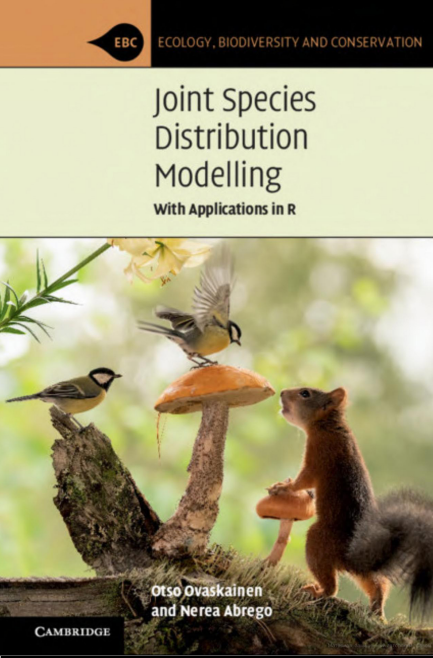
Joint Species Distribution Modelling With Applications in R
,欢迎下载学习
本资源来源于网络,仅供交流学习,不用于商业目的!如涉侵权,请联系删除!

CONTENTS
Part I Introduction to Community Ecology: Theory
and Methods 1
1 Historical Development of Community Ecology 3
1.1 What Is Community Ecology? 3
1.2 What Is an Ecological Community? 4
1.3 Early Community Ecology: A Descriptive Science 6
1.4 Emergence of the First Theories 9
1.5 Current Community Ecology: Search for the
Unifying Theory 11
2 Typical Data Collected by Community
Ecologists 19
2.1 Community Data 20
2.2 Environmental Data 23
2.3 Spatio-temporal Context 24
2.4 Trait Data 26
2.5 Phylogenetic Data 27
2.6 Some Remarks about How to Organise Data 28
3 Typical Statistical Methods Applied by Community
Ecologists 30
3.1 Ordination Methods 30
3.2 Co-occurrence Analysis 33
3.3 Analyses of Diversity Metrics 34
3.4 Species Distribution Modelling 35
4 An Overview of the Structure and Use of HMSC 39
4.1 HMSC Is a Multivariate Hierarchical Generalised
Linear Mixed Model 39
4.2 The Overall Structure of HMSC 41
4.3 Linking HMSC to Community Ecology Theory 45
4.4 The Overall Work flow for Applying HMSC 47
Part II Building a Joint Species Distribution Model Step
by Step 51
5 Single-Species Distribution Modelling 53
5.1 How Do Species Distribution Models Link
to Species Niches? 53
5.2 The Linear Model 55
5.3 Generalised Linear Models 58
5.4 Mixed Models 63
5.5 Partitioning Explained Variation among Groups of
Explanatory Variables 69
5.6 Simulated Case Studies with HMSC 70
5.7 Real Data Case Study with HMSC:
The Distribution of Corvus Monedula in Finland 92
6 Joint Species Distribution Modelling: Variation in
Species Niches 104
6.1 Stacked versus Joint Species Distribution Models 104
6.2 Modelling Variation in Species Niches in a
Community 107
6.3 Explaining Variation in Species Niches by Their
Traits 110
6.4 Explaining Variation in Species Niches by
Phylogenetic Relatedness 114
6.5 Explaining Variation in Species Niches by Both
Traits and Phylogeny 117
6.6 Simulated Case Studies with HMSC 120
6.7 Real Case Study with HMSC: How Do
Plant Traits In fluence Their Distribution? 133
7 Joint Species Distribution Modelling: Biotic
Interactions 142
7.1 Strategies for Estimating Biotic Interactions in
Species Distribution Models 143
7.2 Occurrence and Co-occurrence Probabilities 144
7.3 Using Latent Variables to Model Co-occurrence 147
7.4 Accounting for the Spatio-temporal Context
through Latent Variables 152
7.5 Covariate-Dependent Species Associations 156
7.6 A Cautionary Note about Interpreting Residual
Associations as Biotic Interactions 159
7.7 Using Residual Species Associations for Making
Improved Predictions 160
7.8 Simulated Case Studies with HMSC 165
7.9 Real Case Study with HMSC: Sequencing
Data on Dead Wood-Inhabiting Fungi 172
8 Bayesian Inference in HMSC 184
8.1 The Core HMSC Model 185
8.2 Basics of Bayesian Inference: Prior and Posterior
Distributions and Likelihood of Data 187
8.3 The Prior Distribution of Species Niches 188
8.4 The Prior Distribution of Species Associations 197
8.5 The Prior Distribution of Data Models 206
8.6 What HMSC Users Need and Do Not
Need to Know about Posterior Sampling 207
8.7 Sampling from the Prior with HMSC 210
8.8 How Long Does It Take to Fit an
HMSC Model? 215
9 Evaluating Model Fit and Selecting among
Multiple Models 217
9.1 Preselection of Candidate Models 218
9.2 The Many Ways of Measuring Model Fit 219
9.3 The Widely Applicable Information
Criterion (WAIC) 225
9.4 Variable Selection by a Spike and Slab Prior 228
9.5 Reduced Rank Regression (RRR) 242
Part III Applications and Perspectives 253
10 Linking HMSC Back to Community Assembly
Processes 255
10.1 Simulating an Agent-Based Model of a
Competitive Metacommunity 256
10.2 Statistical Analyses of the Spatial Data Collected
by a Virtual Ecologist 266
10.3 Statistical Analyses of the Time-Series Data
Collected by a Virtual Ecologist 288
10.4 What Did the Virtual Ecologists Learn from
Their Data? 297
11 Illustration of HMSC Analyses: Case Study of
Finnish Birds 300
11.1 Steps 1 –5 of the HMSC Workfl ow 300
11.2 Measuring the Level of Statistical Support and
Propagating Uncertainty into Predictions 316
11.3 Using HMSC for Conservation Prioritisation 321
11.4 Using HMSC for Bioregionalisation: Regions of
Common Pro file 324
11.5 Comparing HMSC to Other Statistical Methods
in Community Ecology 329
12 Conclusions and Future Directions 337
12.1 The Ten Key Strengths of HMSC 337
12.2 Future Development Needs 341
Epilogue 347
References 350
Index 369
The colour plates appear between pages 336 and 337
x · Contents
Preface
Species distribution modelling has become one of the most widely used
tools in ecology, conservation biology and wildlife management. While
methods for species distribution modelling are continually being
developed, it is fair to say that the field itself is well established. Tho




 扫码加好友,拉您进群
 全部版块
全部版块 我的主页
我的主页


 收藏
收藏