
经管之家App
让优质教育人人可得
立即打开



进行本实验前,需掌握以下技能:
[root@gs01 lib64]# sysbench --version
sysbench 1.0.17-71abd99
[root@gs01 lib64]#gsql -d postgres -p 8000 -r
create user sysbench with sysadmin password 'Huawei@1234';[Ruby@gs01 cm_agent]$ gsql -d postgres -p 8000 -U sysbench -W Huawei@1234 -h 192.168.3.60 -r
gsql ((GaussDB Kernel 505.2.1.SPC0800 build 85996fbb) compiled at 2025-07-03 01:15:58 commit 10558 last mr 24271 release)
SSL connection (cipher: ECDHE-RSA-AES128-GCM-SHA256, bits: 128)
Type "help" for help.
gaussdb=>
gaussdb=> \l
List of databases
Name | Owner | Encoding | Collate | Ctype | Access privileges
-----------+-------+-----------+---------+-------+-------------------
postgres | Ruby | SQL_ASCII | C | C |
template0 | Ruby | SQL_ASCII | C | C | =c/Ruby +
| | | | | Ruby=CTc/Ruby
template1 | Ruby | SQL_ASCII | C | C | =c/Ruby +
| | | | | Ruby=CTc/Ruby
templatea | Ruby | SQL_ASCII | C | C | =c/Ruby +
| | | | | Ruby=CTc/Ruby
templatem | Ruby | SQL_ASCII | C | C | =c/Ruby +
| | | | | Ruby=CTc/Ruby
(5 rows)[Ruby@gs01 cm_agent]$ gsql -d postgres -p 8000 -U sysbench -W Huawei@1234 -c "create database db_test;"
CREATE DATABASE
[Ruby@gs01 cm_agent]$[root@gs01 share]# sysbench oltp_read_write --tables=1 --table-size=5000000 --threads=8 --time=600 --db-driver=pgsql --pgsql-db=db_test --pgsql-user=sysbench --pgsql-password=Huawei@1234 --pgsql-host=192.168.3.60 --pgsql-port=8000 --report-interval=5 prepare
sysbench 1.0.17-71abd99 (using bundled LuaJIT 2.1.0-beta2)
Initializing worker threads...
FATAL: Connection to database failed: none of the server's SASL authentication mechanisms are supported
FATAL: `sysbench.cmdline.call_command' function failed: ./oltp_common.lua:88: connection creation failed
FATAL: Connection to database failed: none of the server's SASL authentication mechanisms are supported
FATAL: `sysbench.cmdline.call_command' function failed: ./oltp_common.lua:88: connection creation failed
FATAL: Connection to database failed: none of the server's SASL authentication mechanisms are supported
FATAL: `sysbench.cmdline.call_command' function failed: ./oltp_common.lua:88: connection creation failed
FATAL: Connection to database failed: none of the server's SASL authentication mechanisms are supported
FATAL: `sysbench.cmdline.call_command' function failed: ./oltp_common.lua:88: connection creation failed
FATAL: Connection to database failed: none of the server's SASL authentication mechanisms are supported
FATAL: `sysbench.cmdline.call_command' function failed: ./oltp_common.lua:88: connection creation failed
FATAL: Connection to database failed: none of the server's SASL authentication mechanisms are supported
FATAL: `sysbench.cmdline.call_command' function failed: ./oltp_common.lua:88: connection creation failed
FATAL: Connection to database failed: none of the server's SASL authentication mechanisms are supported
FATAL: `sysbench.cmdline.call_command' function failed: ./oltp_common.lua:88: connection creation failed
FATAL: Connection to database failed: none of the server's SASL authentication mechanisms are supported
FATAL: `sysbench.cmdline.call_command' function failed: ./oltp_common.lua:88: connection creation failed当数据初始化出现异常时,可采取如下措施:
[Ruby@gs01 cm_agent]$ gs_guc reload -Z datanode -N all -I all -c "password_encryption_type=0"
The gs_guc run with the following arguments: [gs_guc -Z datanode -N all -I all -c password_encryption_type=0 reload ].
Begin to perform the total nodes: 1.
Popen count is 1, Popen success count is 1, Popen failure count is 0.
Begin to perform gs_guc for datanodes.
Command count is 1, Command success count is 1, Command failure count is 0.

Total instances: 1. Failed instances: 0.
ALL: Success to perform gs_guc!

[Ruby@gs01 cm_agent]$ gs_guc reload -Z datanode -N all -I all -h "host all all 0.0.0.0/0 md5"
The gs_guc run with the following arguments: [gs_guc -Z datanode -N all -I all -h host all all 0.0.0.0/0 md5 reload ].
Begin to perform the total nodes: 1.
Popen count is 1, Popen success count is 1, Popen failure count is 0.
Begin to perform gs_guc for datanodes.
Command count is 1, Command success count is 1, Command failure count is 0.

Total instances: 1. Failed instances: 0.
ALL: Success to perform gs_guc!
gsql -d postgres -p 8000 -r
drop database db_test;
drop user sysbench;
create database db_test;
create user sysbench with sysadmin password 'Huawei@1234';[root@gs01 share]# sysbench oltp_read_write --tables=1 --table-size=5000000 --threads=8 --time=600 --db-driver=pgsql --pgsql-db=db_test --pgsql-user=sysbench --pgsql-password=Huawei@1234 --pgsql-host=192.168.3.60 --pgsql-port=8000 --report-interval=5 prepare
sysbench 1.0.17-71abd99 (using bundled LuaJIT 2.1.0-beta2)
Initializing worker threads...
Creating table 'sbtest1'...
Inserting 5000000 records into 'sbtest1'
Creating a secondary index on 'sbtest1'...
[root@gs01 share]#gaussdb=# show synchronous_commit;
synchronous_commit
--------------------
off
(1 row)[Ruby@gs01 cm_agent]$ gs_guc reload -Z datanode -N all -I all -c "synchronous_commit=local"
The gs_guc run with the following arguments: [gs_guc -Z datanode -N all -I all -c synchronous_commit=local reload ].
Begin to perform the total nodes: 1.
Popen count is 1, Popen success count is 1, Popen failure count is 0.
Begin to perform gs_guc for datanodes.
Command count is 1, Command success count is 1, Command failure count is 0.
Total instances: 1. Failed instances: 0.
ALL: Success to perform gs_guc!sysbench oltp_read_write --tables=1 --table-size=500000000 --threads=8 --time=600 --db-driver=pgsql --pgsql-db=db_test --pgsql-user=sysbench --pgsql-password=Huawei@1234 --pgsql-host=192.168.3.60 --pgsql-port=8000 --report-interval=5 run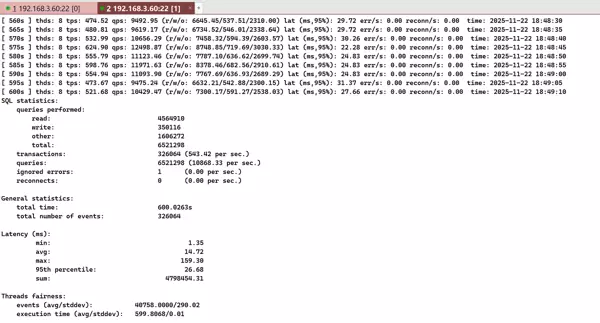
sysbench oltp_read_write --tables=1 --table-size=5000000 --threads=8 --time=600 --db-driver=pgsql --pgsql-db=db_test --pgsql-user=sysbench --pgsql-password=Huawei@1234 --pgsql-host=192.168.3.60 --pgsql-port=8000 --report-interval=5 --percentile=99 run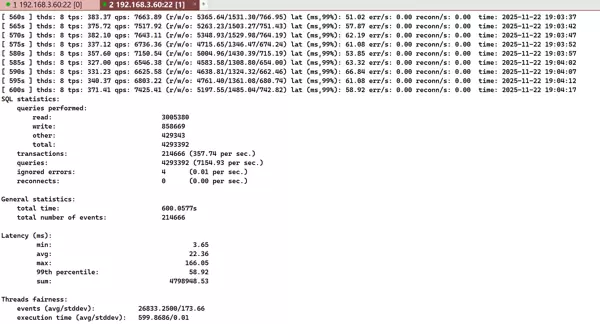
touch /data/cluster/master/datanode1/test_in
touch /data/cluster/master/datanode1/test_out
dd if=/dev/zero of="/data/cluster/master/datanode1/test_in" bs=3G count=10 iflag=fullblock
while true;
do
dd if="/data/cluster/master/datanode1/test_in" of="/data/cluster/master/datanode1/test_out" bs=3G count=10 iflag=fullblock
done;sysbench oltp_read_write --tables=1 --table-size=5000000 --threads=8 --time=600 --db-driver=pgsql --pgsql-db=db_test --pgsql-user=sysbench --pgsql-password=Huawei@1234 --pgsql-host=192.168.3.60 --pgsql-port=8000 --report-interval=5 --percentile=99 run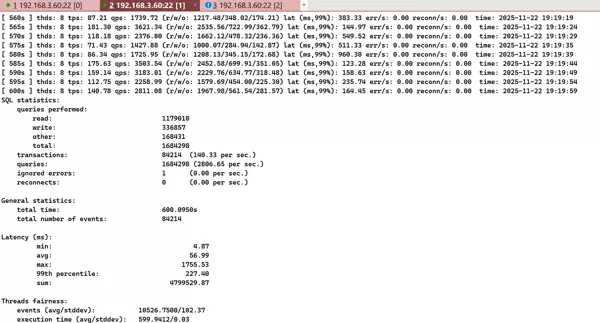
实验结果表明:在无额外IO压力的环境下,系统TPS达到357,QPS为7154;而在磁盘IO压力显著增加的情况下,TPS下降至140,QPS降至2806。由此可见,磁盘IO性能对数据库整体吞吐能力具有显著影响。

 扫码加好友,拉您进群
 全部版块
全部版块 我的主页
我的主页


 收藏
收藏






