在看决策类书籍时看到下面两段文字,没搞明白其中的数理知识,如对于标准正态分布,当取样样本为1时,样本期望为0,这很好理解;然而当取样样本为2时,为什么期望不为0?求大神指导!如嫌打字麻烦,私信我您的电话号码,我打给您!
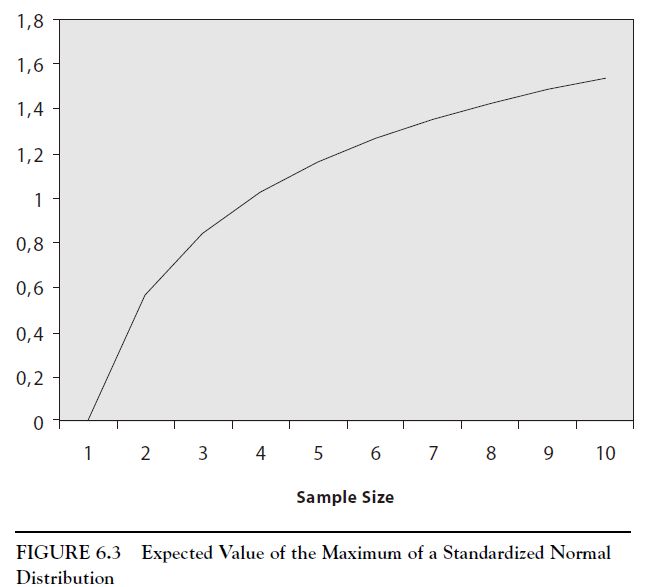
While this finding can seem intriguing, it is not so surprising when looking at statistics of extreme values. If you take a random sample from a normal distribution, the expected value of the maximum will grow with the sample size. Once your sample size is large enough, however, the expected value of the maximum won’t grow significantly with larger samples. If you consider a standardized normal distribution (which has a mean of 0 and a standard deviation equal to 1), and you take a sample of size 1, by definition the expected value will be 0. With increased sample sizes, one can calculate the expected value of the maximum of the sample. If we were to take a very large sample, the maximum would quite likely be a number of 2 or slightly higher (a number of 2 by definition would be 2 standard deviations above the mean, which in a normal distribution would happen with low probability).
Figure 6.3 shows the expected value of the maximum of such distribution according to the sample size. As you can see from this figure, a sample of size 10 would already produce an expected value close to 1.6, not that far away from a practical maximum of 2. This gives you a hint about why “trying a dozen” can work even when you are sampling candidates from a very large population.






 扫码加好友,拉您进群
 全部版块
全部版块 我的主页
我的主页


 收藏
收藏