source from: wsj website
MARKETS WSJ PRO
China Watchers Hunt for New Clues on the Economy
When a widely tracked gauge of China’s manufacturing activity stopped publishing, new readings started to get more attention
Competing gauges of China’s manufacturing data have been gaining traction since Markit stopped releasing one of its economic indicators in September. Here, a steel factory in Tangshan in China's Hebei Province.
 By DOMINIQUE FONG
Nov. 19, 2015 1:28 a.m. ET
China watchers are combing new clues for an early picture of the country’s slowing economy.
By DOMINIQUE FONG
Nov. 19, 2015 1:28 a.m. ET
China watchers are combing new clues for an early picture of the country’s slowing economy.
Analysts and economists once relied on a widely tracked first look at Chinese manufacturing activity, which helps account for more than 40% of China’s gross domestic product. The Caixin flash China manufacturing purchasing managers index gave observers a quick reading on the overall economy roughly two weeks before its final gauge and official figures at the start of each month.
In September, London-based financial-data provider Markit, which compiles the data Caixin Media Co. sponsors, said it would stop releasing the flash reading, though the final reading will continue. Faced with a new hole of information, observers are now searching for other timely thermometers of China’s economy as the government further opens up its capital markets to the world.
“We have been struggling to find appropriate leading indicators,” said Chen Xingdong, chief China economist for BNP Paribas. “We need more credible findings.”
Markit’s decision has whittled down the list of relatively reliable readings on China’s economy, as many investors and economists have long been skeptical about official statistics. China’s better-than-expected growth in the third quarter raised some eyebrows, for example, given the gap between the headline figure and the underlying data like exports and industrial production.
In June, HSBC Holdings PLC ended its five-year sponsorship of Markit’s indexes without providing an explanation. Caixin took over as the new sponsor that month. Spokeswomen from HSBC and Markit declined to comment. Caixin wasn’t immediately available.
For years, Markit’s flash readings were closely watched and would often affect trading both in the region and globally.

“The PMIs have a reasonably good reputation,” said Helen Qiao, greater China chief economist at Bank of America Merrill Lynch. “It actually has been showing the early signs of deterioration very consistently and stably, so the markets started to pick it up and like it more and more.”
In absence of the flash reading, other economic gauges have gained attention.
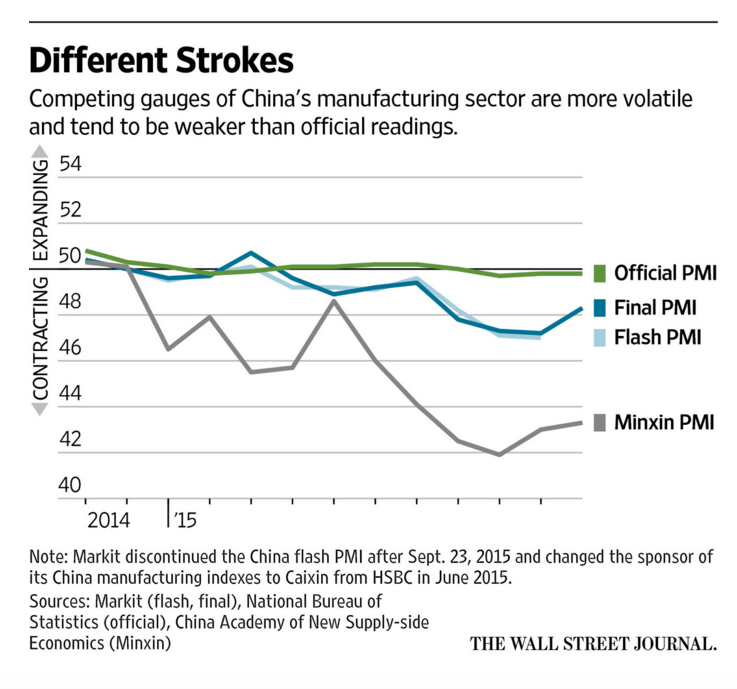
One little-known research group in Beijing has been compiling its own purchasing managers index, the Minxin PMI, over the past year. The China Academy of New Supply-side Economics, a think tank funded by China Minsheng Banking Corp., surveys roughly 4,000 companies across mainland China, compared with the 420 or so in coastal areas tracked by Markit.
About 70% of participants are from small and medium-size enterprises, said Peng Peng, a researcher at the academy who updates the index every month.
“It does look like it could be a leading indicator,” said Hank Terrebrood, managing director of sales at Hong Kong-based brokerage MCM Partners. Like Markit, the index’s weighting toward smaller companies, rather than state-owned enterprises, makes it more reflective of market volatility than official readings, he added. China’s official reading focuses on SOEs, which have been the biggest beneficiaries of measures to boost the stock market and economy.
So far, the Minxin readings of the manufacturing industry, released on the 21st of every month, have been weaker, and some say more volatile, than those of Markit or official data. In September, the Minxin PMI dropped to 43. That compares with Markit’s 47.2 final reading and the official figure of 49.8. A reading below the 50-level indicates contraction in activity, while a reading above that indicates expansion.
Some say a better gauge of China’s economy might focus on Chinese consumption rather than manufacturing or industrial production, as China tries to shift its economic growth drivers. China’s services industry makes up nearly half of GDP.
“A lot of indicators are skewed toward the manufacturing sector and mining industry,” Bank of America Merrill Lynch’s Ms. Qiao said. “They might overstate the magnitude of the slowdown.”
Bank of America Merrill Lynch recently began compiling its own reading of China’s economy by factoring in more services-industry data, such as financial services, passenger turnover and auto sales. So far, the firm’s Aggregate Coincident Tracker data, published since April, show that China’s economic growth is decelerating, but not plummeting, Ms. Qiao said.
Write to Dominique Fong at
Dominique.Fong@wsj.com




 扫码加好友,拉您进群
 全部版块
全部版块 我的主页
我的主页


 收藏
收藏