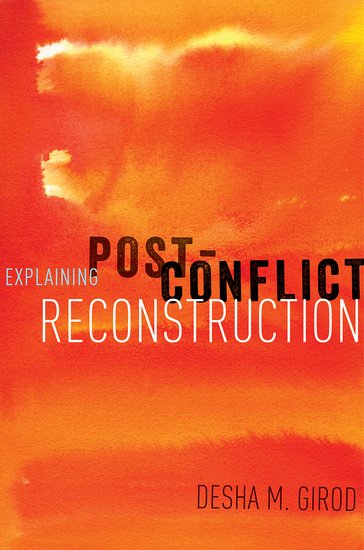
Explaining Post-Conflict Reconstruction
Desha Girod

The international community has donated nearly one trillion dollars during the last four decades to reconstruct post-conflict countries and prevent the outbreak of more civil war. Yet reconstruction has eluded many of these countries, and 1.9 million people have been killed in reignited conflict. Where did the money go?
This book documents how some leaders do bring about remarkable reconstruction of their countries using foreign aid, but many other post-conflict leaders fail to do so. Offering a global argument that is the first of its kind, Desha Girod explains that post-conflict leaders are more likely to invest aid in reconstruction when they are desperate for income and thus depend on aid that comes with reconstruction strings attached. Leaders are desperate for income when they lack access to rents from natural resources or to aid from donors with strategic interests in the country. Using data on civil wars that ended between 1970 and 2009 and evidence both from countries that succeeded and from countries that failed at post-conflict reconstruction, Girod carefully examines the argument from different perspectives and finds support for it. The findings are important for theory and policy because they explain why only some leaders have the political will to meet donor goals in the wake of civil war. The findings also shed light on state-building processes and on the political economy of postconflict countries. Paradoxically, donors are most likely to achieve reconstruction goals in countries where they have the least at stake.
Table of Contents
• List of Illustrations
• Acknowledgements
• Abbreviations
• Prologue
• Phoenix States After Civil War: The Problem and the Argument
• Reconstruction Against All Odds
• Statistical Analysis of Post-Conflict Reconstruction
• Statistical Analysis of Post-Conflict Coup Risk
• Similar Background, Different Windfall: Mozambique and Angola
• Same Country, Change in Windfall: Uganda
• Improving Aid Effectiveness After Civil War
• Bibliography
 如果你喜欢我分享的书籍,请关注我:
https://bbs.pinggu.org/z_guanzhu.php?action=add&fuid=5975757
 订阅我的文库:
【金融 + 经济 + 商学 + 国际政治】
https://bbs.pinggu.org/forum.php?mod=collection&action=view&ctid=3257
【数学 + 统计 + 计算机编程】
https://bbs.pinggu.org/forum.php?mod=collection&action=view&ctid=3258
【历史 + 心理学 + 社会自然科学】
https://bbs.pinggu.org/forum.php?mod=collection&action=view&ctid=3259





 扫码加好友,拉您进群
 全部版块
全部版块 我的主页
我的主页


 收藏
收藏