TECH
Cheaper Rivals Eat Away at Apple Sales in China
Upstarts like Oppo challenge the tech giant in the world’s largest smartphone market

By EVA DOU
Updated Feb. 1, 2017 12:01 a.m. ET
5 COMMENTS
JINAN, China—The walls of the train station in this eastern metropolis are papered with reminders of Apple Inc.’s challenge in China.
The terminal is blanketed with giant green Oppo Electronics Corp. ads showing a young starlet clutching a sleek Chinese phone. Ads like these have swept across much of the country in the past year—they are visible in bus terminals, subways and shopping malls as well—helping make the homegrown Oppo brand a huge hit.
On Tuesday, Apple said its fiscal first-quarter sales rose in every region except for China, Hong Kong and Taiwan. On a call with investors, Chief Executive Tim Cook said there were challenges. It was the fourth consecutive quarter in which Greater China was Apple’s worst-performing region.

Apple said its Greater China sales fell 12% to $16.2 billion for the quarter ended Dec. 31, compared with 14% growth a year earlier.
Its performance in the region dragged Apple’s global sales growth to 3%, despite 9% growth in the Americas. Mr. Cook said that without a currency impact, the drop in mainland China would have been 6%.
China’s smartphone boom helped drive Apple’s growth for several years, but now Chinese companies such as Oppo and Huawei Technologies Co. are offering handsets that are cheaper and nearly as sophisticated as iPhones.
China’s smartphone market, the world’s largest, is brutally competitive and fickle: When Hugo Barra left Xiaomi Corp. last month to return to Silicon Valley, the company he touted a couple of years ago as China’s next big thing had fallen from first to fourth in the sales rankings.
Apple’s sales in the region were also hampered by the limited visual difference between iPhone 6S and iPhone 7, Counterpoint Research analyst James Yan said. With lower average disposable income than western shoppers, Chinese consumers are less eager to splurge on an expensive new phone that could be mistaken for an older one.
“Chinese consumers now have many other options,” Mr. Yan said.
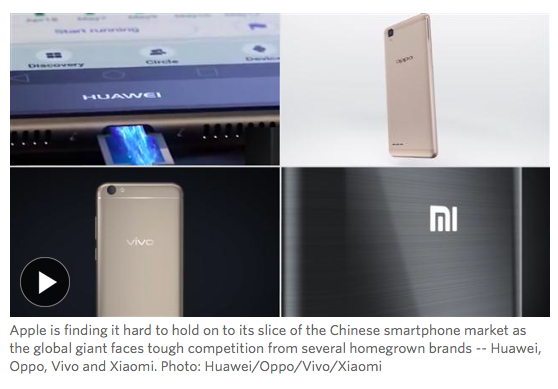
At least four homegrown companies are selling more handsets than Apple in China: Oppo, Vivo, Huawei and Xiaomi.
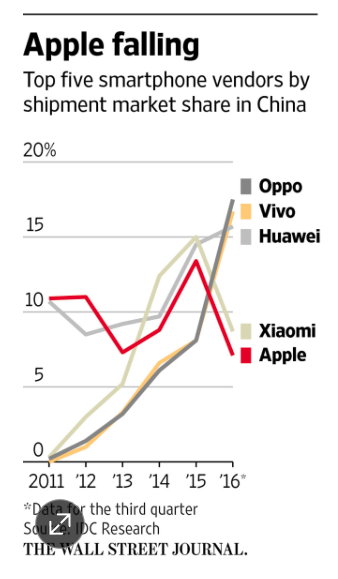
Oppo and sister brand Vivo have climbed to the top of China’s smartphone market by copying a page from Samsung Electronics Co.’s playbook, blanketing target markets with soft-lit ads featuring popular celebrities. Oppo’s market share in the third quarter was 17.5% and Vivo’s was 16.7%, according to market research firm IDC.
Zhang Dong, a 34-year-old Jinan resident, said he bought a Vivo phone last year because it was a good deal.
“Apple phones are too expensive,” he said. “If I don’t buy Vivo, I’ll probably buy Huawei.”
Mr. Zhang is the kind of customer that Apple is seeking: Residents of China’s second-tier cities who are currently using domestic brands. Half of Apple’s iPhone sales in China consist of first-time buyers or “switchers” who previously used other brands, Mr. Cook said Tuesday.
Huawei reached double-digit market share globally for the first time, accounting for one in 10 smartphones sold in the world-wide in the fourth quarter, according to Strategy Analytics.
It is a sign of how competitive China’s smartphone market is that the company once heralded as China’s Apple now ranks fourth. Xiaomi remains a solid contender, though it has been outshone lately by rivals. Just three years ago, it was the country’s leading smartphone vendor with a valuation of $46 billion, making it the world’s most valuable startup at the time.
Xiaomi shook up China’s smartphone market when it started selling handsets that could compete with iPhones for less than half the cost; the company also used online “fan clubs” to promote purchases. Although it became a niche favorite this way, more traditional companies like Oppo found favor with mainstream consumers by building out vast networks of brick-and-mortar stores where customers could try phones before buying them. Xiaomi now ranks fourth in China’s smartphone market.
“The online channel is reaching its glass ceiling,” said Canalys analyst Nicole Peng. She said Xiaomi needs to focus this year on developing its Chinese sales channels instead of expanding internationally. Last year, Xiaomi said it was putting more effort into traditional retail channels.
China remains an important market for Apple, as it contributes 20.7% of its revenue and is the location for the bulk its manufacturing facilities.

Despite its market-share decline in China, analysts say Apple still captures the lion’s share of profits for the sector in the country and globally. World-wide, Apple earned 91% of smartphone operating profits in the third quarter, versus 2.4% for Huawei and 2.2% each for Oppo and Vivo, according to Strategy Analytics.
Eight is a lucky number in China, and analysts say the company may fare better in China with its follow-up to the iPhone 7, which is expected to come with major improvements for the 10th anniversary of the product line.
Some Chinese consumers and investors were also cautiously optimistic about Apple.
“There weren’t many changes in the iPhone 7,” said a 31-year-old man surnamed Li as he watched a video on his iPhone 6 Plus in Jinan’s central Spring City Square on Tuesday. “But I may get the next one.”
“We remain cautiously optimistic on China for the iPhone 8 cycle, as our recent survey still shows the brand is aspirational (and 8 is a lucky number),” wrote UBS in a research note on Jan. 24.
—Tripp Mickle in San Francisco and Wayne Ma in Beijing contributed to this article.




 扫码加好友,拉您进群
 全部版块
全部版块 我的主页
我的主页


 收藏
收藏