source from:wsj
MARKETS HEARD ON THE STREET
China’s Newly Fortified Great Currency Wall Working for Now

By NATHANIEL TAPLIN
Updated Feb. 7, 2017 4:42 a.m. ET
0 COMMENTS
The home page of China’s foreign-exchange regulator features a large, idyllic picture of the Great Wall against a blue sky dotted with clouds. The wall is looking very well maintained.
Data released Tuesday show foreign-exchange reserves dipping just below the symbolic number of $3 trillion. But breaching $3 trillion obscures the fact that the $12 billion fall was the smallest since July. Part of that likely reflects valuation changes—the falling greenback in January boosted the value of China’s other foreign-exchange reserves. But there are increasing signs that tougher capital controls are having an impact too.
Market purists will disapprove, but Beijing’s recently strengthened restrictions on moving money out of yuan, paired with a tighter monetary stance, could help China deliver on a key objective: slow the burning of its foreign-exchange reserves. The outcome may be a mollified Donald Trump as yuan depreciation slows against the dollar, at least temporarily.
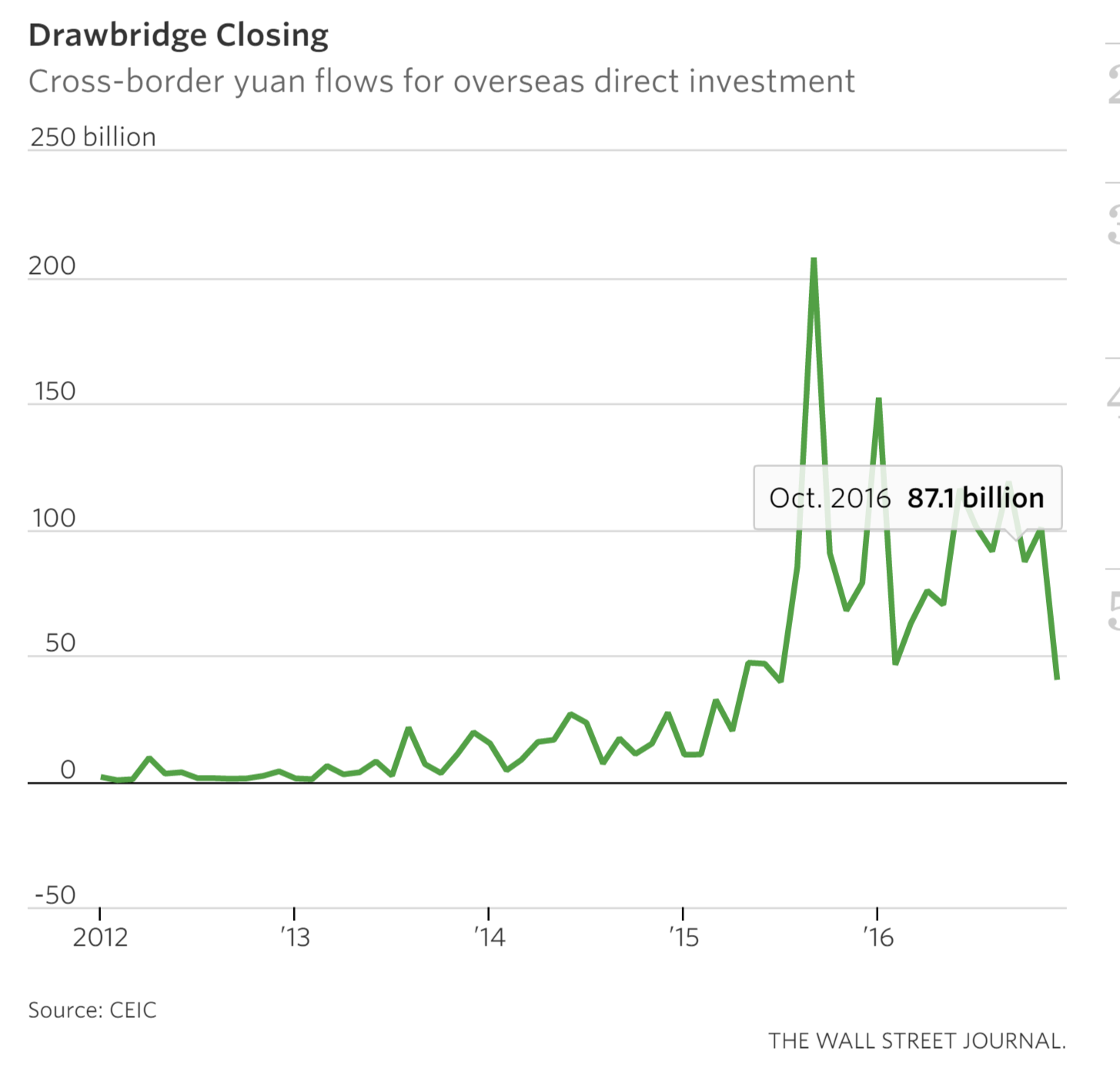
Drawbridge Closing
Cross-border yuan flows for overseas direct investment

In particular, yuan-denominated outflows and outward bound foreign direct investment (FDI)—two main targets of recent crackdowns—both dropped sharply in fourth-quarter 2016. Outbound FDI fell from an estimated $22 billion in November to less than half that in December, the opposite of the usual seasonal pattern, notes Julian Evans-Pritchard of Capital Economics.
For the first time since outflow pressures intensified in mid-2015, monetary policy is also showing a clear tightening bias, which should boost bond yields and the attractiveness of yuan assets. China’s central bank skipped regular daily money-market cash injections for the second day in a row Tuesday, following a series of increases to short-term rates over the past two weeks. Offshore non-deliverable yuan forwards, which foreign investors use to speculate on the yuan, have also begun pricing in a slower depreciation—current prices imply a 3% downside against the dollar one year ahead, against 5% in early January.
For Chinese policy makers nervously listening to bellicose rhetoric reverberating through the shipping lanes from across the Pacific, a more level yuan—for now—makes good political sense.
Nonetheless the wild card remains the Federal Reserve. Higher U.S. rates, whether in March or June or later, will reignite pressure on the yuan. Even for China, it’s not easy to fight the Fed.




 扫码加好友,拉您进群
 全部版块
全部版块 我的主页
我的主页


 收藏
收藏