Asia supply chain gears up for next-generation smartphones
High expectations for game-changing gadgets spark share price rallies

12 HOURS AGO by: Louise Lucas in Hong Kong
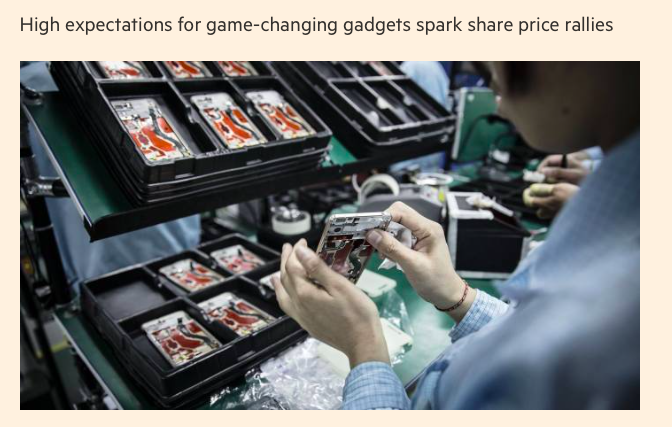
Green lights are flashing across Asia’s supply chain as factories and investors gear up for what is expected to be a pair of game-changing new phones from Apple and Samsung Electronics.
Makers of everything from glass to acoustics to pick-and-place tools — industrial tweezers capable of placing the tiniest of parts on motherboards — are joining the frenzy.
“Last year there was a great big hole for the China manufacturers to come through,” says Steven Pelayo, analyst at HSBC, referring to falling iPhone sales and the recall of Samsung’s exploding Galaxy Note 7s. “But Samsung and Apple are going to be formidable this year.”
That is expected to come with a formidable price tag — the 10th anniversary iPhone could cost as much as $1,000 — and mark Apple’s switch to organic light-emitting diode (OLED) panels, designed to enhance colour and resolution and allow the display to curve over the side of the phone.
Hints from Tim Cook, Apple’s chief executive, have also prompted some expectations of an augmented reality component. The stage is set for “a robust augmented reality feature set that we believe will be key differentiator for the 10-year anniversary iPhone”, wrote Goldman Sachs analysts in a report last month.
However, while high expectations have sparked share price rallies and cheer among gadget geeks, there are also rising concerns of constraints in the supply chain as it cranks up ahead of the new phones’ launch in September.
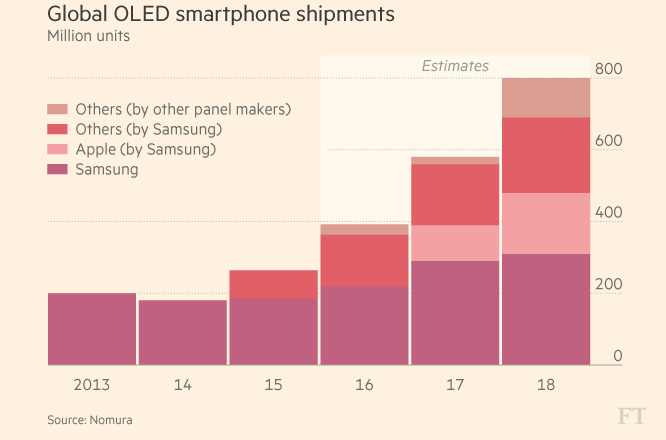
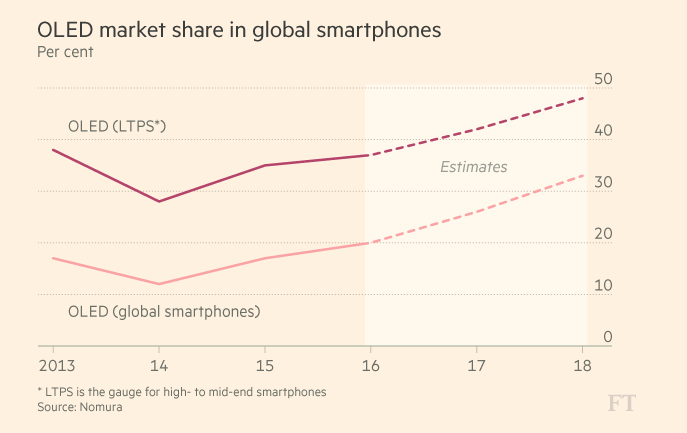
The tightest spot is OLED screens, which Apple is likely to bring to at least one of three expected new iPhone models — and which are already in around one-third of all smartphones sold last year, according to IHS Markit the consultancy.
It is the display used in the majority of Samsung’s smartphones and tablets, thanks to advantages including superior visibility; better energy efficiency; faster response for video, gaming and virtual reality; and less breadth and weight, which allows for more space for a battery within the device.
Samsung’s early adoption was aided by ready supply: its affiliate Samsung Display boasted a market share of 96 per cent in small and medium-sized OLED panels in the third quarter of 2016, according to IHS Markit.

For Apple, disputes over patents with Samsung have added to its determination to diversify its supplier base away from the South Korean group and, says IHS Markit analyst Wayne Lam, “the supply chain has been responding”.
Even Japan Display, which for a long time flew the flag for liquid crystal display technology, has been forced to change its tune. In the final weeks of 2016 the screen maker secured a $640m injection from a government-backed fund to push into OLED.
“To respond to [clients’] needs, we will accelerate development of OLED screens,” said Mitsuru Homma, the company’s chief executive, at the time.
Another dark horse is Chinese screen maker BOE Technology, which is aggressively expanding capacity along with local peers Tianma, Visionox and Truly, according to Jefferies analyst Rex Wu.
However, analysts say Chinese companies are unlikely to grab a substantial share quickly. “OLED requires much more expertise and has a longer learning curve,” notes Mr Wu.
It also requires heavy investment. BOE Technology is pouring $145m into one OLED project and reportedly spending billions more on new plants, but will be unable to scale up much before the end of the year. Besides, as Mr Pelayo adds: “Samsung has cornered the market for equipment and tools for OLED.”
That could worsen bottlenecks in a supply chain that is already under strain. “Because the next-generation phones are changing so much there are risks of component shortages or yield hiccups,” adds Mr Pelayo. Other analysts counter that scarcity value would only add to the newest iPhone’s appeal.
For Apple’s biggest suppliers, the new handsets offer an opportunity to piggyback on higher price tags. Taiwan’s Hon Hai Precision Industry, better known as Foxconn, has more than $100 of components in an iPhone, or 45 per cent of the total bill of materials costs, according to Nomura.

The blended average selling price for parts could rise by more than 20 per cent year on year in the second half, Nomura analystAnne Lee forecasts, thanks to Foxconn’s dominant role in the high-end OLED phone. Thus even though its per-unit market share will drop from 67 per cent last year to 64 per cent in 2017, Ms Lee estimates the Taiwanese company’s iPhone revenue could still grow by 17 per cent this year.
Other innovations under way for top-selling smartphones include under-glass fingerprints — making the home button redundant — and greater use of artificial intelligence, largely in voice recognition.
Not all of this is falling to suppliers. Huawei, the world’s third best-selling smartphone maker, is working to bring more component production in-house as it scrambles to catch up on voice recognition.
The Chinese company has a team in Shenzhen aiming to develop its own Chinese language version of Apple’s Siri; its Mate 9 phone, launched in Berlin last September, features Amazon’s Alexa.
At the more basic end of the spectrum, shares in Hong Kong-listed ASM Pacific are up by nearly 30 per cent since the start of the year. Apple is expected to change its circuit board, boosting demand for ASM’s pick-and-place tools to slot each and every one of the 1,000 or so components into place.
Huawei’s move on software demonstrates one of the gaps between Apple and the Asian handset makers, many of which, such as Samsung, have been far earlier adopters of additions such as dual cameras and OLED screens.
“Non-Apple guys are always faster on hardware,” notes Avril Wu, Taipei-based analyst at DRAMeXchange. “But Apple always does better on the software part.”
Additional reporting by Tim Bradshaw in San Francisco




 扫码加好友,拉您进群
 全部版块
全部版块 我的主页
我的主页


 收藏
收藏