source from:FT
https://www.ft.com/content/cc311e58-264f-11e7-8691-d5f7e0cd0a16
China Society Add to myFT
US fake news feeds information-hungry audience in China
‘Clickbait’ stories generate cottage industry in online fact-checking
Anbang threatens to sue China’s Caixin

10 HOURS AGO by: Emily Feng in Beijing
US fake news is infiltrating China, one of the most tightly controlled media environments on earth, as accounts set up to earn advertising revenue flood the country’s most popular social platforms with sensational content.
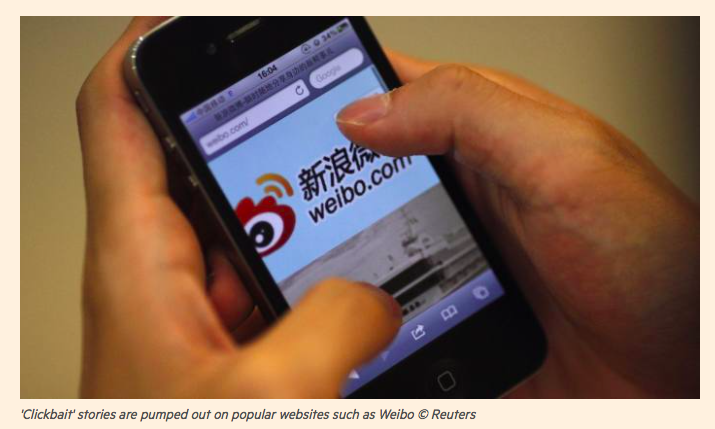
By pumping out “clickbait” stories on WeChat and Weibo, some channels have gained hundreds of thousands of followers, allowing them to sell advertising space.
In a country where access to many legitimate US news sources is blocked by the “Great Firewall”, fake news about American politics, often reinforcing longstanding Chinese suspicions about American biases, tends to bring in the most readers.
“Conspiracy theories fit very well into [Chinese readers’] frames of how they understand politics overall, because they think that in the US, politics is very similar to politics in China, where it is about inner struggles and even murder,” said Fang Kecheng, a media researcher who runs News Lab, a WeChat account promoting media literacy.
The fake news phenomenon has even spawned a cottage industry of online fact-checkers who publish their findings on Chinese social media, debunking everything from commercials to commentary.
“People really want to read foreign media and outside sources but most people do not have the level of English needed to read primary documents,” said one, who declined to be named. “So readers turn to these and WeChat channels which supposedly take foreign news and translate it.”
Duan Lian, founder of the Stop Foreign Rumours Centre, which has accounts on Weibo and WeChat, said he started fact-checking after the US presidential election because of the sheer number of false stories that were going viral.
“I feel that, under such severely polluted circumstances, the general public cannot make accurate decisions any more,” he said.
One series of articles that took Chinese social media by storm described promises supposedly made by Hillary Clinton during last year’s presidential campaign to cap the ratio of Asian-American students at public universities. This infuriated Chinese readers.
Another claimed that the Clinton campaign had assassinated Seth Rich, a Democratic National Committee employee, as revenge for supposedly leaking DNC emails to WikiLeaks, a rumour popularised on US far-right websites. The killing of Rich last July in Washington is a crime that remains unsolved.
The spread of fake news in Chinese has been helped by a lack of cultural awareness. Last month a newspaper run by Xinhua, the state media agency, published a translation of a spoof article from The New Yorker claiming that President Donald Trump covers all White House phones with tinfoil. This was with reference to Mr Trump’s unsubstantiated allegations that Barack Obama, he former president, had wiretapped his communications.
This was not the first time such stories had been presented as fact in China. When The Onion, the US satirical site, named Kim Jong Un, the North Korean dictator, as the sexiest man alive in 2012, the story took on a life of its own. It eventually become a straight news report in the People’s Daily, mouthpiece of the Communist party.
Fearing that they might be held to account for hosting false information, China’s tech groups have started investing in fact-checking operations.
Tencent, owner of WeChat, for instance, launched Jiaozhen, a fact-checking website largely dedicated to debunking false health information. This sub-genre has found a susceptible audience in a society obsessed with longevity.
Toutiao, one of China’s biggest news apps, says it now uses machine-learning software to spot “dubious pieces” after several incidents in which it was criticised for posting sensational information. It then has teams of human employees double-check random samplings of the flagged content to train the machine-learning algorithm.
The Chinese government has attempted to clamp down on the proliferation of false information. Regulations were passed in 2015 making spreading rumours and false news online punishable by up to seven years in prison. However, the law has largely been used to contain sensitive news about natural disasters and government scandals.
China was ranked 176th out of 180 countries in the 2017 index on world press freedom released by Reporters Without Borders last week.
社交媒体关注
美国假新闻在中国社交平台泛滥
微信和微博上许多营销号为了骗点击,发布大量关于美国政治的耸人听闻的假新闻,恶搞新闻也往往被传成了真事。
更新于2017年5月3日 12:56 英国《金融时报》 Emily Feng 北京报道
美国假新闻正渗入中国,在中国最流行的一些社交平台上,为赚取广告收入而开设的营销号如潮水般涌现。中国的媒体环境是世界上控制最为严密的之一。
通过在微信(WeChat)和微博(Weibo)上大量发布“骗点击”的新闻,一些渠道赢得了数以十万计的关注者,从而有资本销售广告位。
在一个许多美国合法新闻网站被“防火长城”屏蔽、无法访问的国家里,关于美国政治的假新闻往往吸引的读者最多——这些假新闻往往强化了中国人长期以来怀疑美国存在的偏见。
运营着新闻实验室(News Lab)的媒体研究员方可成表示:“阴谋论非常符合(中国读者)对政治的整体认识框架,因为他们认为,美国政治与中国政治非常类似,而在中国,政治主要就是内斗、甚至谋杀。”新闻实验室是一个微信公众号,致力于增进人们对媒体的认识。
假新闻现象甚至催生了一个家庭作坊式行业:在线事实核查员在中国社交媒体上发布自己的发现,驳斥从广告到评论文章的一切虚假内容。
一位要求匿名的人士表示:“人们真的想要阅读外国媒体和外部的新闻源,但大多数人没有阅读原始文章所需的英文水平。
“因此读者们转向这些信源和微信渠道,按道理它们应该做的是选取外国新闻并进行翻译。”
反海外谣言中心(Stop Foreign Rumours Centre)创始人Duan Lian表示,他在美国总统大选之后开始开展事实核查,因为大量的假消息被疯转。反海外谣言中心开设了微博和微信账号。
曾在中国社交媒体上广泛流传的一系列文章称,据说希拉里•克林顿(Hillary Clinton)在去年总统大选期间承诺为公立大学亚裔美国学生的比例设置上限,这激怒了中国读者。
还有一系列文章声称,希拉里竞选团队暗杀了民主党全国委员会(Democratic National Committee)工作人员赛思•里奇(Seth Rich),以报复他据说向维基解密(WikiLeaks)泄露民主党全国委员会的电邮,这一传言在美国极右翼网站上广泛流传。去年7月,里奇在华盛顿被杀,案件仍在调查之中。
对外国文化缺乏认知助长了假新闻在中国的传播。上月,一家由国有新闻通讯社新华社主办的报纸翻译发表了《纽约客》(New Yorker)的一篇恶搞文章,该文声称美国总统唐纳德•特朗普(Donald Trump)把白宫所有电话用锡纸包上,意指特朗普如下没有事实根据的指控:美国前总统巴拉克•奥巴马(Barack Obama)窃听了他的通信。
这并非美国笑话首次在中国被传为事实。2012年,美国讽刺新闻网站《洋葱》(The Onion)把朝鲜领导人金正恩(Kim Jong Un)评为全球在世的最性感男人,这篇文章传着传着成了真事,变成中共党报《人民日报》(People’s Daily)上一篇正经新闻。
由于担心可能因散布假新闻承担责任,中国科技公司开始投入资金开展事实核查。例如,微信(WeChat)所有者腾讯(Tencent)推出了一个事实查证网站“较真”,主要致力于揭穿虚假的健康信息,在这个痴迷于长寿的国家,这种假新闻获得了一群容易受骗的受众。
中国最大新闻应用之一“今日头条”称,该应用利用机器学习软件发现“可疑文章”,此前在几次事件中,该应用被批发布耸人听闻的信息。员工会从被标记的内容中随机抽取样本进行复查,以改进机器学习算法。
中国政府一直努力控制虚假信息的泛滥,根据2015年通过的一份刑法修正案,在网上散布谣言和虚假新闻将最高获刑7年。然而,这项法律主要用来遏制有关自然灾害和政府丑闻的敏感新闻。
译者/何黎




 扫码加好友,拉您进群
 全部版块
全部版块 我的主页
我的主页


 收藏
收藏