source from:wsj
BUSINESS
Money From Chinese State Giants Helped Fund Aluminum Stockpile
A complex web of deals shows how aluminum firm China Zhongwang was able to route metal around the globe

By Scott Patterson
May 11, 2017 7:03 a.m. ET
10 COMMENTS
Money from state-run Chinese companies was used to help finance the buildup of a massive aluminum stockpile that has crisscrossed the globe, depressed prices and sparked a criminal investigation in the U.S., according to business records, emails and people with direct knowledge of the transactions.
Any such involvement by these entities could further strain relations between China and the U.S., which says Beijing undercuts global competition by giving government assistance to its commodity companies. Aluminum is among several commodities that the Trump administration has singled out for potential protectionist policies against cheap Chinese imports.
Financing through the deep pockets of Chinese state-run companies could explain how enormous aluminum stockpiles that have captivated the global metals industry were paid for. State-owned enterprises in China, known as SOEs, enjoy low-interest government loans and other subsidies and rank among the largest companies in the world.
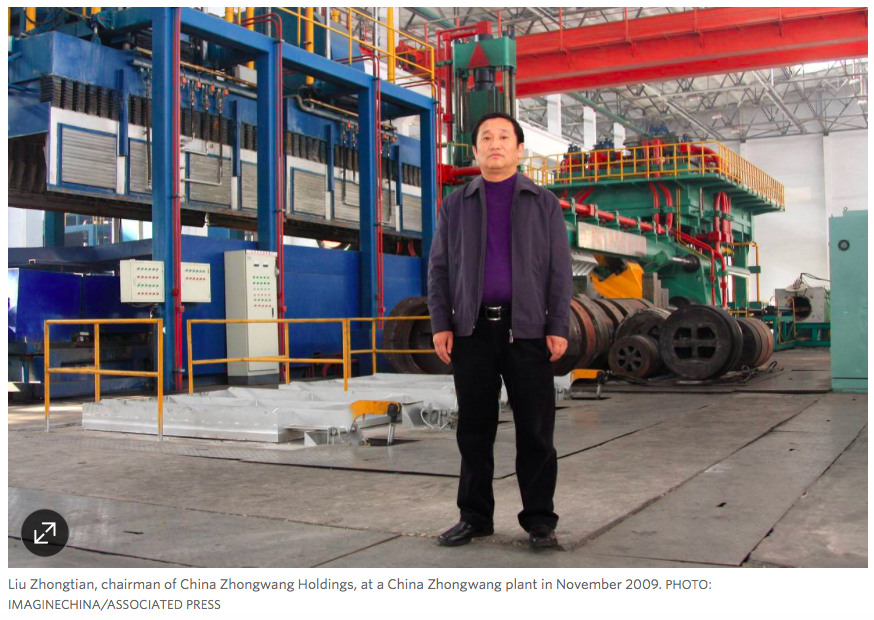
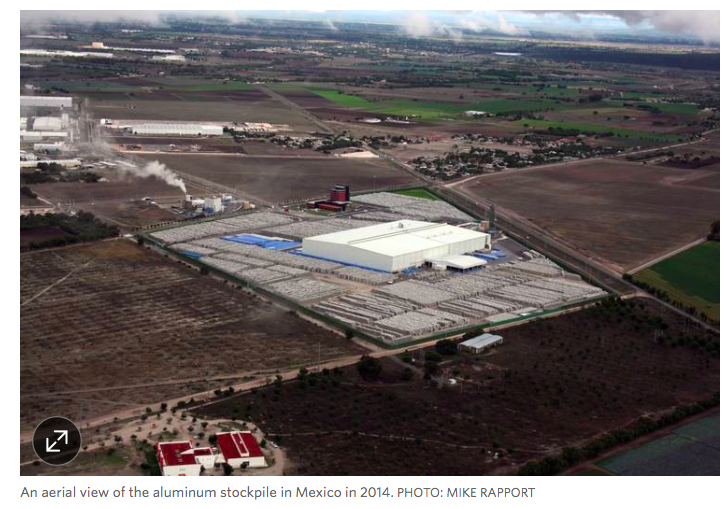
The stockpile in question involves nearly a million tons of aluminum products from China that began accumulating outside a factory in a Mexican desert. A Wall Street Journal article tied the cache to billionaire Liu Zhongtian and his aluminum company, China Zhongwang Holdings Ltd. Last year, much of the pile and other aluminum linked to Mr. Liu was transported to Vietnam, the Journal reported.
His apparent goal, American competitors allege in federal complaints, was to disguise the origin of the metal, which could have faced tariffs as high as 374% in the U.S. Mr. Liu’s former attorney wrote in a 2012 email that the Chinese businessman was planning for retirement in Switzerland by moving assets out of China, where citizens can move only a limited amount of money out of the country.
Mr. Liu and China Zhongwang, one of the world’s biggest aluminum manufacturers, have repeatedly denied any connection to aluminum stockpiles in either Mexico or Vietnam. They say they have violated no laws. China Zhongwang has said it had no knowledge of the attorney or his email about Mr. Liu’s retirement and questioned its authenticity. The attorney’s law firm says it no longer represents Mr. Liu.
Complaints about the stockpiles helped spur investigations by the Department of Homeland Security and Justice Department, people familiar with the matter say. Those authorities are examining whether companies tied to Mr. Liu and China Zhongwang committed civil or criminal violations by routing aluminum through Mexico to mask its origin in China to avoid tariffs, according to court records and people familiar with the investigation.
Mr. Liu and his company have said producing, shipping and storing massive amounts of metal would cost so much as to be financially disastrous. About $5 billion of aluminum from companies associated with Mr. Liu has ended up stockpiled in Vietnam, according to shipping records and people familiar with the matter.
But money from Chinese SOEs could make such an undertaking more economically feasible.
A complex web of transactions involving Chinese SOEs and firms affiliated with Mr. Liu—outlined in documents and emails and confirmed by people with knowledge of the arrangements—shed light on how Mr. Liu could have accumulated so much metal outside of China. Access to funding secured by SOEs helped make it possible for trading firms close to Mr. Liu to buy China Zhongwang aluminum and ship the metal to Mexico, people familiar with the matter said.
In broad terms, these arrangements enabled middlemen to accumulate both money and metal, fueling the expansion of Mr. Liu’s overseas stockpiles. In some instances, the contracts with SOEs provided cash to the middlemen who used it to buy China Zhongwang aluminum and ship it overseas to companies linked to Mr. Liu and his family. At other times, the SOEs sold aluminum directly to Mr. Liu’s middlemen, documents show.
Through such transactions, Mr. Liu could maintain control of the aluminum while masking its Chinese origins.
According to documents reviewed by the Journal and people familiar with the matter, some financing for the aluminum shipped to Mexico from China was linked to three Chinese SOEs that specialize in electronics and industrial businesses: CEIEC Ltd., Great Dynasty and China Machinery & Equipment Co.
China Machinery said it signed contracts agreeing to procure machinery for China Zhongwang affiliates, which it said is “part of normal, compliant trading business.” The company said its business complies with all laws and regulations and protects proprietary information.
CEIEC and Great Dynasty declined to comment.

China Zhongwang announced a deal with the three SOEs in October 2011 in a press statement, saying it inked a $3.8 billion plan with them to build a new aluminum factory outside Beijing.
The same month, China Zhongwang also struck another deal with U.S. businessman Eric Shen, giving him control of how cash from the factory deal was spent, according to a previously undisclosed 2011 contract reviewed by the Journal. Mr. Shen says in a court filing he helped Mr. Liu move aluminum around the world to circumvent tariffs. Mr. Liu denies having a business relationship with Mr. Shen.
Under separate deals reviewed by the Journal, the SOEs agreed to pay Mr. Shen’s trading companies to find and procure equipment for the factory. The SOEs agreed to retrofit it for the aluminum factory and get reimbursed by China Zhongwang.
But Mr. Shen’s companies never purchased aluminum machinery, according to people familiar with the matter. Much of the cash instead was used to purchase China Zhongwang aluminum, a permissible use of the money under the side agreement’s broad terms, these people said.
The arrangements allowed Mr. Shen to purchase aluminum in a variety of ways.
For example, invoices reviewed by the Journal indicate that two of the SOEs, CEIEC and Great Dynasty, sold over 1,400 tons of aluminum for more than $7 million in late 2012 to GT88 Capital. GT88 Capital is a Singapore trading company run by Mr. Shen and whose parent company was owned by Mr. Liu, according to Mr. Liu’s attorney at the time.
Mr. Shen was also able to use money from the arrangement to purchase China Zhongwang aluminum from other sources.
Mr. Liu denies any relationship with companies run by Mr. Shen.
Although it isn’t known where the companies procured the aluminum, the SOEs have been among China Zhongwang’s biggest customers. It isn’t known whether the SOEs were aware of plans to stockpile the metal in Mexico, but the invoices indicated the aluminum’s destination was Mexico.
China Zhongwang said it has no record of the agreement with Mr. Shen viewed by the Journal or the agreements between Mr. Shen and the SOEs.
“Judging from our own files, we do not have such a contract,” China Zhongwang Chief Executive Lu Changqing said, adding that the factory was built via the straightforward process described in its 2011 news release.
Mr. Liu, China Zhongwang’s chairman, didn’t comment for this article.
The signatures of Mr. Shen and a China Zhongwang executive, Chen Yan, appear on the contract authorizing Mr. Shen to disburse money from the SOEs. Emails reviewed by The Wall Street Journal show Mr. Chen coordinating with an associate of Mr. Shen’s about the contract. “Here are the payment details,” the associate wrote in an Oct. 24, 2011, email to Mr. Chen. “It’d be better to transfer 1 million first, and transfer the rest if everything goes well.”
China Zhongwang declined to make Mr. Chen available for comment. A China Zhongwang spokeswoman said neither the company, nor Mr. Chen nor Mr. Liu ever sent money to Mr. Shen or his operations.
Mr. Shen’s lawyers said the agreement exists.
“Transactions were consummated pursuant to written agreements entered in 2011 between Shen’s companies, China Zhongwang and three Chinese state-owned entities,” said Jason Liang of the Los Angeles law firm Liang Ly LLP, which is representing Mr. Shen in several U.S. court cases related to his aluminum businesses and, in part, to the massive stockpile currently in Vietnam.
Mr. Liu sold “hundreds of thousands of tons of aluminum products, which were ultimately exported to the United States, by using straw buyers who would purchase aluminum from Zhongwang with funds provided by Liu,” Mr. Shen says in a complaint filed in a civil court case in Orange County, Calif. Mr. Shen is being sued in the case, which is pending, over a failed attempt to build an aluminum plant in California. The plaintiff is a company owned by a man with ties to Mr. Liu.




 扫码加好友,拉您进群
 全部版块
全部版块 我的主页
我的主页


 收藏
收藏