Charting the World’s Major Stock Markets
[size=1.1]Most investors around the world are familiar with the S&P 500 index.
[size=1.1]Not only is it the most widely accepted barometer of U.S. stock market performance, but it’s also been on a 10-year bull run, now sitting at all-time highs near 3,170.
[size=1.1]This week, we chart those historical returns, and then use the U.S. benchmark as a backdrop to compare other major stock markets around the world, such as those in Europe, Asia, and Canada.
Putting Them All at Scale[size=1.1]One challenge in comparing global markets directly is that all indices are on arbitrary scales.
[size=1.1]To directly compare them, the most natural option would be to transform the data to percentage terms. While that’s all fine and dandy, it’s also a little boring.
[size=1.1]To make things more interesting, we’ve collected historical data that goes back nearly 30 years for each index. This was mostly done using Macrotrends, a fantastic resource for historical data. We used November 26th, 1990 as a cut-off date, since that was the earliest data point available for some of the country indices used.
[size=1.1]We then transformed all of this data to be on the same scale of the S&P 500, so performance can be directly compared to the common American stock market benchmark.
Comparing Markets Using the S&P 500[size=1.1]Alright, now that we have the same scale for each market, let’s dive into the data:
[size=1.1]

Note: Data has been transformed to match the scale of the S&P 500, and is current as of December 13, 2019
[size=1.1]If you invested $100 in the U.S. market on November 26, 1990, you’d have over $1,000 today.
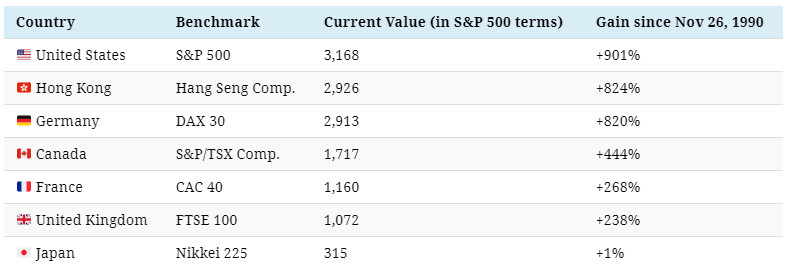
[size=1.1]Over nearly 30 years, the S&P 500 has increased by 901%, which is the most out any of these major indices. If you invested in the German or Hong Kong markets, you’d have fairly similar results as well — each gained more than 800% over the same time period.
[size=1.1]Meanwhile, the markets in Canada, France, and the United Kingdom have all increased, but at a far slower pace:
- In S&P 500 terms, Canada would be sitting at 1,717 — which is where the U.S. market was back in 2013.
- France would be at 1,160, a mark the S&P 500 last hit in 2010.
- The United Kingdom would sit at 1,072, also equivalent to 2010 for the U.S. market.
[size=1.1]Finally, in S&P 500 terms, the Japanese stock market would be at a lowly 315 points today — roughly where it started 30 years ago. In other words, if you had invested $100 in Japanese stocks in 1990, you’d have gained just $1 over a period of three decades.




 扫码加好友,拉您进群
 全部版块
全部版块 我的主页
我的主页


 收藏
收藏