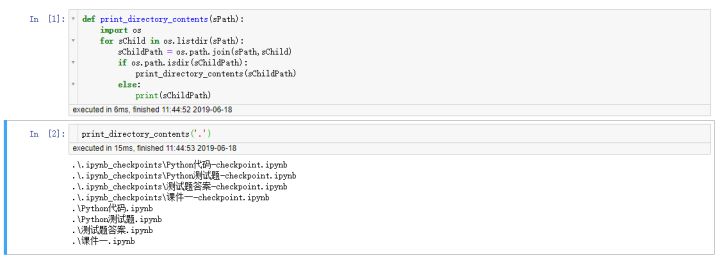
回答 def print_directory_contents(sPath): import os for sChild in os.listdir(sPath): sChildPath = os.path.join(sPath,sChild) if os.path.isdir(sChildPath): print_directory_contents(sChildPath) else: print(sChildPath)
zip(...) zip(seq1 [, seq2 [...]]) -> [(seq1[0], seq2[0] ...), (...)] Return a list of tuples, where each tuple contains the i-th element from each of the argument sequences. The returned list is truncated in length to the length of the shortest argument sequence.
l_mem = [] l = l_mem # the first call for i in range(2): l.append(i*i) print(l) # [0, 1] l = [3,2,1] # the second call for i in range(3): l.append(i*i) print(l) # [3, 2, 1, 0, 1, 4] l = l_mem # the third call for i in range(3): l.append(i*i) print(l) # [0, 1, 0, 1, 4]
问题10 按照效率顺序放置以下功能。它们都包含0到1之间的数字列表。列表可能很长。一个示例输入列表将是[random.random() for i in range(100000)]。你如何证明你的答案是正确的?
def f1(lIn): l1 = sorted(lIn) l2 = [i for i in l1 if i<0.5] return [i*i for i in l2] def f2(lIn): l1 = [i for i in lIn if i<0.5] l2 = sorted(l1) return [i*i for i in l2] def f3(lIn): l1 = [i*i for i in lIn] l2 = sorted(l1) return [i for i in l1 if i<(0.5*0.5)]














 扫码加好友,拉您进群
 全部版块
全部版块 我的主页
我的主页


 收藏
收藏