PROC TRAJ is a SAS procedure that fits a discrete mixture model to longitudinal data. The model performs data sequence grouping, with different parameter values for the groups' data distribution. Groupings may identify distinct subpopulations. Alternatively, groups may represent distribution components approximating an unknown (possibly complex) data distribution.
Supported distributions are: censored (or regular) normal, zero inflated (or regular) Poisson, and Bernoulli distributions (logistic model). The censored normal model is useful for psychometric scale data, the zero inflated Poisson model useful for count data with extra zeros, and the Bernoulli model useful for 0/1 data. The model is appropriate for data with average values changing smoothly as a function of the dependent variable (time, age, ...). Some sharp changes can be handled through the inclusion of time dependent covariates.
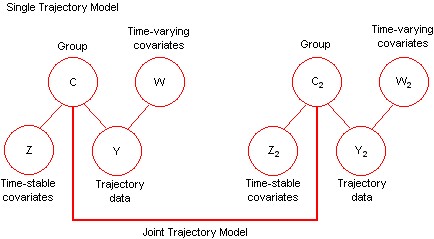
MODEL STRUCTURE: Data sequences, Y, with similar shapes are grouped in a model-based manner. The probability of group membership can be a function of time stable covariates (risk factors), Z. Time dependent covariates, W, can further influence trajectories with effects differing by group, C. A trajectory model for two sets of dependent variables (joint trajectory modeling) is also supported. The model is illustrated in the figure below.
Downloads: Jones, B., Nagin, D., & Roeder, K. "A SAS Procedure Based on Mixture Models for Estimating Developmental Trajectories," Sociol Method Res, 2001, 29: 374-393.
Jones, B. & Nagin, D. "Advances in Group-Based Trajectory Modeling and a SAS Procedure for Estimating Them," submitted.
Nagin, D. "Analyzing Developmental Trajectories: A Semi-parametric, Group-based Approach," Psychol Methods, 1999, 4: 139-177.
Nagin, D. and Tremblay, R E. "Analyzing Developmental Trajectories of Distinct but Related Behaviors: A Group-Based Method," Psychol Methods, 2001, 6: 18:34.




 扫码加好友,拉您进群
 全部版块
全部版块 我的主页
我的主页


 收藏
收藏





