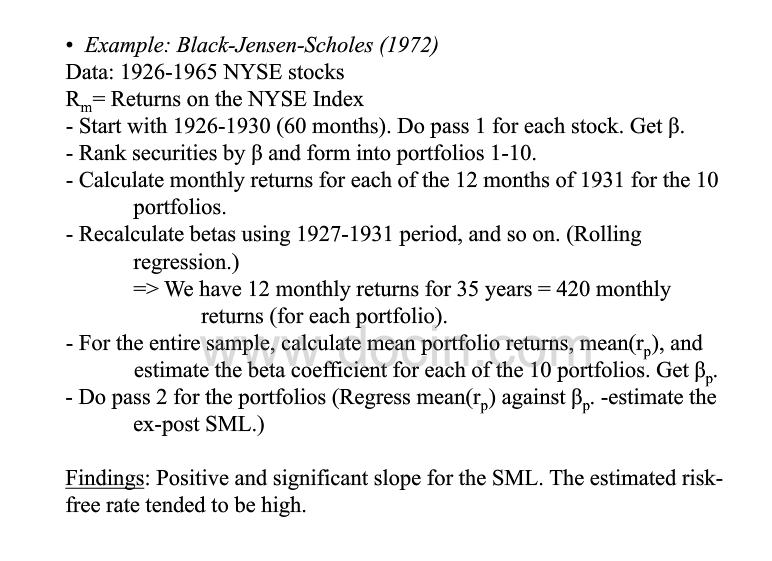
Fama-MacBeth regression就是Fama-Mabeth 1973年paper用的方法。
其主要步骤:
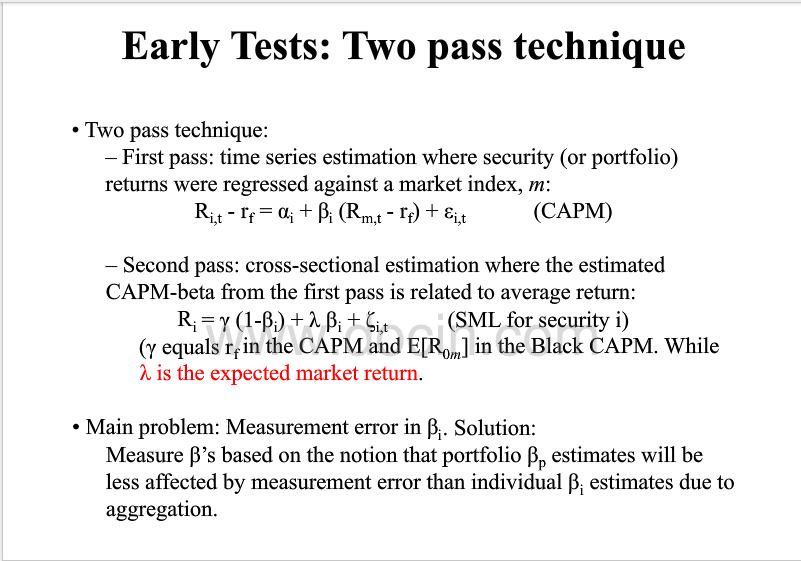
1. Time series regression of retruns on factors to get beta's
2. Cross-sectional regression of returns on betas to get risk premium, this is done repeatedly for all the periods, thus you will get a time series of cross sectional regression coefficient.
3. The final estimates are just the mean of the time series of the cross-sectional estimates from step2, the standard deviation is just the time series standard deviation of those estimates.
你可能还要仔细看一下Fama & French 1992 和1993的两篇文章。
1992:the cross-section of Expected Stock Return;
1993: Common Risk Factors in the returns on Stocks and Bonds.
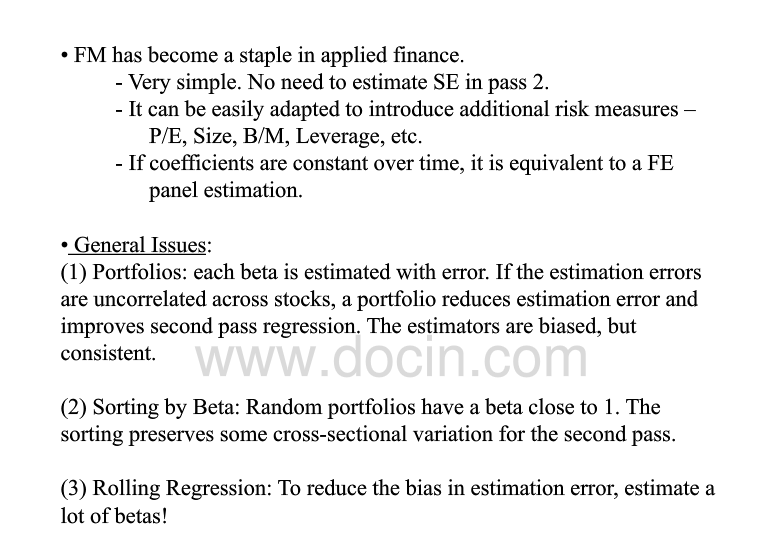
Fama-Macbeth approach is an innovative two-stage approach meant to minimize within-portfolio variance while capturing the across-portfolio characteristics.
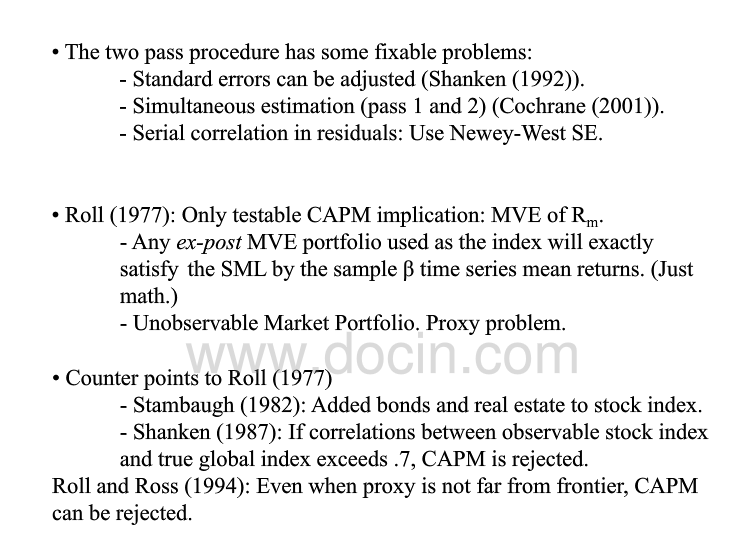
Their 1973 paper is not a landmark in terms of econometric modelling, but the approach is nice. Their approach is meant to test Capital Asset Pricing Model (CAPM).
Suppose there are 1,000 stocks with returns data over 100 months. We also have the market portfolio returns over 100 months. We want to test whether CAPM holds or not for this sample.
Stage 1 analysis: Portfolio formation
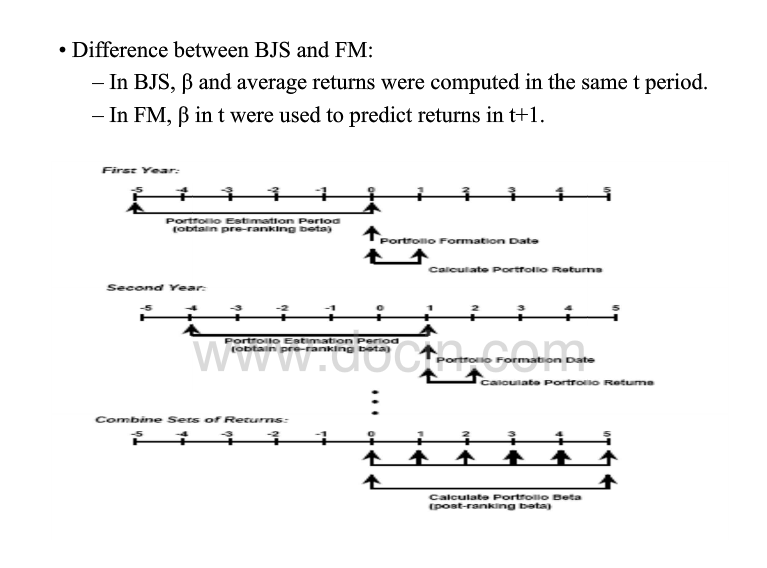
1. Starting, let's say, month 25, we compute the pre-ranking betas for each stock, by regressing the previous 24 month stock returns on the market returns.
2. Each month we rank all stocks as per their betas.
3. Classify all these 1,000 stocks into, say, 10 portfolios
4. Now we have 10 portfolios over 76 months (months 25 through 100)
(The idea of portfolio formation is to minimize within-portfolio variation in betas).
Stage 2 analysis: Cross-sectional tests
1. For each portfolio, we carry out full-period regression of portfolio returns on market returns (10 regressions, each over 76 months).
2. Thus we get 10 post-ranking betas, one for each portfolio.
3. For each of the 76 months, we regress the portfolio returns on the post-ranking betas (76 regressions, each over 10 observations).
4. We collect the time series of all these regression slopes.
5. The essential test is whether time-series average slope = 0




 扫码加好友,拉您进群
 全部版块
全部版块 我的主页
我的主页

 收藏
收藏