Brilliant Idea
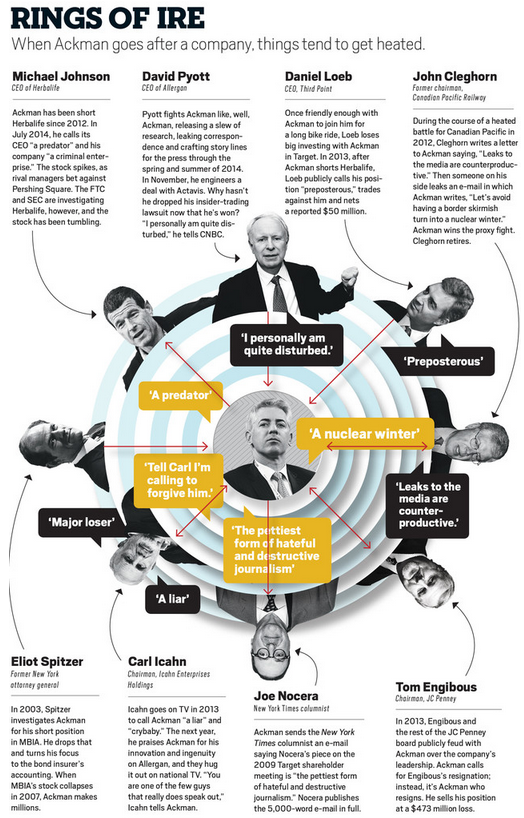
With Allergan, Ackman provoked in a different way. He bought more than 28 million shares in the company knowing he and Valeant were about to try to take it over. Even his critics acknowledged the move was brilliant. (It brought Icahn around; he told CNBC: “I never said he’s not a smart guy. I think the concept of this is good.”) Still, the bid with Valeant raised questions. “Ackman’s conduct seems designed to operate on the edges of legality,” says Harvey Pitt, former chairman of the Securities and Exchange Commission.
Ronny Gal, a senior analyst at Sanford C. Bernstein & Co., attended the presentation at which Ackman described his Allergan plans. He went back to his office and put together a report titled “Allergan: How Can It Be Legal?”
‘Gray Zones’
He wrote: “[O]ne can’t logically argue that the agreement between Valeant and Pershing Square is ‘fair’ to other investors in the context of ‘fair market.’ ... However, fairness is a principle, not a law. Pershing Square ... has carefully designed a vehicle to comply with current law. They may not have clearly violated any laws, but (in our view) have entered some gray zones where a legal challenge is possible.”
In August, Allergan filed a lawsuit alleging insider trading. Valeant, Pershing Square and Ackman all deny they broke any rules. The suit is pending.
Activists most often go after weak, poor-performing companies. Allergan is not that. The company’s stock has risen 10-fold during the past 15 years as Pyott has built huge brands such as Botox, Juvederm and Restasis. To get higher returns out of this already high-performing business, Valeant planned to cut more than 70 percent of Allergan’s research budget.
“When you go after companies, where you try to strip mine them—that is really a perversion of what investing is supposed to be,” says David Maris, an analyst covering Allergan in New York for BMO Capital Markets. After an analyst lunch hosted by Pershing Square, Maris hand-delivered a USD 100 bill to the Pershing Square offices, refusing to let Ackman buy him a meal. “The only people he cares about are George Washington and Benjamin Franklin,” Maris says. “All the dead presidents.”
‘White Knight’
What’s surprising here is not that Ackman disagrees with the criticism; it’s how much he struggles with it. He sees himself as one of the good guys. “We are the white knight always on behalf of the owners of the business,” Ackman says. Defenders of Allergan, he says, won’t acknowledge that the company’s research budget was bloated; he points out that soon after he and Valeant went public with their plans, Allergan itself announced cuts in early-stage research.
At one point, in response to a question using the term billionaire, he visibly cringes. “It’s a weird word; I don’t like what it conveys,” says Ackman, who, according to the Bloomberg Billionaires Index, is worth USD 1.6 billion. “Billionaire sounds like it’s someone who’s all about the money. The only thing money has meant to me is independence.”
Raised in Chappaqua, a suburb of New York, Ackman grew up with plenty of money -- his father was a successful real estate broker -- and an ambition to succeed. He bet his father USD 2,000, everything he’d saved up, that he could get a perfect score on his SAT. He didn’t. He did, however, get two Harvard degrees (undergraduate and business).
Vindicated
In 1992, at age 26 and right out of business school, he started his first fund, Gotham Partners LP, with Harvard classmate David Berkowitz. The partners had early successes, but a series of misfires caused them to wind down the firm in 2003.
Ackman launched one of his best-known attacks while at Gotham. In 2002, he accused MBIA Inc. (MBI), a triple-A-rated bond insurer, of being insolvent and shorted the stock. For five years, virtually no one believed him. Finally, in 2007, the financial crisis exposed MBIA’s troubles. The company’s stock collapsed, and Ackman, vindicated, made millions. By then, he was on to Pershing Square, which he had founded in 2003 with USD 50 million in seed capital from Leucadia National Corp. Since then, Pershing Square has generated annualized returns of 21 percent.
In His Element
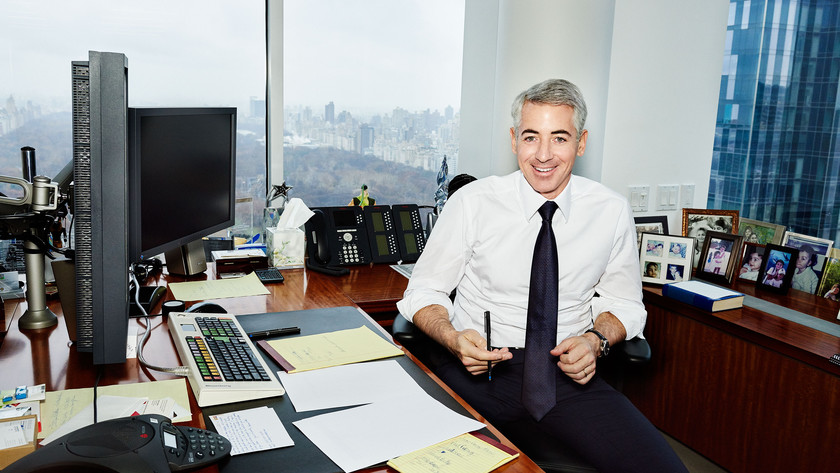
“The reason why people think we are controversial is because we are doing stuff that just looks different,” Ackman says one afternoon at Pershing Square’s headquarters in midtown Manhattan. “You can’t make a lot of money doing what everyone else is doing.” The view from this space is breathtaking, a straight shot over Central Park to Harlem. Here, he is in his element. He talks fast; he’s intense, leaning in when he’s emphasizing a point, not breaking eye contact. He clearly gets energized talking about investing ideas that are perceived as unusual or offbeat.
“People buy debt in bankrupt companies; they don’t buy equity,” Ackman says as he recounts the story of how, in 2008, he began buying shares in a failing mall operator, General Growth Properties Inc. (GGP), for 34 cents a share. Pushing it into Chapter 11 bankruptcy, Ackman restructured the company. He moved a group of its properties into a new entity under the name Howard Hughes Corp. Pershing Square sold its stake in General Growth last February and still owns Howard Hughes. The firm has netted more than USD 3 billion on an initial investment of USD 60 million.
Extensive Research
Pershing Square, for all the money and the media attention, is a small place. There are 65 employees. Many at the firm have known Ackman and one another for years. They stick together; they defend their boss. “There is a view that if you have a high degree of confidence in your conviction that it is arrogance or hubris,” says Tony Asnes, head of investor relations, who has known Ackman for 24 years. “I sense people who don’t know him or are just reading about him in the press think that’s what he must be, but he’s not.”
Ackman’s 12-person investment team meets every Tuesday. “We are always watching great businesses, waiting for the right time,” says Ali Namvar, who has been at Pershing Square since 2006. Last winter, Namvar helped Ackman score a quiet win with liquor company Beam Inc., in which Pershing Square had a stake of more than 12 percent. He and a team gave Beam’s management extensive research arguing that the time was right for the company to sell itself. A few weeks later, Beam entered into an agreement with Japanese whisky maker Suntory Holdings Ltd. The deal closed in May, and Pershing Square netted more than USD 1 billion.
Peculiar Algorithm
It’s easy to miss this amidst the public brawling, but some of the firm’s best investments have been its least contentious: Air Products & Chemicals Inc. (APD), Burger King Worldwide Inc., Platform Specialty Products Corp.
Around Pershing Square, there’s a peculiar algorithm: return on invested brain damage. As in, is this deal worth the headache? Target Corp. (TGT) wasn’t. At one point, a fund Ackman set up (separate from Pershing Square) to invest in the company had lost 90 percent of its value. Ackman apologized to his investors in 2009 and offered to waive fees in his main funds until they made their money back. JC Penney, another failure, cost Pershing Square USD 473 million in 2013.
Then there’s Herbalife. It’s produced huge headaches, but the story is changing. Ackman took his USD 1 billion short position in late 2012. Icahn, Loeb and other investors ridiculed him and bought the stock. The shares rose throughout 2013, even as Ackman declared the company a fraud. Ackman estimates that at one point, he was down USD 760 million. It was widely reported that Loeb briefly set up his Bloomberg terminal message greeting as “New HLF Product: The Herbalife Enema administered by Uncle Carl.”
Herbalife Gains
“Herbalife was the first time there were people hoping we would fail,” Ackman says. “That was the only time in my career where I actively thought people were trying to harm us.” Of course, he was and is actively trying to harm Herbalife. “We are exposing a fraud,” he says.
Herbalife is under investigation by the U.S. Federal Trade Commission and the SEC. Its share price has dropped almost in half since last summer, to USD 37.58 as of Jan. 2. Ackman says his position in Herbalife rose USD 800 million in 2014.
Beyond Theatrics
“We said, ‘OK, we need to get ready because we are going to war,’” says one close adviser to Pyott who worked with him on the proxy contest. (Pyott declined to be interviewed for this story.) His team began studying Ackman, learning his tactics.
One past proxy battle that was useful: the 2012 fight for Canadian Pacific Railway Ltd. (CP) Here, in a heated contest, Ackman ousted a powerful board. At one point, he sent an e-mail to Chairman John Cleghorn with the subject line “War and Peace.” He said he’d recently “become more interested in military history.”
Beyond theatrics, Ackman gave shareholders a reason to vote his way. He painted the incumbents as clubby, outdated, fumbling. He presented shareholders with another option -- a new, highly compelling CEO, Hunter Harrison, who’d successfully run rival railroad Canadian National Railway Co. (CNR) for a decade. Since Ackman took his stake in October 2011, the stock has more than tripled, to USD 188 as of Jan. 2.
Bigger Issues
Pyott’s counteroffensive drew from Ackman’s playbook. His strategy started with attacking Ackman’s investment thesis. His team published research raising questions about Valeant’s business model and its accounting. At one point, the Allergan team leaked an e-mail one of Valeant’s own bankers had sent -— prior to being hired by Valeant -- calling the company “a house of cards.”
Meanwhile, Pyott gave his shareholders an alternative to Valeant. By early fall, he was already in talks with Actavis that would lead to the winning USD 66 billion bid.
In many ways, what happened at Allergan makes the case for shareholder activism. By putting the company into play, Ackman increased its market value almost immediately and, in the end, made shareholders a lot of money.
Critics, however, say there are bigger issues. “We need strong companies to compete in the global economy. Are we better off if companies like Allergan disappear?” asks Bill George, a professor at Harvard Business School and former CEO of Medtronic Inc. The danger, he says, is that well-run companies will be forced to re-deploy resources, change strategy and cut long-term investments to boost earnings and placate activists. “It’s not good for America; it’s not good for society,” George says.
Who’s Next?
Activist hedge funds now manage USD 91 billion, up from USD 59 billion at the end of 2012, according to research firm eVestment. That money means activists can go after bigger, stronger targets and, increasingly, that’s what they are doing. Take Loeb’s pursuit of Amgen Inc. (AMGN), Icahn’s of Apple Inc. (AAPL), Nelson Peltz’s of Pepsico Inc. (PEP) At this point, just about every board member and CEO has to be wondering, who’s next? On Dec. 17, Ackman told Bloomberg TV that McDonald’s Corp. could be better run. Immediately, the stock popped 3 percent.
“Excuse me, Mr. Ackman? Can I have your autograph?” It’s a rainy afternoon in early December, just outside Pershing Square’s offices. William Holmes, a recent college graduate with a degree in economics, is shivering in the cold, holding a notebook. “I’ve studied everything you’ve done,” the young man gushes. “You are like the Socrates of our time.” Ackman writes the kid a note. “I’m telling you, I have a huge fan base,” he says as the beaming young man walks off. Then he turns to head back up to work.






 扫码加好友,拉您进群
 全部版块
全部版块 我的主页
我的主页

 收藏
收藏