source form:WSJ MARKETS ASIA STOCKS Asian Stocks Jump on Easing Hopes
Investors betting that central banks, especially the Bank of Japan, will soon loosen policies
By DOMINIQUE FONG
Updated July 4, 2016 4:42 a.m. ET
0 COMMENTS
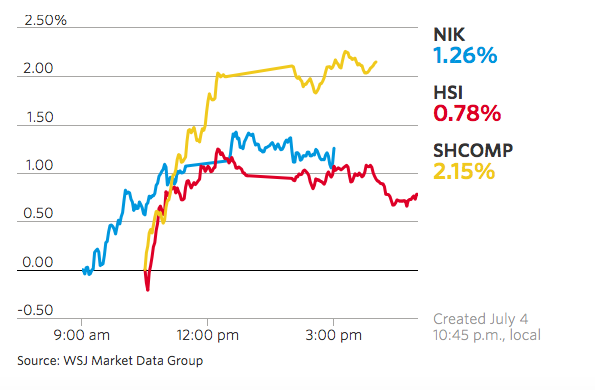
China led gains across Asian stock markets on Monday as investors bet that global central banks would loosen policies to encourage economic growth.
China’s Shanghai Composite Index gained 1.9%, while the smaller Shenzhen Composite Index gained 1.6%.
Elsewhere, Japan’s Nikkei Stock Average ended up 0.6%, Australia’s S&P/ASX 200 rose 0.7% and Korea’s Kospi added 0.4%. Hong Kong’s Hang Seng Index ended up 1.3%.
Investors across the region were buying stocks in the hopes that central banks, in particular the Bank of Japan, would soon ease policies by cutting interest rates or expanding asset-buying programs, said Gavin Parry, managing director of Parry International Trading.
Mount Fuji looms over the Tokyo skyline. Investors are betting that central banks, especially the Bank of Japan, will loosen policies soon. ENLARGE
Mount Fuji looms over the Tokyo skyline. Investors are betting that central banks, especially the Bank of Japan, will loosen policies soon. PHOTO: BLOOMBERG NEWS
Such policies would be “equity positive,” he added, as corporate borrowing costs become lower when liquidity enters the financial system.
The MSCI AC Asia Pacific Index, a broad measure of stocks in the region, was on track Monday to recoup all its losses since the close of June 23, when the U.K.’s decision to leave the European Union roiled markets and sent shares tumbling.
In China, domestic stock investors were betting that the U.S. Federal Reserve would hold off on raising interest rates at all this year, instead of doing so twice as officials had projected, analysts said. That could keep the U.S. dollar from strengthening rapidly and generate demand for shares of commodities, which are priced in the greenback.
In a sign of that expected demand, certain China commodities futures surged. For instance, the main futures contracts for silver, nickel and tin traded in Shanghai hit the 6% daily price-movement limit within the first trading hour Monday, and cotton futures traded in Zhengzhou hit their price limit as well.
China’s CSI 300 Materials subindex, which is strongly correlated with commodities prices, also gained 3.5%. At least a dozen stocks, including Inner Mongolia Xingye Mining Co. and nonferrous metals producer Shenzhen Zhongjin Lingnan Nonfemet Co. rose 10%, hitting the daily limit on share price movements for stocks.
Meanwhile, shares of China Vanke Co., China’s largest real-estate developer by market capitalization, sank 10% after it resumed trading following a six-month halt. The developer has been embroiled in a high-stakes battle among major shareholders for control of the company.
“The trading resumption of China Vanke Co. means that short-term uncertainty has been exhausted and the market will continue to operate on [its] original logic,” says Deng Wenyuan, an analyst at Soochow Securities. “Abundant liquidity has driven up commodities prices amid growing risk-off sentiment.”
In Hong Kong, property stocks that were perceived to be undervalued led gains. Investors focused on a report last Friday from Daiwa Capital Markets that argued shares of Hong Kong-focused real-estate developers are collectively worth 200 billion dollars more than they are priced by the market.
Hong Kong’s largest home builder by market capitalization, Sun Hung Kai Properties Ltd., rose 3.8%, while Cheung Kong Property Holdings Ltd. jumped 3.5%.
In other markets, the Australian dollar sank as much as 0.4% in early Asian trade, but recently pared losses to be down just 0.2%, after preliminary federal election results showed a tight race between two political parties vying for control of Parliament. This raises chances for a hung parliament, which means that whichever party wins will have limited ability to push through policies.




 扫码加好友,拉您进群
 全部版块
全部版块 我的主页
我的主页


 收藏
收藏