source from:WSJ
Markets
The Market Calm Is Suddenly Gone and Correction Watch Is On
The velocity of last week’s declines is of greatest concern to some investors

By Steven Russolillo
Feb. 5, 2018 3:01 a.m. ET
0 COMMENTS
Stocks around the world went nearly two years without a major bout of volatility. That long period of calm vanished within a matter of days.
While the Philadelphia Eagles were busy beating the New England Patriots in the Super Bowl, stocks in Asia slid sharply Monday morning, extending steep declines late last week in European and U.S. markets, including Friday’s 666-point drop for the Dow Jones Industrial Average. U.S. stock futures point to another lower open for Wall Street on Monday.
Meanwhile, a key measure of market choppiness—the Cboe Volatility Index, known as the VIX—surged 55% last week to 17.16, although it remains below its long-term average of around 20. The index is a gauge of expected stock swings based on S&P 500 options prices.
The surprise selloffs, accompanied by sharp rises in U.S. bond yields, could mean that overheated markets will finally start to cool. Most major global indexes haven’t suffered corrections, defined as a 10% fall from recent highs, in at least two years.
But it is the velocity of last week’s declines, which spilled over to this week, that is most troubling to some investors, considering most markets had hot starts to 2018.
“It’s funny how stocks can go up for years and break all sorts of records, and then we all flip out when the pullback we’ve been begging for finally arrives,” says Michael Batnick, director of research at Ritholtz Wealth Management and author of the popular “Irrelevant Investor” blog.

A man passed a securities firm in Tokyo on Monday. Photo: Koji Sasahara/Associated Press
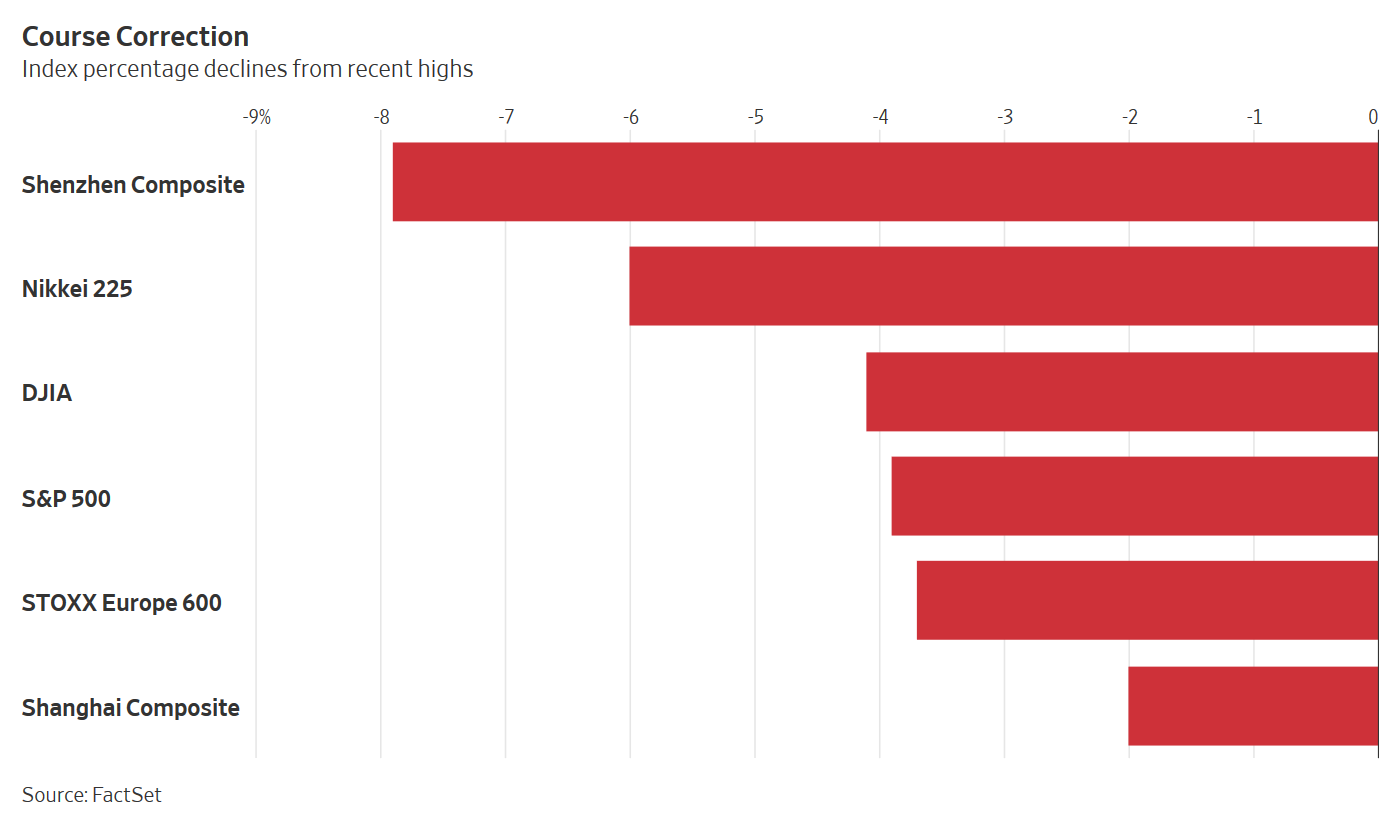
In Asia, Japan’s Nikkei 225 Index has lost 6% over the past two weeks, falling in eight of the past nine trading sessions.
The drop has been severe in China as well. The country’s main benchmark, the Shanghai Composite Index, last week suffered its worst fall since December 2016, falling 2.7%. And it declined more on Monday. The Shenzhen Composite Index, the country’s second-largest market, has fallen 7% since Jan. 26. Neither have suffered declines of at least 10% since the market rout that kicked off in the summer of 2015 and lasted through early 2016.
One worrisome sign is that a measure of leverage in Chinese stocks—indicators such as stock-collateralized loans and margin financing as a percentage of total market value—is currently higher than in mid-2015 when the market crashed, according to David Cui, head of China equity strategy at Bank of America Merrill Lynch.
“We expect deleveraging in the [Chinese] market to cause persistent pressure…in the foreseeable future,” Mr. Cui said.
In Europe, the Stoxx Europe 600 slumped 3.1% last week, its worst fall since Nov. 2016. And in the U.S., the S&P 500’s 3.9% drop last week puts at least one major streak in danger.
The S&P 500 has gone more than 400 trading days without a 5% pullback from a recent high, the longest stretch on record, according to Ryan Detrick, senior market strategist at LPL Financial. That dates back to the 5.3% two-day selloff immediately following the U.K.’s vote to leave the European Union in June 2016.
The index hasn’t had a 10% decline from a recent high since a sharp tumble that kicked off 2016.
“It certainly feels as though something changed last week, something fairly significant,” Chris Weston, chief market strategist at IG Group in Melbourne, Australia, wrote to clients. “The idea that we are now facing a period of elevated implied volatility has knocked us all a bit for six.”
For sure, the declines could offer opportunities for global investors. Some who have missed out on the big gains in recent years could get back in the game when presented with cheaper opportunities for re-entry.
History also suggests the pullbacks could be relatively short-lived. The S&P 500 hit its most recent record high on Jan. 26. There are only two instances in history—1953 and 1973—when the S&P 500 has hit an all-time high in January that wasn’t surpassed later in the year, according to Jonathan Krinsky, a managing director at Connecticut-based research firm MKM Partners.
“Much like last year, we expect weakness to be buyable, but we probably need to be a bit more patient this time around,” he said.




 扫码加好友,拉您进群
 全部版块
全部版块 我的主页
我的主页


 收藏
收藏